Web3 Social Media: Emerging Platforms & Financial Impact in 2026
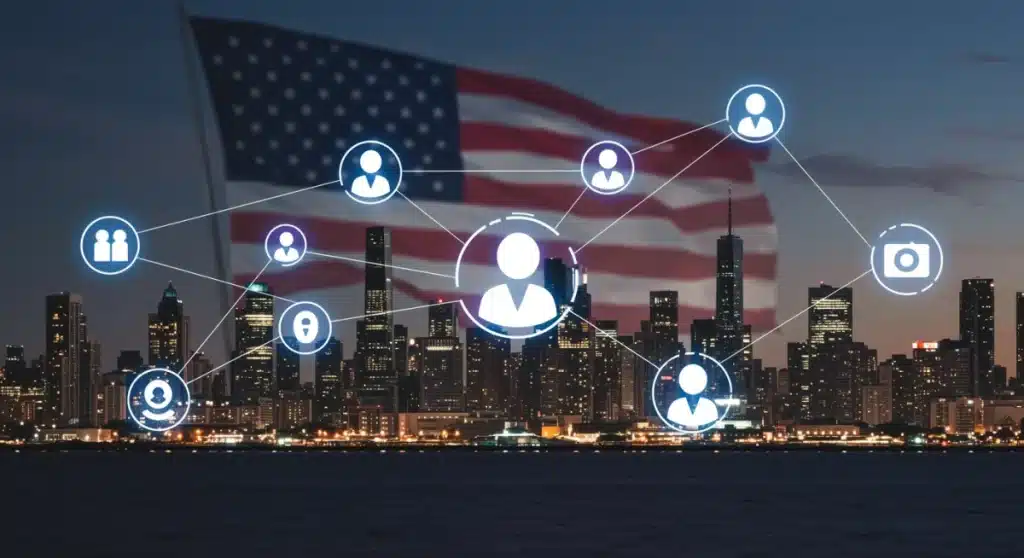
Web3 social media platforms are revolutionizing online interactions by offering decentralized ownership, enhanced privacy, and new monetization avenues, fundamentally altering the financial landscape for U.S. users by 2026 through innovative tokenomics and direct creator compensation.
The digital world is on the cusp of a profound transformation, moving from centralized platforms to a decentralized future. This shift is particularly evident in social media, where new Web3 technologies are empowering users like never before. This article delves into Unlocking Web3 Potential: A Comparison/Analysis of 5 Emerging Decentralized Social Media Platforms for U.S. Users in 2026 and Their Financial Impact, examining how these innovative platforms are reshaping online interactions and offering new financial opportunities.
The paradigm shift to decentralized social media
The current social media landscape is dominated by a few powerful corporations, leading to concerns about data privacy, content censorship, and unfair monetization practices. Decentralized social media, built on blockchain technology, offers a compelling alternative. By leveraging distributed ledgers and cryptographic principles, these platforms aim to return control to the users, fostering a more equitable and transparent online environment.
This fundamental change is not merely technological; it represents a philosophical reorientation of how we interact and exchange value online. In 2026, U.S. users are increasingly seeking platforms that prioritize individual autonomy and offer direct participation in the network’s success. This demand drives the rapid development and adoption of Web3 social media, moving beyond the traditional ad-revenue models.
Core principles of Web3 social platforms
- User ownership: Users own their data and content, not the platform.
- Censorship resistance: Content moderation is often community-driven or governed by smart contracts, making it harder for central authorities to remove posts arbitrarily.
- Transparency: Transactions and governance decisions are recorded on a public blockchain, ensuring accountability.
- Creator economy empowerment: Direct monetization models allow creators to earn directly from their audience, bypassing intermediaries.
Understanding these core principles is crucial to grasping the long-term financial implications and user benefits that decentralized social media platforms promise. The shift from being mere consumers to active participants and owners is a game-changer for the digital economy in the U.S.
Platform 1: Lens Protocol – a modular social graph
Lens Protocol, built on the Polygon blockchain, stands out as a modular and composable social graph. Instead of being a single social media application, Lens provides the underlying infrastructure for developers to build decentralized social applications. This approach allows for a diverse ecosystem of platforms, all sharing the same user profiles, content, and social connections.
For U.S. users in 2026, Lens Protocol means unprecedented interoperability. A profile created on one Lens-powered app can be seamlessly used on another, breaking down traditional social media silos. This fosters innovation and gives users more control over their digital identity and content. The financial impact stems from its open, permissionless nature, enabling creators to mint their content as NFTs and directly monetize their audience without platform intermediaries.
Financial opportunities with Lens Protocol
The financial model of Lens Protocol is deeply embedded in the concept of digital ownership and tokenization. Creators can mint their posts, comments, and follows as NFTs, creating a new class of digital assets. This allows for:
- Direct monetization: Creators can sell their content NFTs directly to their audience.
- Community ownership: Users can own parts of a creator’s social graph, potentially earning royalties or governance rights.
- Developer innovation: Entrepreneurs can build new monetization tools and applications on top of the Lens graph, creating a vibrant marketplace.
The ability to own and trade social data opens up entirely new revenue streams for content creators and offers novel investment opportunities for users, fundamentally altering the traditional advertising-driven model of social media.
Platform 2: Farcaster – a decentralized Twitter alternative
Farcaster positions itself as a decentralized protocol for building social applications, often compared to a Web3 version of Twitter. It combines on-chain identity with off-chain data storage, aiming for a balance between decentralization, scalability, and user experience. Its focus on short-form content and public broadcasting makes it particularly appealing for real-time communication and community building.
In 2026, Farcaster offers U.S. users a robust alternative to centralized microblogging platforms, addressing issues of censorship and data ownership. Users maintain custody of their identity (via Ethereum addresses) and their posts, which are cryptographically signed. This provides a level of authenticity and security that traditional platforms cannot match. The financial impact is tied to its novel approach to data ownership and potential for integrated token-gated content or features.
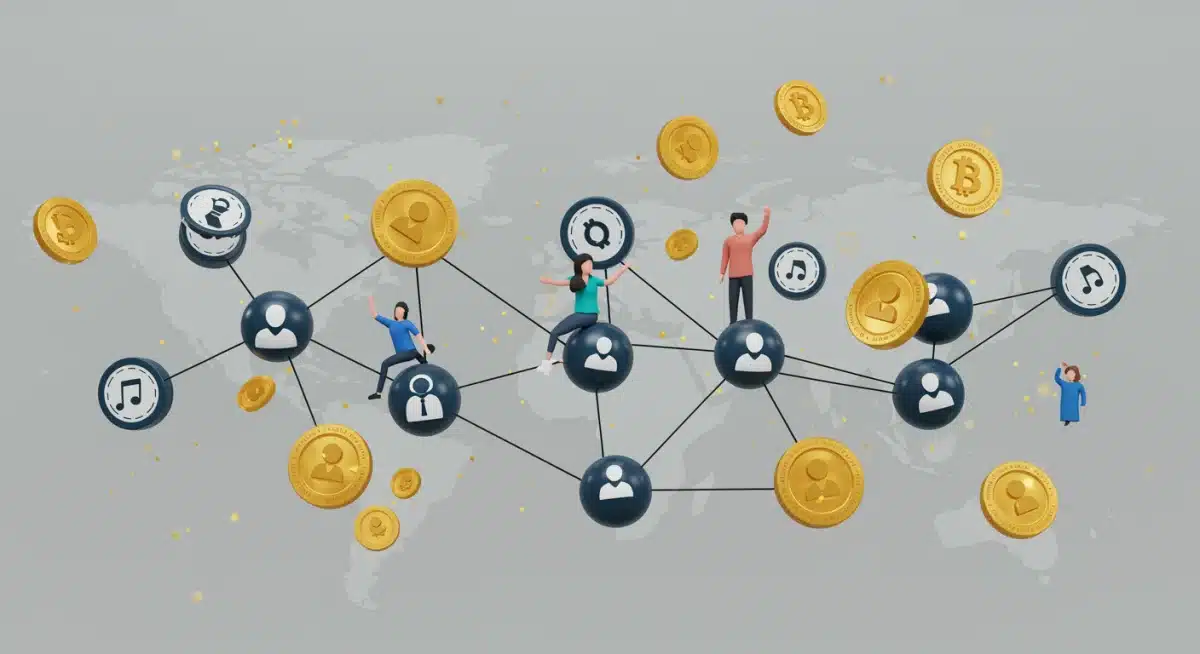

Monetization and governance within Farcaster
While Farcaster’s monetization specifics are still evolving, its decentralized nature lays the groundwork for several financial models:
- Tip jars and direct payments: Users can directly tip creators using cryptocurrencies.
- Token-gated communities: Exclusive content or channels accessible only to holders of specific tokens, fostering deeper engagement and value.
- Protocol fees: Future iterations might involve small fees for certain actions, distributed back to network participants or used for protocol development.
The emphasis on user-controlled data also means that users can potentially monetize their own data streams, should they choose to, rather than platforms profiting exclusively from it. This shift empowers individuals financially by granting them agency over their digital footprint.
Platform 3: DeSo (Decentralized Social) – a blockchain for social apps
DeSo, or Decentralized Social, is a layer-1 blockchain specifically designed to power decentralized social applications. It aims to solve the scalability and cost issues often associated with building social media on general-purpose blockchains. By optimizing for social features like profiles, posts, and followers, DeSo provides a high-performance foundation for a new wave of social platforms.
For U.S. users, DeSo offers a seamless experience that feels familiar yet operates on fundamentally different principles. In 2026, platforms built on DeSo can provide faster transaction speeds and lower fees, making micro-transactions and creator compensation more viable. Its native token, DESO, plays a crucial role in securing the network and facilitating economic activity within its ecosystem, directly impacting the financial incentives of participants.
Financial mechanisms on DeSo-powered platforms
DeSo’s architecture supports a variety of financial models, focusing on empowering creators and users:
- Creator coins: Every profile on DeSo can have its own ‘creator coin,’ allowing fans to invest directly in their favorite creators. As a creator’s popularity grows, so does the value of their coin.
- NFTs for content: Content creators can mint their posts as NFTs, opening up new avenues for digital art and collectible sales.
- Social tipping: Direct in-app tipping mechanisms using DESO or other cryptocurrencies.
These mechanisms provide robust financial incentives for both content creation and community engagement, offering a more direct and transparent pathway for economic value to flow from consumers to creators, unlike traditional platforms where intermediaries take a significant cut.
Platform 4: Aether – privacy-focused and peer-to-peer
Aether represents a different approach to decentralized social media, focusing on true peer-to-peer (P2P) communication and extreme privacy. Unlike blockchain-based platforms that often have public ledgers, Aether uses a distributed hash table (DHT) and end-to-end encryption to ensure that user data and communications remain private and are not stored on any central server. It’s designed for small, self-moderated communities rather than global public feeds.
While not directly focused on tokenomics, Aether’s financial impact for U.S. users in 2026 is subtle but significant. By providing a truly private and censorship-resistant space, it caters to niche communities and discussions that might be stifled on more public or commercially driven platforms. The value here lies in the protection of intellectual property, sensitive discussions, and the ability to organize without external interference, which can have indirect financial benefits for specific groups or ventures.
Indirect financial benefits of Aether
Though not overtly monetized, Aether’s privacy-first design yields valuable financial advantages:
- Protection of proprietary information: Secure discussions for business strategies or sensitive research.
- Reduced risk of data breaches: Minimizing the financial and reputational costs associated with centralized data storage.
- Niche community building: Fostering highly engaged, private communities that can eventually transition to other platforms for monetization or collective action.
Aether exemplifies how not all financial impact in Web3 is about direct token gains; sometimes, it’s about the security and freedom that enables other forms of economic activity or protects existing ones.
Platform 5: Mastodon – the federated alternative
Mastodon, while not strictly a blockchain-based Web3 platform, embodies many of the decentralized principles that Web3 champions. It is a federated social network, meaning it consists of many independent servers (instances) that can communicate with each other. Users choose an instance to join, and their posts can be seen by users on other instances. This model distributes control across many operators rather than a single entity.
For U.S. users in 2026, Mastodon offers a highly customizable and community-driven social experience. Each instance can set its own rules and moderation policies, allowing users to find communities that align with their values. The financial impact is primarily seen in its non-profit, community-funded model. Many instances are run by volunteers or funded through donations, removing the advertising revenue motive that often compromises user experience and privacy on commercial platforms.
Financial sustainability and community support
Mastodon’s financial model is distinct from token-driven Web3 platforms but equally impactful:
- Donation-based funding: Many instances rely on user donations to cover server costs, fostering a sense of collective ownership.
- Subscription models: Some larger instances offer premium features or enhanced support through paid subscriptions.
- Reduced data monetization: Without an advertising imperative, user data is not commoditized, preserving privacy and user trust.
This model demonstrates that financial viability in a decentralized context doesn’t always require complex tokenomics; it can also be sustained by community support and a shared commitment to a more ethical social media experience.
The evolving financial landscape for U.S. users
The emergence of these decentralized social media platforms signals a significant shift in the financial dynamics of online interaction for U.S. users. By 2026, the traditional advertising-driven model, where platforms profit from user data and attention, is increasingly challenged by models that empower creators and users directly. This creates a more equitable distribution of value and opens up new avenues for earning and investing.
The financial impact extends beyond individual creators. Businesses and brands can engage with communities in more authentic ways, potentially through token-gated experiences or by issuing their own social tokens. This fosters deeper loyalty and creates new forms of digital commerce. The transparency of blockchain also reduces fraud and increases trust in online transactions, benefiting the entire ecosystem.
Key financial shifts to observe
- Creator empowerment: Direct monetization models bypass intermediaries, allowing creators to retain a larger share of their earnings.
- User as owner: Users can own digital assets (NFTs, social tokens) related to their online activity and community, potentially gaining financial value.
- New investment opportunities: Investing in creator coins or platform tokens becomes a new form of digital asset investment.
- Reduced data exploitation: Greater control over personal data mitigates the financial risks associated with data breaches and targeted advertising.
These shifts are not merely theoretical; they are actively shaping how U.S. users perceive and interact with online platforms, moving towards a future where digital presence equates to tangible value and ownership.
| Key Platform | Financial Impact Overview |
|---|---|
| Lens Protocol | Enables content as NFTs, direct creator monetization, and community ownership of social graphs. |
| Farcaster | Facilitates direct tipping, token-gated content, and user data control for potential monetization. |
| DeSo | Supports creator coins for direct investment, NFT minting for posts, and in-app social tipping. |
| Aether & Mastodon | Offer indirect financial benefits through privacy, data security, and community-funded models. |
Frequently asked questions about Web3 social media
Web3 social media platforms offer users true ownership of their data and content, enhanced privacy through decentralization, and direct monetization opportunities for creators, bypassing traditional intermediaries and their fees. They foster censorship resistance and transparent governance models.
Creators can mint their content as NFTs, sell ‘creator coins’ directly to their audience, receive direct tips in cryptocurrency, and participate in token-gated communities. This allows them to retain a significantly larger share of their earnings compared to traditional platforms.
Generally, yes. By distributing data across a blockchain or peer-to-peer network, they reduce single points of failure common in centralized systems. Cryptographic signatures ensure content authenticity, and user-controlled identities minimize risks associated with centralized data breaches.
Tokens serve multiple functions: they can represent ownership of content (NFTs), facilitate direct payments and tipping, grant governance rights, or act as a medium of exchange within the platform’s ecosystem, creating new financial incentives.
Challenges include user experience complexity, scalability issues for mass adoption, regulatory uncertainties, and the need for greater awareness and education among mainstream users. Bridging the gap between Web2 familiarity and Web3’s technical demands is crucial for growth.
Conclusion
The journey to a truly decentralized internet is well underway, and nowhere is this more apparent than in the realm of social media. The platforms analyzed—Lens Protocol, Farcaster, DeSo, Aether, and Mastodon—each offer unique approaches to reclaiming user ownership, privacy, and financial autonomy. For U.S. users in 2026, these emerging Web3 social media platforms represent not just new ways to connect, but fundamental shifts in how value is created, exchanged, and owned online. The financial impact is profound, ushering in an era where creators are directly rewarded, and users are empowered stakeholders, moving beyond the extractive models of the past. As these innovations mature, they promise a more equitable and resilient digital future.