Web3 Ransomware: 2026 Outlook & US Business Defense Strategies

The dawn of Web3, characterized by decentralization, blockchain technology, and token-based economies, promised a more secure and transparent internet. However, with every technological advancement comes a new frontier for malicious actors. As we hurtle towards 2026, the landscape of cyber threats is rapidly evolving, and ransomware, a perennial nemesis, is finding new and insidious ways to exploit the very foundations of Web3. For US businesses, understanding these emerging attack vectors and implementing robust defense strategies is not merely a recommendation but a critical imperative for survival in the decentralized era.
In this comprehensive analysis, we will delve into the projected evolution of ransomware in Web3 by 2026, dissecting the novel methods cybercriminals are likely to employ. We will explore how the unique characteristics of blockchain, smart contracts, and decentralized applications (dApps) create new vulnerabilities, moving beyond traditional file encryption to encompass asset freezing, oracle manipulation, and even governance attacks. More importantly, we will outline four proactive and actionable defense strategies specifically tailored to fortify US businesses against these sophisticated Web3 ransomware threats. The goal is not just to react, but to anticipate and build resilience against a future where digital assets and decentralized operations are increasingly under siege.
Understanding the Web3 Paradigm: A Double-Edged Sword for Security
Web3 represents a fundamental shift from the centralized internet (Web2) we know today. Instead of relying on central authorities like Google or Amazon to host data and applications, Web3 leverages distributed ledger technologies (DLTs) like blockchain to create a peer-to-peer network. This decentralization offers numerous benefits: enhanced data ownership, censorship resistance, and increased transparency. However, these very advantages introduce a new set of security challenges that traditional cybersecurity models are ill-equipped to handle.
The core components of Web3 – blockchain, smart contracts, and dApps – are the new battlegrounds. Blockchain’s immutability, while a strength for data integrity, means that once a malicious transaction (e.g., a ransomware payment) is recorded, it’s nearly impossible to reverse. Smart contracts, self-executing agreements coded onto the blockchain, are prone to vulnerabilities that can be exploited to lock assets or manipulate critical functions. dApps, built on these smart contracts, inherit these risks and often introduce their own through complex integrations and user interfaces.
For US businesses, the adoption of Web3 technologies, whether through managing digital assets, participating in decentralized finance (DeFi), or building dApps, means confronting a new threat landscape. The traditional perimeter defense models are becoming obsolete. Instead, a more nuanced, ‘zero-trust’ approach focusing on every interaction within the decentralized ecosystem is paramount. The stakes are incredibly high; a successful Web3 ransomware attack could lead to irreversible loss of digital assets, reputational damage, and severe operational disruptions.
The Evolution of Ransomware: Beyond File Encryption in Web3
Ransomware, historically, has focused on encrypting files and demanding payment for their decryption. In Web3, this model is poised for a significant transformation. Cybercriminals are innovating, leveraging the unique features of the decentralized web to create more sophisticated and impactful attacks. By 2026, we anticipate several new ransomware attack vectors to become prominent:
1. Smart Contract Ransomware (SCR): Asset Freezing and Control Hijacking
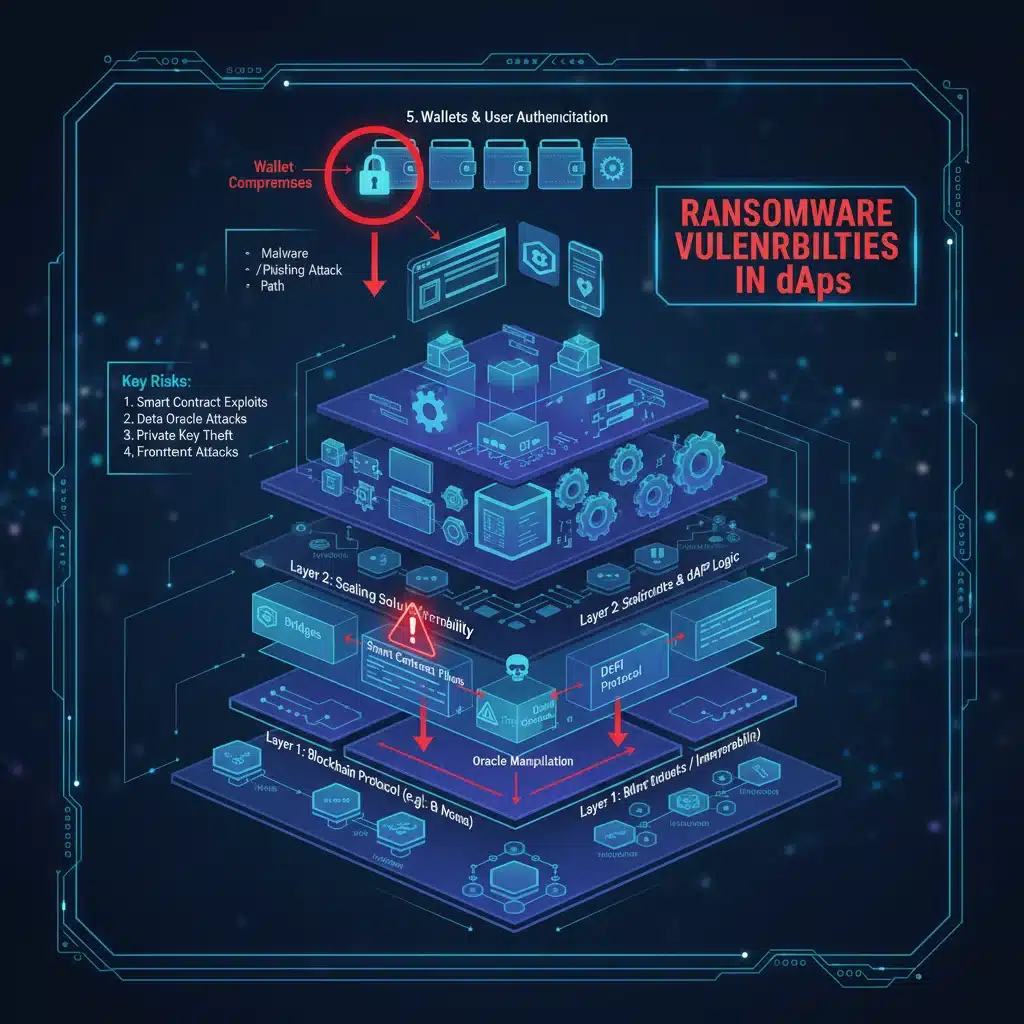
One of the most potent new forms of ransomware will be Smart Contract Ransomware (SCR). Instead of encrypting data, SCR will exploit vulnerabilities within smart contracts to lock up digital assets (e.g., cryptocurrencies, NFTs, tokenized real estate) or seize control of critical contract functions. Imagine a scenario where a dApp’s treasury or a DeFi protocol’s liquidity pool is held hostage by a malicious smart contract function triggered by an attacker. The ransom demand would be for the release of these assets or the transfer of control back to the legitimate owners.
These attacks could target various smart contract types: ERC-20 tokens, NFT contracts (ERC-721, ERC-1155), or even complex governance contracts in DAOs (Decentralized Autonomous Organizations). The immutable nature of blockchain means that once a malicious contract is deployed and executed, reversing its effects without the attacker’s cooperation would be extremely challenging, if not impossible, unless a pre-planned escape hatch or upgrade mechanism is in place.
2. Oracle Manipulation Ransomware: Data Integrity Under Siege
Oracles are essential components of Web3, acting as bridges between real-world data and blockchain smart contracts. They feed external information (e.g., price feeds, weather data, sports results) that smart contracts rely on to execute their logic. Oracle Manipulation Ransomware would involve compromising these oracle services to feed false or manipulated data into smart contracts, leading to incorrect executions that could effectively lock or transfer assets. For example, by manipulating a price oracle, an attacker could force a lending protocol to liquidate collateral at an artificially low price, then demand a ransom to restore correct data feeds and prevent further losses.
The impact of such an attack could be catastrophic for DeFi protocols and any dApp relying on external data. The ransom could be demanded for the cessation of manipulation or for rectifying the manipulated data. This vector highlights the critical importance of decentralized and robust oracle networks, as a single point of failure in an oracle can have cascading effects across an entire Web3 ecosystem.
3. Wallet and Private Key Ransomware: Direct Asset Capture
While not entirely new, the methods for compromising Web3 wallets and private keys are becoming more sophisticated. Beyond phishing and malware, we can expect more targeted social engineering attacks, supply chain attacks on wallet software, and even quantum computing advancements potentially threatening current cryptographic standards by 2026. Once a private key is compromised, the attacker has direct access to all associated digital assets. The ‘ransom’ in this scenario might involve threatening to permanently move or destroy assets unless a payment is made, or demanding a payment for the return of the compromised key (though this is rarely advisable).
This type of attack leverages the user’s direct custody of their assets in Web3. Unlike traditional banking where institutions hold funds, in Web3, the user is their own bank. This empowerment comes with the immense responsibility of securing private keys, and ransomware actors will continuously seek to exploit any weakness in this personal security chain.
4. Decentralized Autonomous Organization (DAO) Governance Ransomware
DAOs are governed by their token holders, who vote on proposals to manage the organization’s treasury, upgrades, and strategic direction. Governance Ransomware would involve an attacker gaining enough voting power (either by accumulating tokens or exploiting vulnerabilities in the governance mechanism) to propose and pass malicious resolutions. This could include proposals to transfer treasury funds to an attacker’s wallet, freeze legitimate accounts, or even shut down critical DAO operations. The ransom would be for relinquishing control or undoing the malicious proposals.
This attack vector is particularly insidious because it leverages the very democratic principles of DAOs against them. It highlights the need for robust governance frameworks, multi-signature requirements for critical decisions, and continuous monitoring of voting power distribution to prevent hostile takeovers. The financial and reputational damage to a DAO from such an attack would be immense, potentially leading to its collapse.
4 Proactive Defense Strategies for US Businesses Against Web3 Ransomware
Given the evolving threat landscape, US businesses engaged in Web3 must adopt a multi-layered, proactive defense strategy. Here are four critical approaches:
Strategy 1: Comprehensive Smart Contract Audits and Secure Development Lifecycles (SDLC)
The foundation of Web3 security lies in the integrity of its smart contracts. For businesses developing or utilizing dApps, rigorous smart contract auditing is non-negotiable. This goes beyond a single audit before deployment. It requires:
- Multiple Independent Audits: Engage reputable cybersecurity firms specializing in blockchain and smart contract audits. Different auditors often bring diverse perspectives and tools, increasing the likelihood of identifying vulnerabilities.
- Continuous Auditing and Monitoring: Smart contracts are often upgraded or interact with new protocols, introducing new risks. Implement continuous monitoring tools and periodic re-audits, especially after significant changes or integrations.
- Formal Verification: For mission-critical smart contracts, consider formal verification techniques. This mathematical approach proves the correctness of a contract’s code against its specifications, significantly reducing the risk of logic flaws that could be exploited by SCR.
- Secure Development Lifecycles (SDLC): Integrate security best practices from the very beginning of the development process. This includes threat modeling, secure coding standards, peer reviews, and comprehensive testing (unit, integration, and penetration testing) focused on identifying and mitigating Web3-specific vulnerabilities.
- Bug Bounty Programs: Incentivize ethical hackers to find vulnerabilities before malicious actors do. A well-structured bug bounty program can be a highly effective defense mechanism, leveraging the collective intelligence of the security community.
Investing in these measures is an upfront cost that pales in comparison to the potential losses from a successful smart contract ransomware attack.
Strategy 2: Decentralized Oracle Redundancy and Data Integrity Verification
To combat Oracle Manipulation Ransomware, US businesses must prioritize the security and decentralization of their data feeds:
- Multiple Decentralized Oracles: Do not rely on a single oracle provider. Utilize multiple, independent, and decentralized oracle networks (e.g., Chainlink, Band Protocol, API3) to source critical data. This redundancy makes it significantly harder for an attacker to compromise all data feeds simultaneously.
- Data Aggregation and Validation: Implement mechanisms to aggregate data from multiple oracles and validate its consistency. Smart contracts should be designed to detect significant discrepancies between data sources and pause operations or trigger alerts if manipulation is suspected.
- Reputation Systems and Slashing: Choose oracle networks that incorporate reputation systems and ‘slashing’ mechanisms. Slashing penalizes oracle nodes that provide incorrect or malicious data, incentivizing honest behavior and data accuracy.
- Off-Chain Data Verification: For highly sensitive data, consider off-chain verification processes where human oversight or independent audits confirm the integrity of data before it is fed into smart contracts. While this adds a layer of centralization, it can be a necessary safeguard for critical operations.
Ensuring the integrity of external data is crucial for the reliable and secure operation of any Web3 application, making robust oracle strategies a cornerstone of Web3 ransomware defense.
Strategy 3: Advanced Wallet Security and Multi-Factor Authentication (MFA) for Digital Assets
Protecting private keys and digital assets from direct capture is fundamental. Businesses must implement stringent wallet security protocols:
- Hardware Wallets for Cold Storage: For significant digital asset holdings, hardware wallets (e.g., Ledger, Trezor) are essential. These devices store private keys offline, making them impervious to online ransomware attacks.
- Multi-Signature (Multi-Sig) Wallets: Implement multi-sig wallets for organizational funds. This requires multiple private keys to authorize a transaction, preventing a single point of compromise from leading to asset loss. For example, 3 out of 5 key holders might be required to approve a transaction.
- Strong Multi-Factor Authentication (MFA): For any hot wallets or dApp interfaces, enforce robust MFA beyond just passwords. This could include biometric authentication, hardware security keys (e.g., YubiKey), or time-based one-time passwords (TOTP).
- Regular Security Training: Educate all employees involved in Web3 operations about phishing, social engineering, and the importance of private key security. Human error remains a significant vulnerability, and continuous training is vital.
- Supply Chain Security for Wallet Software: Be vigilant about the authenticity and integrity of wallet software. Only download from official sources, verify checksums, and be aware of potential supply chain attacks that could inject malware into legitimate software.
- Emergency Protocols: Have clear, tested emergency protocols for suspected wallet compromises, including procedures for revoking approvals, transferring funds to secure cold storage, and notifying relevant parties.
The principle here is to make it as difficult as possible for an attacker to gain singular control over an organization’s digital assets, emphasizing layers of protection.
Strategy 4: Robust DAO Governance Security and Incident Response Planning
For US businesses participating in or building DAOs, securing governance mechanisms against ransomware-style attacks is paramount:
- Decentralized Voting Mechanisms: Ensure that voting mechanisms are truly decentralized and resistant to manipulation. Avoid systems where a small group of entities can exert disproportionate control.
- Time-Locks and Delay Periods: Implement time-locks for critical governance proposals (e.g., treasury transfers, contract upgrades). This introduces a delay between a proposal being approved and its execution, providing a window for the community or security teams to detect and potentially nullify malicious actions.
- Multi-Sig for Critical Treasury Operations: Even within a DAO, critical treasury operations (e.g., large fund transfers) should ideally require multi-signature approval from a diverse and trusted group of signers, separate from the general governance vote.
- Continuous Monitoring of Governance Activity: Utilize blockchain analytics tools to monitor voting patterns, token distribution, and proposal activity for any anomalous or suspicious behavior that could indicate an attempted governance attack.
- Community Engagement and Education: Foster an engaged and educated community of token holders who understand the importance of governance security and can collectively identify and respond to threats.
- Comprehensive Incident Response Plan (IRP): Develop a specific IRP for Web3 ransomware incidents. This plan should detail steps for detection, containment, eradication, recovery, and post-incident analysis. It should include clear communication protocols for stakeholders, law enforcement, and the broader Web3 community. Regular drills and simulations of these plans are crucial for ensuring their effectiveness when a real incident occurs.
A well-defined incident response plan is not just about reacting to an attack; it’s about minimizing damage and accelerating recovery, turning a potential disaster into a manageable crisis.

Conclusion: Building Resilience in the Decentralized Frontier
The evolution of ransomware in Web3 by 2026 presents a formidable challenge for US businesses. The shift from traditional file encryption to sophisticated attacks targeting smart contracts, oracles, wallets, and governance mechanisms demands a paradigm shift in cybersecurity thinking. The decentralized nature of Web3, while offering immense opportunities, also distributes the responsibility for security across a wider ecosystem, necessitating a collaborative and proactive approach.
By implementing comprehensive smart contract audits, ensuring decentralized oracle redundancy, fortifying wallet security with advanced MFA, and establishing robust DAO governance with detailed incident response plans, US businesses can build significant resilience against these emerging threats. The future of the internet is decentralized, and with it comes a new era of cyber warfare. Those who anticipate and prepare will not only survive but thrive in this exciting, yet challenging, new frontier. The time to act is now, to secure the digital assets and operations that will define the next generation of commerce and interaction.
The journey towards a secure Web3 is ongoing. It requires continuous vigilance, adaptation, and investment in cutting-edge security practices. US businesses that embrace these challenges head-on will not only protect their own interests but also contribute to the overall security and trustworthiness of the decentralized web, paving the way for its widespread adoption and success. Remember, in Web3, security is not an afterthought; it is the bedrock upon which trust and innovation are built.