Navigating Altcoin Volatility: Data-Driven Risk Mitigation

Implementing a robust data-driven strategy, encompassing advanced analytics and dynamic portfolio adjustments, is crucial for effectively navigating altcoin volatility and achieving a 20% risk mitigation in today’s market cycle.
Navigating altcoin volatility: A data-driven strategy to mitigate risk by 20% in the current market cycle is a critical challenge for every cryptocurrency investor. The dynamic nature of altcoins, while offering immense potential returns, also presents significant risks. Understanding how to leverage data for informed decision-making is no longer a luxury but a necessity for safeguarding and growing your digital assets.
Understanding the current altcoin market cycle
The altcoin market operates within distinct cycles, often influenced by Bitcoin’s movements but possessing unique characteristics. Identifying the current phase—be it accumulation, bull run, distribution, or bear market—is fundamental to formulating an effective risk mitigation strategy. This understanding allows investors to anticipate potential shifts and position their portfolios accordingly.
In 2026, the altcoin landscape is evolving rapidly, with new innovations in Web3 and decentralized finance (DeFi) continually reshaping market dynamics. These innovations can introduce both new opportunities and unforeseen risks, making a data-centric approach more vital than ever.
Key characteristics of the current altcoin cycle
The present market cycle for altcoins is distinguished by several factors that demand keen observation. High correlation with broader crypto market sentiment, coupled with increasing institutional interest, plays a significant role. Furthermore, the rapid development of layer-2 solutions and interoperability protocols is creating a more complex, yet interconnected, ecosystem.
- Increased institutional participation leading to higher liquidity but also potentially larger price swings.
- Dominance of narratives around AI integration and real-world assets (RWAs) in driving altcoin valuations.
- Enhanced regulatory scrutiny impacting investor confidence and market stability.
- Faster innovation cycles, meaning projects can emerge and fade quickly.
Recognizing these characteristics helps investors not just react to market events, but proactively adjust their strategies. For instance, understanding the impact of institutional capital means anticipating larger trading volumes and potentially more volatile price action. This foundational understanding sets the stage for a data-driven approach to risk management.
Leveraging on-chain data for predictive insights
On-chain data provides an unparalleled view into the true state of a cryptocurrency network, offering insights that traditional market indicators might miss. By analyzing transactions, addresses, and network activity, investors can gain a clearer picture of demand, supply, and investor sentiment, which are crucial for altcoin volatility mitigation.
This type of data is transparent and immutable, making it a reliable source for quantitative analysis. It allows for a deeper understanding of market participants’ behavior, helping to identify potential accumulation or distribution phases before they become evident in price action.
Key on-chain metrics to monitor
Several on-chain metrics are particularly useful for assessing altcoin health and predicting future price movements. These metrics can reveal underlying strength or weakness that is not immediately apparent from price charts alone.
- Active addresses: Indicates network usage and adoption; a rising number suggests growing interest.
- Transaction volume: Measures the total value transferred on the network; high volume often precedes significant price moves.
- Whale accumulation/distribution: Tracking large wallet movements can signal upcoming shifts in supply and demand.
- Exchange flows: Monitoring inflows and outflows from exchanges can indicate selling pressure or buying interest.
By systematically tracking these metrics, investors can develop a more nuanced understanding of an altcoin’s fundamental value and market sentiment. This data-driven approach empowers them to make more informed decisions, reducing reliance on speculative sentiment and increasing the accuracy of their risk assessments.
Implementing advanced technical indicators
While on-chain data offers a fundamental perspective, advanced technical indicators provide crucial insights into price action and market structure. Combining these two analytical frameworks creates a powerful synergy for predicting price movements and managing risk effectively. Technical analysis, when applied judiciously, can help identify entry and exit points, as well as potential support and resistance levels.
The goal is not to predict the exact future, but to identify probabilities and manage risk based on historical price patterns and mathematical indicators. This approach is central to achieving a 20% risk mitigation target.
Effective technical indicators for altcoins
Certain technical indicators prove particularly useful in the volatile altcoin market. These tools, when used in conjunction, can provide a comprehensive view of market momentum and potential reversals.
- Relative Strength Index (RSI): Helps identify overbought or oversold conditions, signaling potential reversals.
- Moving Average Convergence Divergence (MACD): A momentum indicator that shows the relationship between two moving averages of an asset’s price.
- Bollinger Bands: Measures market volatility and identifies potential price extremes.
- Volume Profile: Reveals areas of significant trading activity at specific price levels, indicating strong support or resistance.
Integrating these technical indicators into a trading strategy allows for a more disciplined approach to altcoin investments. They provide objective signals that can help override emotional biases, leading to more rational decisions and a higher likelihood of successful risk management.
Portfolio diversification and dynamic rebalancing
Diversification remains a cornerstone of risk management in any investment class, and altcoins are no exception. However, simply holding multiple altcoins isn’t enough; a strategic, data-driven approach to diversification and dynamic rebalancing is essential. This involves carefully selecting a range of altcoins with varying characteristics and adjusting their proportions based on market conditions.
The objective is to minimize portfolio-wide risk by spreading investments across different sectors, use cases, and market capitalizations, ensuring that the underperformance of one asset does not severely impact the entire portfolio. This proactive management is critical for altcoin volatility mitigation.
Strategies for intelligent diversification
Intelligent diversification goes beyond simply buying multiple assets. It involves a thoughtful selection process guided by data and an understanding of market correlations.
- Sector-based diversification: Invest across different Web3 sectors like DeFi, NFTs, gaming, and infrastructure to reduce exposure to a single narrative.
- Correlation analysis: Choose altcoins with low correlation to each other to ensure that price movements in one do not directly mirror others.
- Market cap stratification: Balance investments between large-cap, mid-cap, and small-cap altcoins to capture different growth potentials and risk profiles.
- Project fundamental strength: Prioritize projects with strong fundamentals, active development, and clear use cases, validated by on-chain data.
Dynamic rebalancing involves regularly reviewing and adjusting portfolio allocations to maintain desired risk levels and capitalize on market shifts. This could mean selling portions of overperforming assets to buy into underperforming ones, or adjusting based on significant changes in fundamental data or technical indicators. This continuous optimization is vital for navigating the unpredictable nature of altcoin markets.
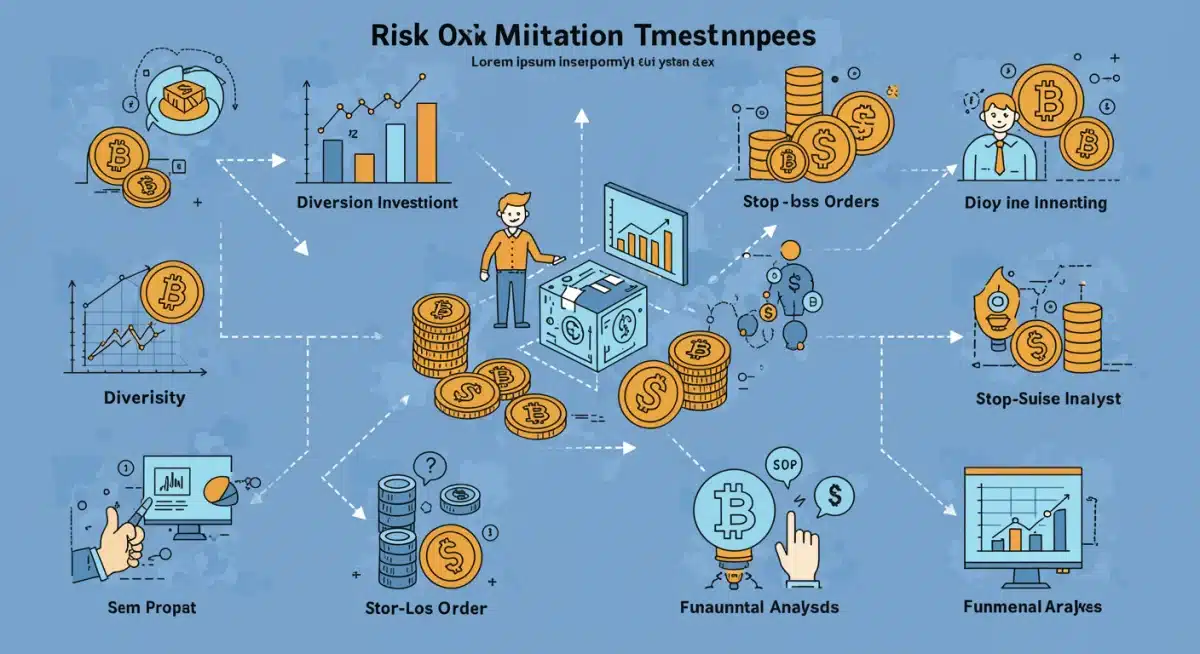
Implementing robust risk management protocols
Beyond diversification and analytical tools, concrete risk management protocols are indispensable for protecting capital during periods of high altcoin volatility. These protocols provide a structured framework for reacting to market events and preventing emotional decisions from leading to significant losses. A well-defined risk management strategy is the backbone of any successful investment approach.
The goal is to define acceptable levels of risk for each trade and for the overall portfolio, ensuring that potential losses remain within predetermined limits. This systematic approach is key to achieving a 20% risk reduction.
Essential risk management tools and techniques
Several practical tools and techniques can be employed to enforce disciplined risk management within an altcoin portfolio.
- Stop-loss orders: Automatically sell an asset if its price drops to a predetermined level, limiting potential losses.
- Position sizing: Determine the appropriate amount of capital to allocate to each trade based on risk tolerance and potential reward.
- Take-profit targets: Set predetermined price levels at which to sell a portion or all of an asset to lock in gains.
- Risk-to-reward ratio: Evaluate the potential profit versus potential loss for each trade, aiming for ratios that favor higher rewards.
Adhering to these protocols consistently helps mitigate the psychological impact of market fluctuations, allowing investors to execute their data-driven strategy with greater confidence and less emotional interference. It transforms speculative trading into a more controlled and calculated endeavor.
Backtesting and continuous strategy refinement
A data-driven strategy is not static; it requires continuous refinement based on performance analysis and evolving market conditions. Backtesting, the process of applying a strategy to historical data to see how it would have performed, is a critical step in validating and improving any investment approach. This iterative process ensures that the strategy remains effective and adaptable.
The insights gained from backtesting provide valuable feedback, allowing for adjustments that can further enhance risk mitigation and optimize returns. This commitment to continuous improvement is what differentiates successful investors from those who merely react to the market.
The iterative process of strategy optimization
Refining an altcoin investment strategy involves several key steps, each contributing to its overall robustness and effectiveness.
- Historical data analysis: Use extensive historical price and on-chain data to test various parameters and indicators.
- Parameter optimization: Adjust stop-loss levels, take-profit targets, and indicator settings to find the most effective configurations.
- Scenario testing: Simulate extreme market conditions (e.g., flash crashes, prolonged bear markets) to assess strategy resilience.
- Live market monitoring: Continuously observe how the strategy performs in real-time and make minor adjustments as needed.
Through diligent backtesting and a commitment to continuous refinement, investors can build a strategy that is not only data-driven but also resilient and responsive to the ever-changing altcoin market. This proactive approach is fundamental to achieving and sustaining significant risk mitigation over the long term.
| Key Strategy | Brief Description |
|---|---|
| On-chain Data Analysis | Utilizing network activity, transaction volumes, and whale movements for predictive insights. |
| Advanced Technical Indicators | Applying RSI, MACD, and Bollinger Bands to identify market momentum and potential reversals. |
| Dynamic Diversification | Strategic portfolio rebalancing across sectors and market caps based on data and correlations. |
| Robust Risk Protocols | Implementing stop-loss orders and proper position sizing to limit potential losses. |
Frequently asked questions about altcoin risk mitigation
▼
Altcoin volatility is primarily driven by factors like low liquidity, speculative trading, market sentiment, technological developments, and regulatory news. Bitcoin’s performance also significantly influences altcoin prices. Understanding these drivers helps in anticipating market movements and adjusting strategies accordingly.
▼
On-chain data offers transparency into network activity, such as active addresses, transaction volume, and whale movements. By analyzing these metrics, investors can gauge true demand, supply dynamics, and potential accumulation or distribution phases, providing early signals for risk assessment and mitigation.
▼
Dynamic portfolio rebalancing involves regularly adjusting the allocation of altcoins within a portfolio based on market conditions, performance, and risk tolerance. This strategy aims to maintain desired risk levels and capitalize on market shifts by selling overperforming assets and buying into underperforming ones.
▼
Yes, stop-loss orders are highly effective. They automatically sell an altcoin if its price drops to a predetermined level, thereby limiting potential losses. While not foolproof in extremely volatile markets, they are a crucial tool for disciplined risk management and protecting capital from significant downturns.
▼
An altcoin investment strategy should be continuously backtested and refined. While there’s no fixed schedule, major market shifts, introduction of new data sources, or significant underperformance are good triggers. Regular quarterly or semi-annual reviews are also recommended to ensure the strategy remains robust and relevant.
Conclusion
Ultimately, successfully navigating altcoin volatility: A data-driven strategy to mitigate risk by 20% in the current market cycle requires a blend of analytical rigor, disciplined execution, and continuous adaptation. By integrating on-chain data, advanced technical indicators, intelligent diversification, and robust risk management protocols, investors can significantly enhance their ability to protect capital and achieve sustainable growth. The dynamic nature of the altcoin market demands proactive engagement and a commitment to data-informed decision-making, ensuring that your investment journey is as secure and profitable as possible in the exciting Web3 landscape.