Web3 Innovations: ZKPs for Data Privacy & Fraud Reduction

Zero-Knowledge Proofs (ZKPs) are pivotal Web3 innovations, fundamentally transforming data privacy and security within decentralized applications, projected to significantly reduce fraud by 20% by 2026.
The landscape of decentralized applications, or dApps, is evolving at an unprecedented pace, driven by the relentless pursuit of enhanced security and user privacy. In this dynamic environment, Web3 innovations: insider knowledge on Zero-Knowledge Proofs (ZKPs) and their role in enhancing data privacy for decentralized applications by 2026, reducing fraud by 20%, stands out as a transformative force. These cryptographic marvels are not just theoretical constructs; they are becoming the bedrock upon which the next generation of Web3 security is being built, promising a future where privacy and trust coexist seamlessly without sacrificing functionality.
Understanding the Core of Zero-Knowledge Proofs (ZKPs)
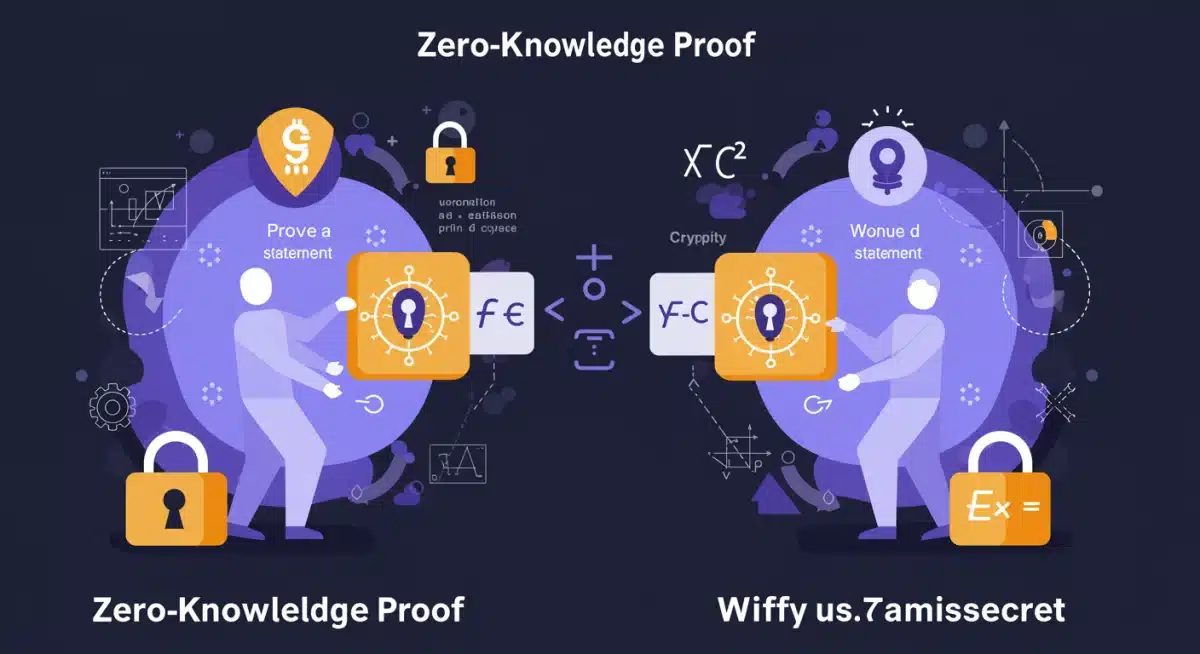
Zero-Knowledge Proofs, or ZKPs, represent a monumental leap in cryptographic technology. At their heart, ZKPs allow one party (the prover) to convince another party (the verifier) that a given statement is true, without revealing any information beyond the validity of the statement itself. This concept, while seemingly paradoxical, holds immense implications for data privacy and security in the digital realm.
Imagine being able to prove your identity, your age, or even your financial solvency without disclosing your name, birthdate, or bank balance. This is the power that ZKPs unlock. They fundamentally shift the paradigm of trust, moving it from reliance on central authorities to cryptographic certainty.
The foundational principles of ZKPs
- Completeness: If the statement is true and both prover and verifier follow the protocol, the verifier will be convinced.
- Soundness: If the statement is false, a dishonest prover cannot convince the verifier, except with a negligible probability.
- Zero-Knowledge: If the statement is true, the verifier learns nothing beyond the fact that the statement is true.
These three properties ensure that ZKPs are not only effective but also highly secure, making them ideal for environments where data minimization is paramount. As we delve deeper into Web3, the necessity for such privacy-preserving tools becomes increasingly clear, especially when dealing with sensitive user data on public blockchains.
The evolution of ZKPs from theoretical cryptography to practical applications is a testament to the ingenuity of the Web3 development community. Early iterations were computationally intensive, limiting their widespread adoption. However, advancements in algorithms and hardware have made ZKPs more efficient and accessible, paving the way for their integration into mainstream decentralized applications. This ongoing improvement is crucial for their role in the broader Web3 ecosystem.
ZKPs: A Game Changer for Data Privacy in Web3
The inherent transparency of public blockchains, while beneficial for trust and immutability, presents significant challenges for data privacy. Every transaction, every interaction, every piece of data written to the blockchain is typically visible to anyone. This model is unsustainable for many real-world applications requiring confidentiality, from financial services to healthcare.
ZKPs offer a powerful solution to this dilemma. By allowing users to prove ownership, authorization, or eligibility without revealing the underlying data, they enable a new era of privacy-preserving decentralized applications. This capability is not merely an enhancement; it is a fundamental shift that can unlock previously impossible use cases for Web3.
Practical applications of ZKPs in privacy
- Private transactions: Enabling confidential transfers of assets on public ledgers without revealing sender, receiver, or amount.
- Identity verification: Proving age or residency without exposing personal documents or full identity details.
- Access control: Granting access to resources or services based on specific criteria, without disclosing the criteria itself.
These applications demonstrate the versatility of ZKPs in safeguarding user data in ways that traditional cryptographic methods cannot. The ability to selectively disclose information, or rather, to prove a fact without disclosing the information that proves it, is a cornerstone of a more private and secure internet. This is particularly relevant in a world increasingly concerned with digital footprints and data exploitation.
The impact of ZKPs on data privacy extends beyond individual transactions. They are instrumental in building privacy-centric decentralized autonomous organizations (DAOs) and other governance models where voting or participation can be done confidentially. This fosters greater participation and reduces the potential for coercion or discrimination, leading to more robust and equitable decentralized systems. The future of privacy in Web3 is intrinsically linked to the adoption and refinement of ZKP technologies.
Reducing Fraud by 20% with ZKP Implementations by 2026
Fraud is a pervasive issue across all digital platforms, and decentralized applications are not immune. While blockchain technology offers inherent security advantages, sophisticated fraud schemes continue to evolve. Zero-Knowledge Proofs are emerging as a critical tool in the fight against these illicit activities, with projections indicating a significant reduction in fraud, potentially up to 20%, by 2026 through their strategic implementation.
The mechanism through which ZKPs combat fraud is multifaceted. By enabling verifiable computations on encrypted or private data, ZKPs can detect fraudulent patterns or unauthorized activities without exposing sensitive information. This allows for proactive security measures that are both effective and privacy-preserving, a combination rarely achieved with traditional anti-fraud systems.
How ZKPs enhance fraud detection and prevention
- Credential verification: Validating user credentials without revealing them, preventing identity theft and unauthorized access.
- Transaction anomaly detection: Identifying suspicious transaction patterns or values without exposing full transaction details to all network participants.
- Compliance without exposure: Enabling regulatory compliance checks (e.g., AML/KYC) without requiring users to disclose their entire financial history or personal data to every service provider.
The ability of ZKPs to provide strong guarantees about data integrity and computation correctness, even when the underlying data is hidden, makes them invaluable for fraud prevention. For instance, in a decentralized exchange, ZKPs could verify that a user has sufficient funds for a trade without revealing their exact balance, thereby preventing front-running and other market manipulation tactics. This creates a fairer and more secure trading environment.
The adoption of ZKPs in anti-fraud frameworks is still in its early stages but is rapidly gaining traction. Industry leaders and research institutions are actively developing and deploying ZKP-based solutions to address various forms of digital fraud. The 20% reduction projected by 2026 is an ambitious yet achievable goal, underscoring the transformative potential of these cryptographic techniques in securing the Web3 ecosystem against increasingly sophisticated threats.
Challenges and Opportunities in ZKP Adoption for dApps
While the promise of Zero-Knowledge Proofs is immense, their widespread adoption in decentralized applications faces several challenges. These hurdles range from technical complexities to the need for greater developer education and the establishment of industry standards. Addressing these challenges is crucial for ZKPs to reach their full potential and truly revolutionize Web3 security and privacy.
One of the primary challenges lies in the computational intensity of generating and verifying ZKPs. While significant advancements have been made, particularly with the development of more efficient ZKP schemes like zk-SNARKs and zk-STARKs, they can still be resource-heavy, impacting scalability and transaction costs for certain applications. This is an area of ongoing research and development within the cryptographic community.
Key challenges for ZKP integration
- Computational overhead: ZKP generation and verification can be resource-intensive, affecting performance.
- Developer expertise: Implementing ZKPs requires specialized cryptographic knowledge, which is currently a niche skill.
- Standardization: Lack of universal standards for ZKP protocols can hinder interoperability and broader adoption.
Despite these challenges, the opportunities presented by ZKPs are compelling. The demand for privacy-preserving technologies is growing, driven by regulatory pressures and increasing user awareness. ZKPs offer a unique solution that aligns with the core principles of decentralization and user empowerment inherent in Web3. This creates a fertile ground for innovation and significant investment in ZKP-related technologies.
Moreover, the development of user-friendly ZKP toolkits and frameworks is simplifying the integration process for developers. As more educational resources become available and the developer community gains expertise, the barriers to entry for ZKP implementation will decrease. This democratizes access to advanced cryptographic privacy, accelerating the pace of Web3 innovations and making privacy a default rather than an afterthought. The collaborative nature of the Web3 ecosystem is also a significant advantage in overcoming these challenges.
The Future Landscape: ZKPs in Web3, DeFi, and Beyond
The trajectory of Zero-Knowledge Proofs suggests a future where they are not just a niche cryptographic tool but a fundamental component of the entire Web3 ecosystem. Their influence is expected to permeate various sectors, from decentralized finance (DeFi) to supply chain management, digital identity, and even the metaverse, redefining how we interact with digital assets and information.
In DeFi, ZKPs are poised to enable a new generation of financial products and services that combine the transparency of blockchain with the privacy required for institutional adoption. Imagine private lending platforms, confidential trading strategies, or anonymous asset management, all secured by the mathematical assurances of ZKPs. This could unlock trillions of dollars in traditional finance, currently hesitant to engage with public blockchains due to privacy concerns.
Projected impact of ZKPs across Web3 sectors
- DeFi: Enabling private financial transactions and compliance without disclosing sensitive data.
- Digital Identity: Creating self-sovereign identities where users control their data and selectively prove attributes.
- Metaverse: Securing virtual asset ownership and enabling private interactions within immersive digital worlds.
- Supply Chain: Verifying product authenticity and ethical sourcing without revealing proprietary business data.
Beyond these specific applications, ZKPs are also crucial for scalability solutions like ZK-rollups, which are vital for increasing the transaction throughput of major blockchains. By offloading computation and storage off-chain and only posting ZKPs to the main chain, these rollups can dramatically improve efficiency, making dApps faster and more affordable to use. This scalability is a key enabler for mass adoption of Web3 technologies.
By 2026, we anticipate ZKPs to be deeply embedded in the infrastructure of many leading Web3 projects. Their ability to deliver both privacy and verifiable integrity positions them as an indispensable technology for a more secure, private, and scalable decentralized internet. The ongoing research and development in this field are continuously pushing the boundaries of what is possible, promising an even more transformative impact in the years to come.
Navigating the Regulatory and Ethical Considerations of ZKPs
As Zero-Knowledge Proofs become more prevalent, it is imperative to address the regulatory and ethical considerations that accompany such powerful privacy-enhancing technologies. The ability to conduct verifiable yet private transactions raises questions for regulators concerning anti-money laundering (AML) and know-your-customer (KYC) compliance, as well as broader societal implications.
Regulators worldwide are grappling with how to balance privacy innovations with the need to prevent illicit activities. ZKPs offer a unique opportunity to achieve compliance without compromising user privacy. For example, a ZKP could prove that a user meets specific KYC requirements without revealing their identity to the dApp itself, only to an authorized, trusted third party, if necessary. This ‘privacy-by-design’ approach can satisfy both regulatory demands and user expectations.
Key regulatory and ethical aspects
- Balancing privacy with compliance: Developing ZKP solutions that satisfy AML/KYC regulations while preserving user anonymity.
- Data ownership and control: Empowering users with greater control over their personal information and how it is shared.
- Responsible development: Ensuring ZKP technologies are developed and deployed ethically, avoiding misuse for harmful purposes.
The ethical implications extend to ensuring equitable access to these technologies and preventing their use for discrimination or censorship. Developers and policymakers must collaborate to establish frameworks that guide the responsible deployment of ZKPs, ensuring they serve to empower individuals and enhance societal well-being within the Web3 landscape. This proactive approach is essential to harness the benefits of ZKPs while mitigating potential risks.
Open dialogues between technologists, legal experts, and government bodies are crucial for shaping a regulatory environment that fosters innovation while upholding public safety. By proactively addressing these considerations, the Web3 community can ensure that ZKPs continue to be a force for good, building a more private, secure, and trustworthy digital future. The integration of ZKPs into various regulatory sandboxes and pilot programs is already demonstrating their potential to meet these complex demands effectively.
| Key Aspect | Brief Description |
|---|---|
| Data Privacy Enhancement | ZKPs allow users to prove information without revealing the underlying data, crucial for Web3 privacy. |
| Fraud Reduction Target | Expected 20% reduction in digital fraud by 2026 through ZKP implementations. |
| Web3 Integration | ZKPs are becoming foundational for DeFi, digital identity, and scalable dApps. |
| Challenges & Opportunities | Computational overhead and developer expertise are challenges, met by growing demand for privacy. |
Frequently asked questions about ZKPs in Web3
A ZKP is a cryptographic method allowing one party to prove a statement to another without revealing any information beyond the statement’s truth. It ensures privacy by validating facts without exposing underlying data, making it crucial for secure Web3 interactions.
ZKPs enable dApps to verify user attributes or transaction validity without requiring full data disclosure. This means users can prove age, identity, or ownership on a public blockchain while keeping their sensitive personal information confidential, fostering greater trust.
By enabling verifiable, privacy-preserving checks, ZKPs can detect fraudulent activities like unauthorized access or suspicious transactions without exposing sensitive data. This allows for more robust and proactive anti-fraud measures, aiming for a significant reduction in digital fraud.
Historically, ZKPs were computationally intensive, but advancements in schemes like zk-SNARKs and zk-STARKs have greatly improved efficiency. While some overhead remains, ongoing research and optimized implementations are making ZKPs increasingly practical for widespread Web3 integration and scalability solutions.
In DeFi, ZKPs will enable private transactions and compliance without data exposure, attracting institutional adoption. Across Web3, they will secure digital identities, enhance metaverse privacy, and improve supply chain verification, becoming a foundational layer for a more secure internet.
Conclusion
The journey into the heart of Web3 innovations: insider knowledge on Zero-Knowledge Proofs (ZKPs) and their role in enhancing data privacy for decentralized applications by 2026, reducing fraud by 20% reveals a future brimming with potential. ZKPs are more than just a cryptographic tool; they are a beacon for a more private, secure, and trustworthy digital world. By enabling verifiable interactions without compromising sensitive information, they are addressing some of the most pressing challenges facing decentralized applications today. As development continues and adoption grows, ZKPs will undoubtedly be instrumental in shaping a Web3 ecosystem where users are empowered with unprecedented control over their data, and digital fraud becomes a significantly diminished threat, paving the way for truly transformative innovations across various sectors.