ZK-Rollups: Scaling Smart Contracts & Privacy in US Web3 by 2026
The Rise of ZK-Rollups: Impact on Smart Contract Scalability and Privacy in the U.S. Web3 Landscape by 2026
The dawn of Web3 promises a decentralized internet, empowering users with greater control over their data and digital assets. However, the foundational blockchain technology, while revolutionary, faces significant hurdles in achieving widespread adoption, primarily concerning scalability and privacy. As we hurtle towards 2026, a groundbreaking innovation, Zero-Knowledge Rollups (ZK-Rollups), is emerging as a critical solution, poised to fundamentally reshape the U.S. Web3 landscape. This comprehensive article delves into the transformative potential of ZK-Rollups Web3 US, exploring how they are addressing the inherent limitations of smart contract scalability and enhancing privacy, thereby paving the way for a more robust and accessible decentralized future in the United States.
Understanding the Core Challenge: Scalability and Privacy in Early Web3
Before we dissect the solutions offered by ZK-Rollups Web3 US, it’s crucial to grasp the magnitude of the problems they aim to solve. The earliest iterations of blockchain technology, while pioneering, were not designed for the immense transaction volumes and complex smart contract interactions that a fully realized Web3 demands. Networks like Ethereum, the backbone of many decentralized applications (dApps), often struggle with congestion, leading to slow transaction times and exorbitant gas fees. This lack of scalability severely hampers user experience and limits the practical applications of decentralized technologies.
Furthermore, privacy remains a paramount concern. While blockchain transactions are pseudonymous, meaning they are linked to wallet addresses rather than directly to personal identities, the public nature of the ledger means that all transactions are visible to anyone. This transparency, while beneficial for auditing and security, can be a major deterrent for individuals and businesses who require confidentiality for their financial activities, medical records, or proprietary data. The tension between transparency and privacy presents a significant roadblock to mainstream Web3 adoption, particularly in a privacy-conscious nation like the U.S.
The existing solutions, such as sharding or other Layer-2 scaling solutions (like optimistic rollups), have made strides, but often come with their own set of trade-offs. Optimistic rollups, for instance, rely on a ‘fraud proof’ period, introducing delays that can be problematic for time-sensitive applications. This is where ZK-Rollups Web3 US step into the spotlight, offering a compelling alternative that addresses both scalability and privacy with a unique cryptographic approach.
What Exactly Are ZK-Rollups? A Technical Deep Dive
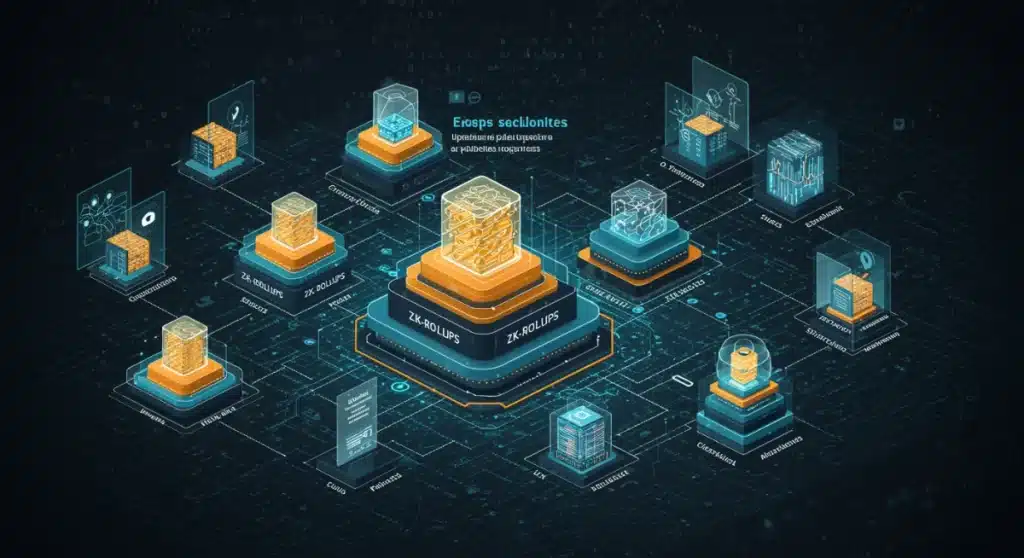
Zero-Knowledge Rollups are Layer-2 scaling solutions that bundle hundreds, or even thousands, of off-chain transactions into a single transaction that is then submitted to the Layer-1 blockchain (e.g., Ethereum). The ‘zero-knowledge’ aspect refers to the cryptographic proof generated alongside this bundled transaction. This proof, known as a Zero-Knowledge Proof (ZKP), allows a verifier to be convinced that all transactions within the bundle are valid, without revealing any of the underlying transaction data itself. This is a game-changer for both efficiency and privacy.
The mechanism works as follows: a specialized off-chain network, often called a ‘sequencer’ or ‘operator,’ aggregates numerous transactions. Instead of processing each transaction individually on the main chain, the sequencer executes them off-chain, updates the state, and then generates a succinct ZKP that cryptographically attests to the correctness of the state transition. This proof is then posted to the Layer-1 blockchain, along with a minimal amount of data representing the new state root. The Layer-1 smart contract can then quickly and efficiently verify the ZKP, thereby confirming the validity of all bundled transactions without needing to re-execute them or examine their details.
This process offers several critical advantages:
- Massive Scalability: By processing transactions off-chain and only posting a small proof to the main chain, ZK-Rollups significantly reduce the data load on the Layer-1 blockchain. This translates to a dramatic increase in transaction throughput and a substantial reduction in gas fees, making dApps more affordable and accessible.
- Instant Finality (Near-Instant): Unlike optimistic rollups, which require a challenge period, ZK-Rollups provide cryptographic proof of validity. Once the ZKP is verified on the Layer-1, the transactions are considered final, offering a much faster user experience.
- Enhanced Privacy: The zero-knowledge property allows for the verification of transactions without revealing their contents. This is particularly powerful for applications requiring confidentiality, such as private DeFi transactions, confidential voting systems, or secure supply chain tracking. The ability to verify without revealing sensitive information is a cornerstone for the future of ZK-Rollups Web3 US.
- Security Inherited from Layer-1: ZK-Rollups inherit the security guarantees of the underlying Layer-1 blockchain. Because the ZKP is verified on the main chain, the integrity of the transactions is as strong as the Layer-1 itself.
The mathematical complexity behind ZKPs is considerable, involving advanced cryptography like SNARKs (Succinct Non-Interactive Argument of Knowledge) and STARKs (Scalable Transparent Argument of Knowledge). However, users and developers primarily interact with the simplified interface, benefiting from the underlying power without needing to master the intricate mathematics.

Impact on Smart Contract Scalability in the U.S. Web3 Landscape
The U.S. Web3 ecosystem, characterized by its rapid innovation and diverse range of decentralized applications, stands to benefit immensely from the scalability offered by ZK-Rollups Web3 US. Smart contracts, the self-executing agreements that power dApps, are currently constrained by the throughput limitations of Layer-1 blockchains. This bottleneck restricts the complexity and user base of applications in critical sectors like Decentralized Finance (DeFi), gaming, NFTs, and supply chain management.
DeFi and Financial Services:
DeFi protocols, which aim to recreate traditional financial services in a decentralized manner, are particularly sensitive to high transaction costs and slow confirmation times. Imagine trying to execute a complex arbitrage strategy or manage a lending pool when each transaction costs tens or hundreds of dollars and takes minutes to confirm. ZK-Rollups will dramatically reduce these barriers, enabling:
- Micro-transactions: Facilitating smaller, more frequent transactions that are currently uneconomical on Layer-1.
- Complex Financial Products: Allowing for more intricate and efficient smart contract interactions, opening the door for sophisticated financial instruments.
- High-Frequency Trading: Enabling faster order execution and settlement in decentralized exchanges.
- Broader Participation: Lowering the entry barrier for everyday users, making DeFi more accessible to a wider U.S. audience.
Gaming and Metaverse:
The burgeoning blockchain gaming and metaverse sectors demand extremely high transaction throughput for in-game asset transfers, character interactions, and virtual world mechanics. Current Layer-1 solutions simply cannot handle the volume. ZK-Rollups Web3 US will provide the necessary infrastructure for:
- Seamless In-Game Economies: Enabling instant and cheap transfers of NFTs and tokens within games.
- Dynamic Metaverse Experiences: Supporting real-time interactions and complex simulations without lag or high fees.
- Mass Adoption: Attracting traditional gamers who are accustomed to fluid and responsive digital experiences.
Enterprise and Supply Chain:
U.S. enterprises are exploring blockchain for supply chain transparency, intellectual property management, and data sharing. However, the need for private and scalable solutions is paramount. ZK-Rollups can offer:
- Efficient Data Recording: Rapidly and cost-effectively recording large volumes of supply chain data.
- Confidential Transactions: Allowing businesses to maintain privacy over sensitive commercial data while still leveraging blockchain’s immutability.
- Interoperability: Potentially enabling seamless data flow across different enterprise systems.
By 2026, we can expect to see a significant migration of dApps to ZK-Rollup-powered chains, leading to a more vibrant, efficient, and user-friendly U.S. Web3 ecosystem.
Enhancing Privacy in the U.S. Web3 Landscape
Privacy is not just a feature; it’s a fundamental right and a critical requirement for Web3 to reach its full potential, especially in a regulatory environment like the U.S. where data protection is increasingly emphasized. The ‘zero-knowledge’ aspect of ZK-Rollups is a powerful tool for addressing privacy concerns without sacrificing transparency or security.
Confidential Transactions:
Imagine being able to send money or transfer assets on a public blockchain without revealing the sender, receiver, or amount to the public. ZK-Rollups make this possible. While the validity of the transaction is cryptographically proven, the details remain hidden. This is crucial for:
- Corporate Transactions: Businesses can conduct private settlements or transfers without exposing their financial strategies to competitors.
- Personal Finance: Individuals can manage their finances with a greater degree of privacy, similar to traditional banking, but with the benefits of decentralization.
- Payroll and Salaries: Enabling confidential disbursement of salaries on-chain.
Identity Management and KYC/AML:
One of the persistent challenges for Web3 adoption in regulated environments like the U.S. is the need for Know Your Customer (KYC) and Anti-Money Laundering (AML) compliance. ZK-Rollups offer a potential solution:
- Zero-Knowledge KYC: Users could prove they meet specific age, residency, or accreditation requirements without revealing their actual identity documents. For example, a user could prove they are over 18 without disclosing their date of birth.
- Regulatory Compliance with Privacy: Financial institutions could verify compliance without needing to store or access sensitive user data directly on the blockchain, reducing their liability and enhancing user privacy.
Decentralized Voting and Governance:
For decentralized autonomous organizations (DAOs) and other governance structures, ZK-Rollups can ensure that votes are cast and counted privately, preventing coercion or undue influence, while still providing a verifiable and tamper-proof record of the overall outcome. This strengthens the integrity of decentralized governance, making it more appealing for robust decision-making processes within the ZK-Rollups Web3 US sphere.
By 2026, the integration of ZK-Rollups will likely lead to a new paradigm of privacy-preserving dApps, fostering greater trust and encouraging broader participation from individuals and institutions who value confidentiality.
Key Players and Developments in the U.S. ZK-Rollup Space
The development and adoption of ZK-Rollups in the U.S. Web3 landscape are being driven by a combination of innovative startups, established blockchain companies, and academic research. Several prominent projects are leading the charge:
- Polygon (zkEVM): Polygon, a major player in the Ethereum scaling space, is heavily investing in zkEVM technology. A zkEVM is a Zero-Knowledge Ethereum Virtual Machine, designed to be fully compatible with existing Ethereum smart contracts, making it incredibly easy for developers to migrate their dApps to a scalable and private ZK-Rollup environment. This is a significant step towards bringing ZK-Rollups Web3 US to mainstream adoption.
- StarkWare (StarkNet): StarkWare, a U.S.-based company, is a pioneer in STARK-based ZK-Rollups. Their StarkNet platform is a permissionless decentralized ZK-Rollup that operates as an L2 network over Ethereum, allowing any dApp to scale without compromising on Ethereum’s composability and security.
- Matter Labs (zkSync): zkSync, another prominent ZK-Rollup solution, focuses on providing a low-cost, secure, and scalable payment and general-purpose smart contract platform. Their zkEVM efforts are aimed at making Ethereum scaling seamless and future-proof.
- ConsenSys: A leading Ethereum software company, ConsenSys is actively involved in ZK-Rollup research and development, recognizing its importance for the future of enterprise blockchain and DeFi.
Beyond these specific projects, there’s a vibrant ecosystem of researchers, cryptographers, and developers across U.S. universities and tech hubs contributing to the advancement of ZKP technology. This collaborative effort is crucial for overcoming the remaining technical challenges and ensuring the robustness and security of these systems.
Regulatory Considerations and the Future of ZK-Rollups in the U.S.
While the technological promise of ZK-Rollups Web3 US is immense, their widespread adoption in the United States will also depend on navigating the evolving regulatory landscape. The U.S. government and various agencies (SEC, CFTC, Treasury) are still grappling with how to classify and regulate digital assets and decentralized technologies.
Privacy vs. Compliance:
The privacy-enhancing features of ZK-Rollups, while beneficial for users, could raise concerns for regulators focused on preventing illicit activities like money laundering or terrorist financing. The challenge will be to strike a balance where privacy is preserved for legitimate users, while still allowing for necessary compliance mechanisms (e.g., through zero-knowledge verifiable credentials for identity). Dialogue between developers, policymakers, and legal experts will be crucial to establish clear guidelines that foster innovation while upholding regulatory objectives.
Security and Auditing:
The complexity of ZK-Rollup cryptography necessitates rigorous security audits and formal verification. Regulators will likely demand high standards of security and transparency in the underlying code, given the potential for significant financial value to be managed on these systems. Establishing robust auditing frameworks and best practices will be essential for building trust and gaining regulatory acceptance.
Interoperability and Standardization:
As multiple ZK-Rollup solutions emerge, there will be a need for interoperability standards to ensure seamless communication and asset transfer between different Layer-2 networks and the main Layer-1 blockchain. Standardization efforts, potentially led by industry consortia or open-source initiatives, will be vital for a cohesive and efficient U.S. Web3 ecosystem.
By 2026, it is plausible that the U.S. will have developed more refined regulatory frameworks that acknowledge the unique characteristics of ZK-Rollups. Proactive engagement from the Web3 community, demonstrating the benefits of these technologies for economic growth and consumer protection, will be key to shaping a favorable regulatory environment for ZK-Rollups Web3 US.
Challenges and Limitations to Overcome
Despite their immense potential, ZK-Rollups are not without their challenges. Understanding these limitations is crucial for a realistic outlook on their adoption by 2026.
Complexity of Development:
Developing ZK-Rollups and dApps on them is significantly more complex than on a traditional Layer-1. The cryptographic proofs require specialized knowledge, and the tooling and developer experience are still maturing. While zkEVMs aim to simplify this, the learning curve remains steep for many developers. Attracting and training more talent in cryptography and ZKP engineering will be vital.
Computational Overhead of Proof Generation:
While verification of ZKPs is fast, generating them can be computationally intensive, requiring significant processing power. This overhead is borne by the ZK-Rollup operators, who then pass on the costs to users through transaction fees. Continuous research into more efficient ZKP algorithms and hardware acceleration will be necessary to further reduce these costs and enhance speed.
Centralization Risks (Initial Stages):
In their early stages, some ZK-Rollup implementations may involve a degree of centralization, particularly concerning the sequencer responsible for bundling transactions and generating proofs. While efforts are underway to decentralize these components, it’s a critical aspect to monitor to ensure that ZK-Rollups uphold the core ethos of decentralization inherent in Web3.
Quantum Computing Threat (Long-Term):
While a longer-term concern, the cryptographic primitives underlying ZKPs (and indeed, much of blockchain technology) could theoretically be vulnerable to attacks from sufficiently powerful quantum computers. Research into post-quantum cryptography is ongoing, and future iterations of ZK-Rollups will need to consider these advancements to ensure long-term security.
Addressing these challenges through ongoing research, community collaboration, and technological innovation will be crucial for the sustained growth and success of ZK-Rollups Web3 US.
The Road Ahead: ZK-Rollups and the Future of U.S. Web3 by 2026
By 2026, the U.S. Web3 landscape will likely be profoundly transformed by the widespread integration of ZK-Rollups. We can anticipate several key trends:
- Dominance of ZK-Rollups for High-Throughput Applications: Most mainstream dApps requiring high transaction volumes and low fees, such as decentralized exchanges, gaming platforms, and social media protocols, will likely operate on ZK-Rollup networks.
- Hybrid Architectures: We may see hybrid solutions where critical, high-value transactions remain on Layer-1 for maximum security, while the vast majority of interactions occur on ZK-Rollups.
- Privacy-Preserving dApps as the Norm: The demand for privacy will drive the development of dApps that leverage ZK-Rollups to offer confidential transactions and identity solutions, making Web3 more appealing to a broader user base and enterprises.
- Increased Institutional Adoption: With enhanced scalability, privacy, and clearer regulatory pathways, traditional financial institutions and large enterprises in the U.S. will be more inclined to explore and integrate Web3 technologies powered by ZK-Rollups.
- Innovation in ZKP Technology: Continuous breakthroughs in ZKP algorithms and hardware will further improve efficiency, reduce costs, and expand the capabilities of ZK-Rollups, potentially leading to new use cases we can barely imagine today.
The journey to a fully scalable and private Web3 is complex, but ZK-Rollups represent a monumental leap forward. Their ability to simultaneously address the critical issues of scalability and privacy positions them as a cornerstone technology for the next generation of decentralized applications in the United States. As developers continue to build, regulators adapt, and users embrace these powerful tools, the vision of a truly decentralized, efficient, and private internet will move closer to reality, reshaping how we interact with digital services and assets in the years to come.
Conclusion
The trajectory of the U.S. Web3 landscape towards 2026 is inextricably linked with the advancement and adoption of ZK-Rollups. This innovative Layer-2 scaling solution offers a compelling answer to the persistent challenges of smart contract scalability and privacy that have hindered mainstream blockchain adoption. By batching transactions off-chain and proving their validity with cryptographic certainty, ZK-Rollups unlock unprecedented throughput and enable privacy-preserving functionalities crucial for a mature decentralized internet. From revolutionizing DeFi and blockchain gaming to offering sophisticated privacy solutions for identity and enterprise, the impact of ZK-Rollups Web3 US is multifaceted and profound. While challenges such as developmental complexity and regulatory clarity remain, the rapid pace of innovation and the growing ecosystem of projects dedicated to ZK-Rollups suggest a future where these technologies are not just supplemental but fundamental to the fabric of Web3 in the United States. As we look ahead, the promise of a more efficient, private, and accessible decentralized digital economy powered by ZK-Rollups is becoming an increasingly tangible reality.