Discover 2026’s Hidden Gems: Identifying Underpriced Altcoins with Data

The cryptocurrency market is a dynamic and often unpredictable landscape, yet within its volatility lies immense potential for astute investors. As we look towards 2026, the focus for many is shifting from established giants to the next wave of innovation – the underpriced altcoins. Identifying these hidden gems requires more than just a passing glance at price charts; it demands a rigorous, data-driven approach. This comprehensive guide will equip you with the knowledge and tools to navigate the complexities of the altcoin market and uncover projects with substantial growth potential.
The allure of altcoins stems from their capacity for exponential growth. While Bitcoin and Ethereum have solidified their positions, countless other cryptocurrencies, often referred to as ‘altcoins’ (alternative coins), aim to solve specific problems, introduce novel technologies, or disrupt existing industries. Many of these projects are still in their nascent stages, offering entry points at valuations that do not yet reflect their future potential. However, the sheer volume of altcoins, coupled with speculative trading, makes discerning genuine value from hype a significant challenge. This is precisely where a data-driven strategy becomes indispensable.
Our journey to identifying underpriced altcoins for 2026 will delve into various facets of cryptocurrency analysis, moving beyond superficial metrics to examine the underlying fundamentals that drive long-term value. We’ll explore market capitalization, trading volume, tokenomics, development activity, community engagement, and the macroeconomic factors that influence the broader crypto market. By adopting a systematic approach, investors can mitigate risks and position themselves to capitalize on the next bull run.
Understanding the current market sentiment and historical cycles is crucial. The crypto market operates in distinct cycles, characterized by periods of rapid growth (bull markets) followed by corrections or consolidations (bear markets). Predicting the exact timing of these cycles is impossible, but recognizing their patterns can inform investment strategies. For 2026, many analysts anticipate a renewed bull market, potentially fueled by increased institutional adoption, regulatory clarity, and technological advancements. This makes the current period an opportune time to research and accumulate underpriced altcoins.
The Foundation: Understanding Market Capitalization and Valuation
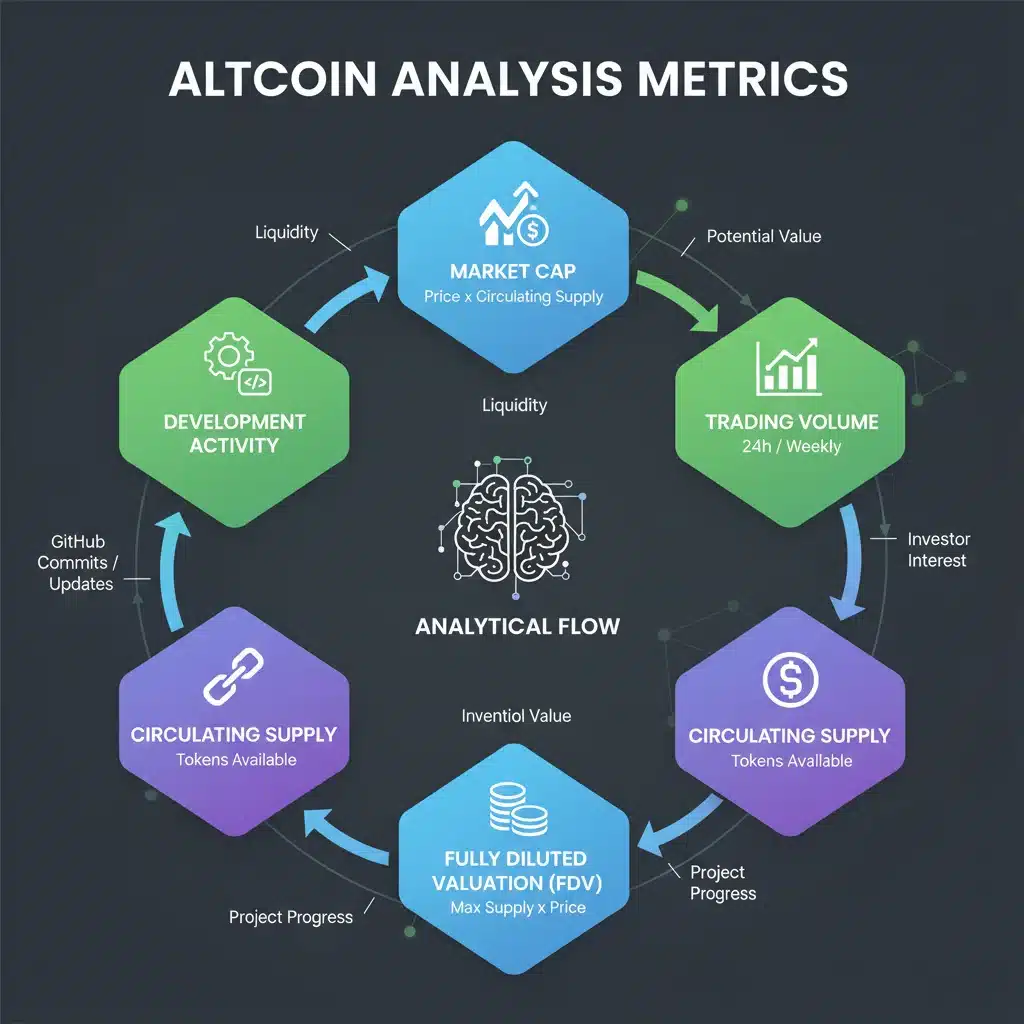
When searching for underpriced altcoins, the first metrics to scrutinize are market capitalization and valuation. Market capitalization (often shortened to market cap) is calculated by multiplying the current price of a cryptocurrency by its circulating supply. It provides a snapshot of the project’s current value in the market. However, market cap alone can be misleading. A low market cap doesn’t automatically mean an altcoin is underpriced; it could simply indicate a lack of adoption or a flawed project.
A more nuanced metric to consider is the Fully Diluted Valuation (FDV). FDV calculates the market cap if all tokens that will ever exist are in circulation. Comparing the current market cap to the FDV can reveal insights into a project’s future token supply inflation. If the FDV is significantly higher than the current market cap, it suggests that a large number of tokens are yet to be released, which could put downward pressure on the price as they enter circulation. Underpriced altcoins often have a reasonable balance between their current market cap and FDV, or a clear, transparent vesting schedule for future token releases.
Furthermore, it’s essential to compare these valuations to the project’s utility and potential. Is a project with a $100 million market cap genuinely solving a pressing problem or introducing a truly innovative technology? Or is it merely a speculative asset with little real-world application? Underpriced altcoins typically possess strong fundamentals that are not yet fully reflected in their market valuation.
Another critical aspect of valuation is the project’s competitive landscape. How does its market cap compare to similar projects in the same niche? If a project offers superior technology, a stronger team, or a larger user base but has a significantly lower market cap than its competitors, it might be an underpriced opportunity. This comparative analysis helps to contextualize the valuation and identify potential discrepancies.
Deep Dive into Tokenomics: The Engine of Value
Tokenomics, a portmanteau of ‘token’ and ‘economics,’ refers to the economic principles governing a cryptocurrency’s creation, distribution, and management. It is arguably one of the most crucial factors in identifying underpriced altcoins. Poorly designed tokenomics can undermine even the most innovative projects, while robust tokenomics can propel a project to significant heights.
Supply and Demand Dynamics
At its core, tokenomics revolves around supply and demand. Understanding the total supply, circulating supply, and emission schedule is paramount. Projects with a high inflation rate or an excessively large total supply that will be released quickly can experience significant selling pressure, making it difficult for the price to appreciate. Conversely, projects with a fixed or deflationary supply, or a well-managed emission schedule that aligns with adoption, tend to hold value better and offer greater potential for price appreciation.
Utility and Value Accrual
What is the utility of the token within its ecosystem? Does it serve a genuine purpose, such as governance, staking, payment for services, or access to exclusive features? Tokens with strong utility are more likely to attract and retain users, creating organic demand. Furthermore, how does the token accrue value? Does it capture a portion of the platform’s fees? Is it burned with each transaction, reducing supply? Underpriced altcoins often have well-defined value accrual mechanisms that incentivize holding and usage.
Distribution and Vesting Schedules
The distribution of tokens among early investors, the team, advisors, and the public is another critical aspect. A highly centralized distribution, where a large percentage of tokens are held by a few entities, can pose risks of market manipulation. Transparent vesting schedules, which dictate when team and early investor tokens are released, are crucial. Long vesting periods indicate a team’s long-term commitment to the project and prevent large dumps that could depress the price. Projects with fair and decentralized distribution, coupled with sensible vesting, are more likely to be underpriced altcoins.
Staking and Governance
Many altcoins offer staking rewards, allowing holders to earn passive income by locking up their tokens to support network operations. Attractive staking rewards can reduce the circulating supply and incentivize long-term holding. Similarly, governance tokens empower holders to participate in decision-making processes, giving them a voice in the project’s future development. Projects with strong staking and governance models often demonstrate a robust and engaged community, a key indicator of potential long-term success.
Analyzing Development Activity and Team Strength
A cryptocurrency project is only as strong as its underlying technology and the team behind it. Data-driven analysis of development activity and team strength can provide invaluable insights into a project’s long-term viability and potential to be an underpriced altcoin.
Code Commits and GitHub Activity
For open-source projects, which most cryptocurrencies are, GitHub is a treasure trove of information. Regular code commits, pull requests, and active discussions indicate a dedicated and productive development team. A project with consistent, high-quality development activity is far more likely to deliver on its roadmap and adapt to evolving technological demands. Conversely, a stagnant GitHub repository with infrequent updates can be a red flag, suggesting a lack of progress or even abandonment.
Tools like Santiment, CoinGecko, and CoinMarketCap often provide metrics on developer activity, aggregating data from various sources. Looking beyond just the number of commits, it’s important to assess the quality and significance of these updates. Are they minor bug fixes, or are they substantial improvements and new feature implementations? Underpriced altcoins typically exhibit strong, sustained development efforts.
Team Experience and Transparency
Who are the individuals leading the project? Do they have a proven track record in blockchain, technology, or relevant industries? A team with extensive experience, successful past projects, and a clear vision inspires confidence. Transparency is also key; a team that openly communicates its progress, challenges, and future plans builds trust within the community. Anonymous teams, while not inherently bad, introduce an additional layer of risk that investors should carefully consider.
Researching the team’s LinkedIn profiles, past projects, and any public interviews or presentations can provide valuable context. Look for advisors who bring genuine expertise and connections to the project. A strong team often attracts talent and partnerships, further bolstering the project’s potential.
Roadmap and Milestones
A well-defined roadmap outlines the project’s future development plans and key milestones. Does the team consistently meet its targets? Are the milestones ambitious yet achievable? A project that regularly delivers on its roadmap demonstrates competence and reliability. Conversely, a roadmap that is constantly delayed or lacks clear objectives can signal organizational issues. Underpriced altcoins are often those that are diligently working towards and achieving their outlined goals, sometimes ahead of market recognition.
Community Engagement and Social Sentiment
In the decentralized world of cryptocurrency, community plays a pivotal role. A strong, engaged community can act as a powerful marketing force, provide valuable feedback, and contribute to the project’s resilience. Analyzing community engagement and social sentiment can offer qualitative insights into a project’s potential to be an underpriced altcoin.
Active Community Channels
Monitor official community channels such as Telegram, Discord, Reddit, and Twitter. Is the community active and growing? Are discussions constructive and focused on the project’s technology and utility, or are they primarily driven by price speculation? A healthy community fosters organic growth and provides a robust support system for the project. Look for projects where the team actively engages with the community, answers questions, and solicits feedback.
Social Media Presence and Sentiment
Social media platforms like Twitter are hubs for crypto discussions. Track the project’s follower count, engagement rates, and the overall sentiment surrounding it. Are influencers discussing the project positively? Are there genuine conversations, or is it mostly bots and shilling? Tools for social sentiment analysis can help gauge public perception. While hype can be fleeting, sustained positive sentiment driven by genuine interest in the project’s fundamentals is a good sign for underpriced altcoins.
Partnerships and Integrations
Strategic partnerships with other blockchain projects, traditional businesses, or technology providers can significantly enhance a project’s credibility and adoption. These collaborations often indicate real-world utility and market acceptance. Researching a project’s partnerships can reveal its integration into the broader ecosystem and its potential for future growth. A project with significant, yet perhaps underreported, partnerships might be an underpriced altcoin waiting to be discovered.
Macroeconomic Factors and Market Cycles
While project-specific fundamentals are crucial, the broader macroeconomic environment and cryptocurrency market cycles significantly influence altcoin performance. Ignoring these external factors would be a grave mistake when seeking underpriced altcoins for 2026.
Interest Rates and Inflation
Traditional financial markets, particularly interest rates and inflation, have an indirect but powerful impact on crypto. High inflation often leads central banks to raise interest rates, which can make riskier assets like cryptocurrencies less attractive compared to safer, yield-bearing investments. Conversely, periods of low interest rates and high liquidity can fuel speculative investments in crypto. Monitoring global economic indicators is essential for understanding the overall risk appetite of investors.
Regulatory Landscape
The regulatory environment for cryptocurrencies is constantly evolving. Favorable regulations can pave the way for institutional adoption and greater mainstream acceptance, while restrictive regulations can stifle innovation and deter investment. Keeping an eye on regulatory developments in major economic blocs (e.g., US, EU, Asia) can provide insights into the future trajectory of the crypto market. Projects that are proactive in navigating regulatory challenges or are built with compliance in mind might be better positioned for long-term success, potentially making them underpriced altcoins in the current uncertain climate.
Bitcoin’s Influence and Altcoin Seasons
Bitcoin’s performance often dictates the overall direction of the crypto market. When Bitcoin enters a bull run, capital typically flows into BTC first, and then, as Bitcoin’s gains consolidate, it often rotates into altcoins, leading to an ‘altcoin season.’ Identifying underpriced altcoins involves understanding where we are in the broader market cycle. Investing in altcoins during a Bitcoin accumulation phase, before the broader altcoin market heats up, can yield significant returns.
Historically, altcoin seasons follow Bitcoin’s major price movements. As Bitcoin gains traction and captures market attention, investors often look for higher-risk, higher-reward opportunities in altcoins. This rotation of capital can lead to explosive growth for well-positioned altcoins. Therefore, timing your investments in underpriced altcoins with an understanding of these cycles is crucial.

Advanced Metrics and Tools for Discovery
Beyond the fundamental analysis, several advanced metrics and tools can aid in uncovering underpriced altcoins. These often require a deeper understanding of blockchain technology and on-chain data.
On-Chain Metrics
On-chain data provides a transparent view of network activity directly from the blockchain. Key metrics include:
- Active Addresses: The number of unique addresses sending or receiving tokens. A growing number indicates increasing adoption and usage.
- Transaction Volume: The total value of transactions processed on the network. Sustained high transaction volume suggests genuine utility and demand.
- Developer Activity (refined): Beyond GitHub, look at the number of unique developers, core contributors, and the frequency of updates to core protocols.
- Whale Activity: Tracking large wallet movements can sometimes indicate insider knowledge or significant institutional interest. While not a standalone indicator, it can be a supplementary data point.
Valuation Models
While traditional valuation models like discounted cash flow (DCF) are challenging to apply directly to cryptocurrencies, adaptations exist. For instance, some analysts use variations of the ‘Metcalfe’s Law’ (which states that the value of a telecommunications network is proportional to the square of the number of connected users of the system) to estimate network value based on active users. Others focus on price-to-sales ratios (if the project generates revenue) or compare market cap to total value locked (TVL) for DeFi protocols. Developing or utilizing these models can help identify discrepancies between intrinsic value and market price, pointing to underpriced altcoins.
Screeners and Analytics Platforms
Leverage cryptocurrency screeners and analytics platforms like CoinGecko, CoinMarketCap, Messari, Santiment, and Nansen. These platforms offer filters and data aggregation that can help you narrow down your search based on specific criteria (e.g., market cap range, category, recent price performance, developer activity). Many provide advanced charts and indicators that are invaluable for a data-driven approach.
Risk Management and Portfolio Diversification
Even with the most rigorous data-driven analysis, investing in underpriced altcoins carries significant risks. The crypto market is inherently volatile, and many projects fail. Therefore, robust risk management and portfolio diversification are paramount.
Allocate Wisely
Never invest more than you can afford to lose. Altcoins, especially those considered ‘underpriced,’ are often higher-risk investments. A small percentage of your overall investment portfolio should be allocated to these speculative assets. This ensures that even if a few projects don’t pan out, your overall financial health remains intact.
Diversify Your Holdings
Don’t put all your eggs in one basket. Diversify your altcoin holdings across different sectors (DeFi, NFTs, Layer 1s, gaming, privacy coins, etc.), different market caps, and different levels of maturity. This strategy reduces the impact of any single project’s failure on your portfolio. A well-diversified portfolio of underpriced altcoins can maximize your chances of catching the next big winner.
Continuous Monitoring and Rebalancing
The cryptocurrency market evolves rapidly. What is underpriced today might be overvalued tomorrow, or a promising project could encounter unforeseen challenges. Continuously monitor your investments, review project updates, and stay informed about market trends. Periodically rebalance your portfolio to lock in profits, cut losses, and reallocate capital to new underpriced opportunities. This active management is crucial for long-term success.
The Path to 2026: Patience and Conviction
Identifying underpriced altcoins for 2026 is not a get-rich-quick scheme. It requires patience, diligence, and conviction in your research. The market will undoubtedly experience ups and downs, and it’s during these periods of volatility that many investors capitulate. Those who have done their homework, understand the fundamentals, and maintain a long-term perspective are most likely to reap significant rewards.
The next few years are poised to be transformative for the blockchain and cryptocurrency space. As technology matures, adoption grows, and regulatory frameworks become clearer, the potential for innovative altcoins to disrupt traditional industries and create new economies is immense. By applying a data-driven approach, focusing on strong fundamentals, and managing risks effectively, you can position yourself to discover the underpriced altcoins that will define the next chapter of the crypto revolution.
Remember, the goal is not just to find a project with a low price, but to find a project whose current price does not accurately reflect its intrinsic value and future potential. This nuanced understanding, backed by thorough data analysis, is the cornerstone of successful altcoin investing. Happy hunting for those underpriced altcoins!