FFIEC Crypto Security: 7 Steps for US Investors by Q3 2026
New FFIEC Guidelines for Crypto Security: 7 Steps US Investors Must Take by Q3 2026 for Wallet Protection (Recent Updates, Practical Solutions)
The landscape of digital assets is constantly evolving, bringing with it both unprecedented opportunities and significant risks. As cryptocurrencies become more integrated into the mainstream financial system, regulatory bodies are stepping up their efforts to ensure the safety and soundness of these assets. Among the most influential of these bodies is the Federal Financial Institutions Examination Council (FFIEC), which has recently issued new guidelines on FFIEC crypto security. These guidelines are not just for financial institutions; they have profound implications for US investors, dictating critical steps that must be taken to protect digital wallets and comply with emerging standards.
The deadline of Q3 2026 is rapidly approaching, and understanding these new directives is paramount for any US investor holding or dealing with cryptocurrencies. Failure to adhere to these evolving standards could result in significant financial losses, regulatory penalties, and compromised asset security. This comprehensive guide will break down the FFIEC’s recent updates, outline 7 essential steps US investors must implement, and provide practical solutions to ensure robust wallet protection in the face of these new requirements. Our focus is on providing actionable insights that empower you to proactively secure your digital assets.
Understanding the FFIEC’s Role in Crypto Security
The FFIEC is a formal interagency body empowered to prescribe uniform principles, standards, and report forms for the federal examination of financial institutions. Its primary goal is to promote uniformity in the supervision of financial institutions by various federal and state regulatory agencies. While its direct purview is over banks and credit unions, its pronouncements inevitably set the standard for best practices across the broader financial ecosystem, including how these institutions interact with and manage crypto assets. This, in turn, influences the expectations placed upon individual investors and the platforms they use.
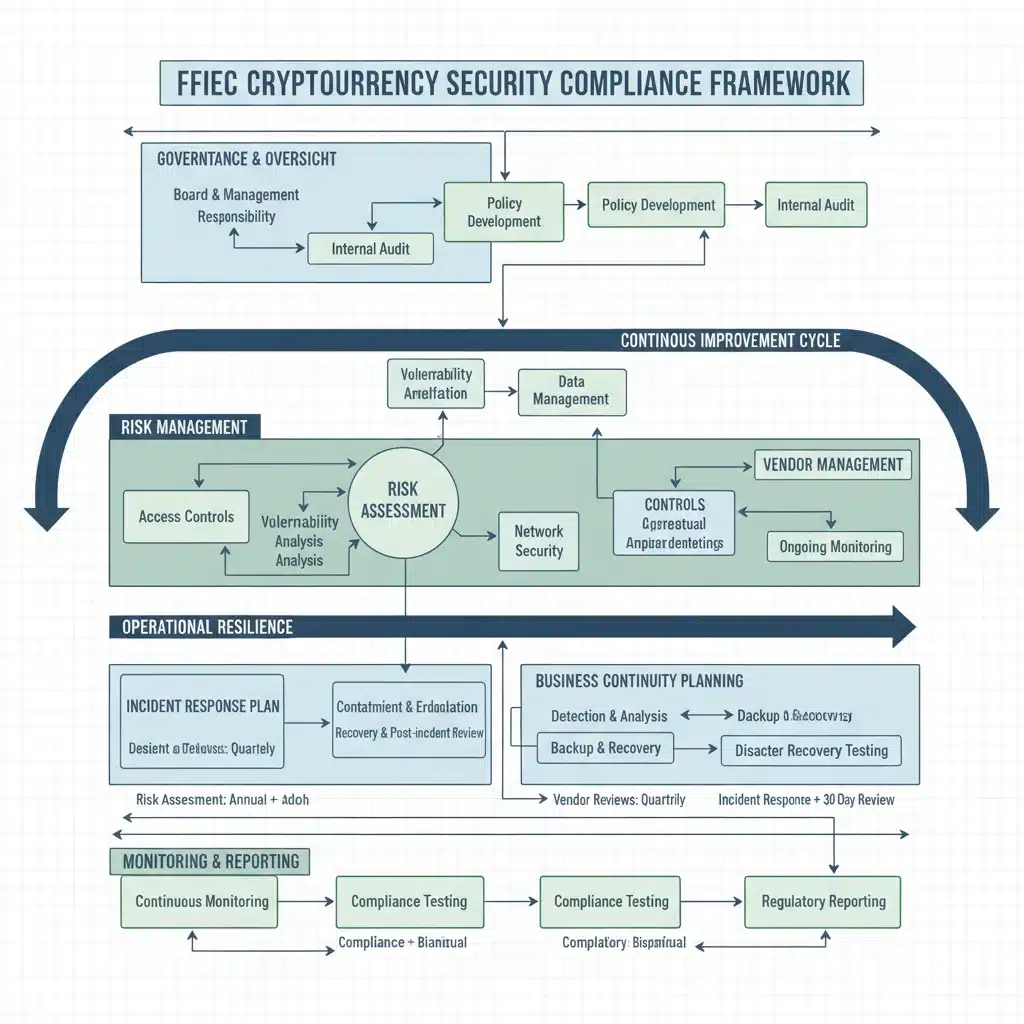
Recent FFIEC statements and guidance emphasize the inherent risks associated with crypto assets, including volatility, liquidity risk, illicit finance activities, and most critically, cybersecurity risks. The FFIEC expects financial institutions to have robust risk management frameworks in place to address these concerns. For US investors, this translates into a heightened need for personal vigilance and the adoption of sophisticated security measures that mirror, in principle, those expected of regulated entities. The guidelines are designed to create a safer, more transparent, and more resilient crypto environment, ultimately benefiting informed investors who prioritize wallet protection.
The Imperative for US Investors: Why Q3 2026 Matters for FFIEC Crypto Security
The Q3 2026 deadline isn’t a hard-and-fast regulatory mandate directly imposed on individual investors in the same way it is on financial institutions. However, its implications are far-reaching and critical. By this date, regulated financial institutions are expected to have implemented comprehensive risk management programs and controls related to their crypto-asset activities, aligning with the FFIEC’s guidance. This institutional shift will inevitably impact the services available to investors, the security standards of platforms they use, and potentially even future tax and reporting requirements.
For US investors, Q3 2026 serves as a crucial benchmark. It signifies the point by which the financial ecosystem dealing with crypto assets should have matured significantly in terms of security and compliance. Investors who have not adapted their own practices by this time may find themselves:
- Vulnerable to Exploits: Without updated security practices, digital assets remain susceptible to sophisticated cyberattacks.
- Limited Access to Services: Financial institutions may restrict services to investors who do not meet certain security or verification standards.
- Non-compliant with Evolving Norms: Future regulations, potentially stemming from FFIEC’s foundational work, might place formal demands on individual asset holders.
- At a Disadvantage: Proactive measures now will ensure a smoother transition into a more regulated and secure crypto future.
Therefore, while not a direct personal mandate, treating Q3 2026 as a personal deadline for enhancing your FFIEC crypto security measures is a strategic move for any serious US investor.
7 Essential Steps for US Investors to Enhance FFIEC Crypto Security by Q3 2026
The FFIEC’s guidance, while complex, boils down to several core principles: robust risk management, strong cybersecurity, and operational resilience. For individual US investors, these principles translate into actionable steps. Here are 7 crucial measures to implement by Q3 2026:
Step 1: Conduct a Comprehensive Digital Asset Risk Assessment
Before you can protect your assets, you need to understand the specific risks they face. This step mirrors the FFIEC’s expectation for financial institutions to perform thorough risk assessments. For an individual investor, this involves:
- Identifying All Digital Assets: List every cryptocurrency, NFT, or token you own and where it’s stored (exchanges, hot wallets, cold wallets).
- Assessing Storage Methods: Evaluate the security of each storage method. Are your exchange accounts protected by strong 2FA? Are your hot wallets connected to reputable DApps? Is your hardware wallet firmware up-to-date?
- Understanding Exposure: Consider how your assets might be exposed – through phishing attempts, malware, insecure internet connections, or even physical theft of devices.
- Evaluating Counterparty Risk: If you use centralized exchanges or DeFi protocols, understand the risks associated with those platforms (e.g., potential hacks, regulatory actions, smart contract vulnerabilities).
- Reviewing Transaction History: Regularly audit your transaction history for any unauthorized activity.
Practical Solution: Create a detailed spreadsheet or use a portfolio tracker to document all your holdings, their storage locations, and the security features enabled for each. Regularly update this document.
Step 2: Implement Multi-Factor Authentication (MFA) Universally
This is a foundational cybersecurity principle emphasized by the FFIEC across all digital interactions. For crypto assets, MFA is non-negotiable.
- Beyond SMS: While SMS 2FA is better than nothing, it’s vulnerable to SIM-swap attacks. Prioritize authenticator apps (e.g., Google Authenticator, Authy) or, even better, hardware security keys (e.g., YubiKey) for all critical accounts.
- Exchange Accounts: Ensure every cryptocurrency exchange account has strong MFA enabled.
- Wallet Access: If your software wallet supports it, enable MFA for access.
- Email Accounts: Secure the email address associated with your crypto accounts with the strongest possible MFA, as this is often the recovery point for other services.
Practical Solution: Audit all your online accounts, starting with crypto exchanges and email, and upgrade to hardware security key-based MFA wherever possible. For accounts that don’t support hardware keys, use authenticator apps.
Step 3: Secure Your Digital Wallets with Best Practices
Wallet protection is at the heart of FFIEC crypto security for investors. The FFIEC expects institutions to have robust controls over digital asset custody, and investors should adopt similar diligence.
- Hardware Wallets for Cold Storage: For significant holdings, hardware wallets (e.g., Ledger, Trezor) offer the best protection against online threats. They keep your private keys offline.
- Seed Phrase Management: Your seed phrase (recovery phrase) is the master key to your funds. Store it offline, in a secure, fireproof, and waterproof location. Never store it digitally or share it. Consider splitting it and storing parts in different secure locations.
- Software Wallet Prudence: Use reputable software wallets, keep them updated, and only connect them to trusted decentralized applications (DApps). Be wary of phishing sites.
- Regular Backups: Ensure you have secure, offline backups of any wallet data necessary for recovery, beyond just the seed phrase if applicable.
Practical Solution: Invest in at least one hardware wallet for long-term holdings. Practice the process of recovering a wallet from a seed phrase with a small amount of crypto on a test device to ensure your backup method works, before trusting it with significant assets.
Step 4: Practice Prudent Transaction Management and Verification
FFIEC guidance emphasizes the need for strong internal controls over transactions. For investors, this means meticulous care with every single transaction.
- Verify Addresses: Always double-check recipient addresses before sending crypto. Copy-pasting can be compromised by malware that swaps addresses. Consider using address books for frequently used addresses.
- Small Test Transactions: For large transfers, send a small test amount first to confirm the address is correct and the transaction goes through successfully before sending the full amount.
- Understand Network Fees: Be aware of network fees and transaction speeds for different blockchains to avoid unexpected costs or delays.
- Review Smart Contract Interactions: When interacting with DeFi or NFTs, carefully review the permissions you grant to smart contracts. Understand what access you are giving them to your wallet.
Practical Solution: Adopt a “verify, then send” mantra. Use a second device or method to cross-reference addresses. For complex DeFi interactions, use tools that simulate transactions before executing them.
Step 5: Stay Informed on Phishing, Malware, and Social Engineering Tactics
Cybersecurity education is a continuous process, and the FFIEC expects financial institutions to train their employees. Investors must similarly educate themselves to protect their FFIEC crypto security.
- Phishing Awareness: Be highly suspicious of unsolicited emails, messages, or pop-ups asking for private keys, seed phrases, or login credentials. Always navigate directly to official websites.
- Malware Protection: Use reputable antivirus software, keep your operating system and browsers updated, and avoid downloading suspicious files or clicking unknown links.
- Social Engineering: Be wary of investment scams, fake customer support, or anyone pressuring you to transfer funds. Never disclose personal information or security details over unofficial channels.
- Secure Browsing: Use secure, encrypted internet connections (VPNs, HTTPS) especially when managing sensitive financial information.
Practical Solution: Dedicate time weekly to read reputable crypto security news and updates. Bookmark official exchange and wallet support pages and use them exclusively for help. Implement a strong password manager.
Step 6: Diversify Storage and Limit Exposure on Centralized Platforms
While the FFIEC doesn’t directly tell investors how to store assets, its emphasis on minimizing concentration risk for institutions provides a good parallel. Relying solely on one platform or one type of wallet increases risk.
- Hot vs. Cold Storage: Keep only the amount of crypto you actively trade or use in hot wallets (connected to the internet) and move the majority of your holdings to cold storage (hardware wallets, paper wallets).
- Exchange Limits: Avoid keeping large sums on centralized exchanges for extended periods. While convenient, exchanges are prime targets for hackers and are subject to regulatory actions or insolvency risks.
- Geographic Diversification (for significant wealth): For very large portfolios, consider diversifying cold storage locations and even types of hardware wallets.
Practical Solution: Implement a tiered storage strategy: small amounts for daily use in a hot wallet, medium amounts for active trading on a reputable exchange (with strong MFA), and the vast majority in an offline hardware wallet.
Step 7: Develop an Incident Response and Recovery Plan
The FFIEC requires institutions to have robust incident response plans. As an investor, you should also have a plan for what to do if the worst happens.
- Emergency Contacts: Know how to contact your exchange’s support, your hardware wallet manufacturer, and potentially legal or cybersecurity professionals.
- Freezing Accounts: Understand the process for freezing accounts on exchanges if you suspect unauthorized access.
- Documentation: Keep records of all your wallet addresses, transaction IDs, and any communications with platforms.
- Regular Review: Periodically review your plan and ensure all backup information is current and accessible, but only by you.
- Cyber Insurance: While not universally available or comprehensive for crypto, explore options for cyber insurance if your holdings are substantial.

Practical Solution: Create a physical or encrypted digital document (stored securely offline) outlining your incident response steps, including contact numbers, recovery procedures, and relevant account information (excluding private keys/seed phrases). Practice a dry run of each step.
Recent Updates and Evolving Landscape of FFIEC Crypto Security
The FFIEC’s approach to crypto security is not static; it’s continuously evolving in response to technological advancements, market developments, and emerging risks. Recent updates consistently highlight the need for:
- Enhanced Due Diligence: This applies not just to financial institutions assessing crypto-related businesses but also to investors selecting platforms and services.
- Interoperability and Standardization: As the crypto space matures, there’s a push for more standardized security protocols and better interoperability between secure systems.
- Focus on stablecoins and CBDCs: The FFIEC, along with other regulators, is paying close attention to the development and risks associated with stablecoins and potential central bank digital currencies, which will undoubtedly influence broader crypto regulations.
- Supply Chain Risk Management: For institutions, this means vetting third-party vendors. For investors, it means being aware of the security posture of wallet providers, exchanges, and DApps you interact with.
Staying abreast of these changes requires continuous education and adaptability. The spirit of the FFIEC guidelines is about proactive risk management rather than reactive damage control. Investors who embrace this philosophy will be better positioned for the future of digital assets.
Practical Solutions for US Investors: Beyond the 7 Steps
While the seven steps provide a robust framework, true FFIEC crypto security for US investors also involves integrating these practices into a broader, security-conscious lifestyle. Here are additional practical solutions:
- Dedicated Devices: Consider using a dedicated, air-gapped device (e.g., an old laptop wiped clean and never connected to the internet) for generating and storing private keys or seed phrases.
- Network Security: Ensure your home Wi-Fi network is secure with a strong password and WPA3 encryption if available. Avoid public Wi-Fi for crypto transactions.
- Professional Advice: For substantial holdings, consult with a financial advisor specializing in digital assets or a cybersecurity expert to review your overall security posture.
- Community Engagement: Follow reputable crypto security researchers and communities. Often, early warnings about new threats emerge from these sources.
- Understand Tax Implications: While not directly security-related, understanding the tax implications of your crypto transactions (and keeping meticulous records) is another facet of responsible digital asset management that often goes hand-in-hand with regulatory compliance.
- Regular Security Audits: Treat your personal crypto security like a mini-audit. Periodically (e.g., quarterly) review all your security settings, update passwords, and check for any suspicious activity.
The Future of FFIEC Crypto Security and Investor Readiness
The FFIEC’s guidelines are a clear signal that the era of unregulated, ‘Wild West’ crypto is drawing to a close. As the digital asset space matures, regulatory oversight will only intensify, driven by goals of financial stability, consumer protection, and combating illicit finance. For US investors, this means that proactive engagement with security best practices is no longer optional; it is a fundamental requirement for participating safely and successfully in the crypto economy.
By diligently implementing the 7 steps outlined above and staying informed about recent updates, US investors can not only protect their digital wallets but also position themselves advantageously for the future. The Q3 2026 deadline serves as a powerful reminder to take action now, ensuring that your FFIEC crypto security measures are robust, compliant, and ready for the evolving demands of the digital financial world.
The journey towards comprehensive digital asset security is continuous. It requires vigilance, education, and adaptability. By taking these steps, you are not just complying with potential future mandates; you are safeguarding your financial future in the rapidly expanding digital frontier.