Decentralized Identity Solutions 2026: Web3 Technologies for Privacy and Fraud Prevention

Decoding Decentralized Identity Web3: The Future of Privacy and Fraud Prevention in 2026
In an increasingly digital world, the concept of identity has undergone a profound transformation. From physical documents to centralized digital profiles, our personal information has often been a commodity, prone to breaches, misuse, and fraud. However, as we stand on the cusp of 2026, a revolutionary paradigm is taking hold: Decentralized Identity Web3. This isn’t just an incremental improvement; it’s a fundamental shift in how we own, control, and share our identity, promising unprecedented levels of privacy and robust fraud prevention.
The promise of Web3 – a decentralized internet built on blockchain technology – is finally maturing, and nowhere is its impact more keenly felt than in the realm of identity. Traditional identity systems, often managed by large corporations or governments, create honeypots of sensitive data, making them prime targets for cybercriminals. In contrast, Decentralized Identity Web3 empowers individuals with self-sovereignty, meaning they have complete control over their digital identities and personal data.
This comprehensive guide will delve into the core principles of Decentralized Identity Web3, explore the key Web3 technologies driving its adoption, and illuminate how these solutions are poised to redefine privacy and combat fraud by 2026. We will examine the intricate workings of Self-Sovereign Identity (SSI), the power of Verifiable Credentials (VCs), and the foundational role of blockchain in creating a more secure and private digital future.
The Urgency for Decentralized Identity in a Centralized World
Before we dive into the intricacies of Decentralized Identity Web3, it’s crucial to understand why this shift is not merely desirable but essential. The current centralized model of identity management is fundamentally flawed. Every time we create an account online, we entrust an organization with a piece of our identity. This leads to a fragmented digital existence where our data is scattered across countless databases, each a potential point of failure. The consequences are severe:
- Data Breaches: High-profile data breaches are a weekly occurrence, exposing millions of personal records and leading to identity theft.
- Lack of User Control: Individuals have minimal say in how their data is collected, stored, and used. Opt-out options are often buried in lengthy terms and conditions.
- Fraud and Impersonation: The ease with which identities can be faked or stolen in centralized systems fuels a multi-billion dollar fraud industry.
- Surveillance and Privacy Erosion: Centralized data collection enables extensive surveillance, eroding fundamental privacy rights.
- Inefficiency and Redundancy: Repeatedly proving identity across different services is time-consuming and inefficient for both users and organizations.
These challenges highlight the urgent need for a more resilient, user-centric, and secure approach to identity. This is precisely where Decentralized Identity Web3 steps in, offering a robust alternative that puts the individual back in control.
Understanding Self-Sovereign Identity (SSI): The Cornerstone of Decentralized Identity Web3
At the heart of Decentralized Identity Web3 lies the concept of Self-Sovereign Identity (SSI). SSI is a framework that grants individuals ultimate ownership and control over their digital identities without reliance on a central authority. It’s about shifting from an identity system where others define and manage who you are, to one where you are the sole arbiter of your identity.
Key principles of SSI include:
- User Control: Individuals manage their own identifiers and identity data.
- Privacy by Design: Personal data is only shared when necessary and with explicit consent.
- Portability: Identity data is not tied to a single platform or provider.
- Persistence: Identity remains constant and accessible, regardless of changes in service providers.
- Interoperability: Identity solutions can work across different systems and platforms.
- Consent: Users explicitly grant permission for data sharing.
- Minimization: Only the necessary information is disclosed.
In practice, SSI means you hold your identity credentials in a secure digital wallet (often a mobile app), and you decide exactly which pieces of information to share with whom, and for how long. This granular control is a game-changer for privacy and security, and it’s a foundational element of how Decentralized Identity Web3 operates.
Verifiable Credentials (VCs): The Building Blocks of Trust in Decentralized Identity Web3
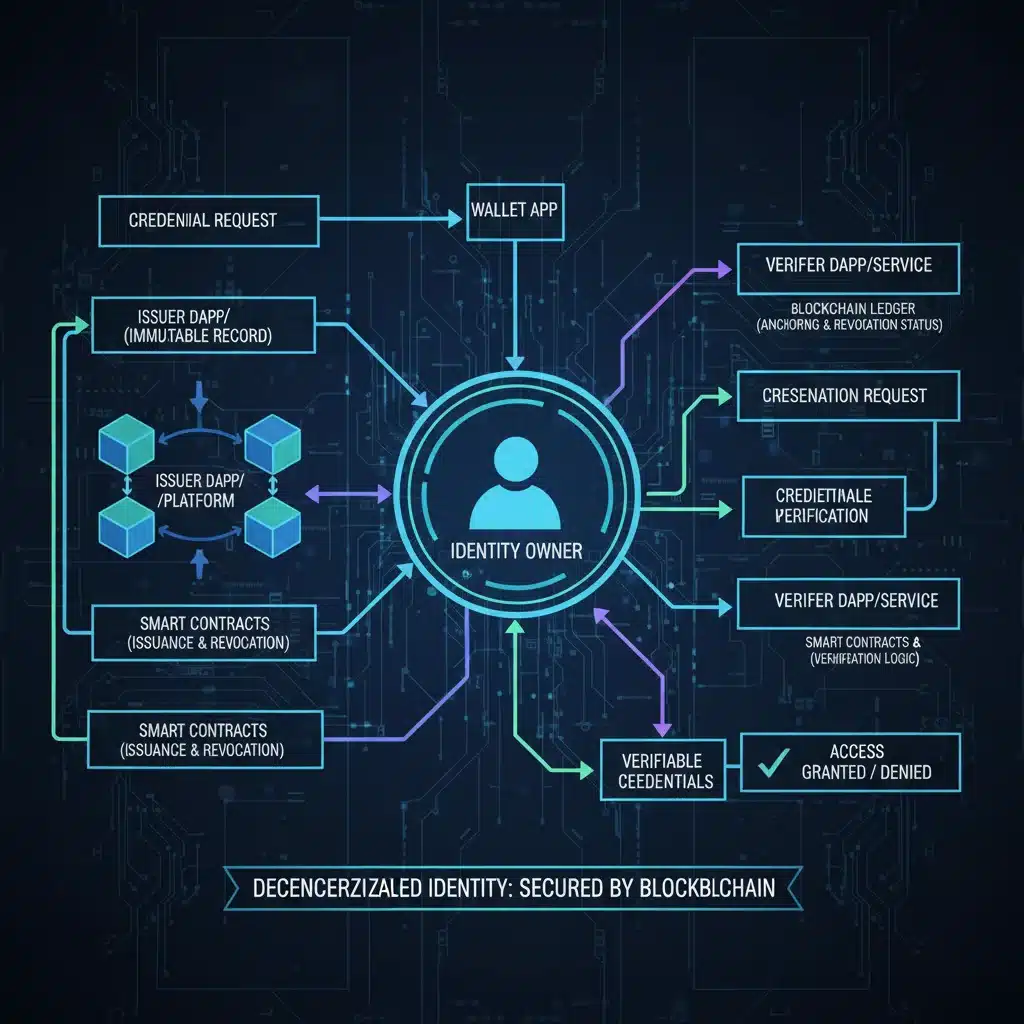
How does SSI actually work in the context of Decentralized Identity Web3? The answer lies in Verifiable Credentials (VCs). VCs are tamper-proof digital attestations of attributes or qualifications, issued by trusted entities (like governments, universities, or employers) and cryptographically secured on a blockchain. Think of them as digital versions of your driver’s license, university degree, or professional certification, but with enhanced security and privacy features.
Here’s how VCs function within the Decentralized Identity Web3 ecosystem:
- Issuer: An organization (e.g., a university) issues a digital credential (e.g., a degree) to an individual. This credential is cryptographically signed by the issuer.
- Holder: The individual receives and stores this Verifiable Credential in their secure digital wallet. They are the sole holder of this credential.
- Verifier: When the individual needs to prove an attribute (e.g., their degree to a potential employer), they present the VC from their wallet to a verifier.
- Verification: The verifier uses the blockchain to confirm the authenticity of the issuer’s signature and the integrity of the credential, without needing to contact the issuer directly or see any unnecessary personal data.

The beauty of VCs in Decentralized Identity Web3 is their selective disclosure capability. Instead of showing your entire driver’s license to prove you’re over 21, you can simply present a VC that cryptographically confirms your age without revealing your name, address, or license number. This minimizes the data shared, drastically reducing the risk of data breaches and enhancing privacy.
Blockchain: The Unifying Ledger for Decentralized Identity Web3
While SSI defines the philosophy and VCs are the data structures, blockchain technology provides the underlying infrastructure that makes Decentralized Identity Web3 possible. Blockchain acts as a distributed, immutable ledger that securely records the issuance and revocation of identifiers and credentials, without storing the sensitive personal data itself.
Here’s blockchain’s critical role in Decentralized Identity Web3:
- Decentralized Identifiers (DIDs): Blockchain enables the creation of DIDs, which are globally unique, cryptographically verifiable identifiers that are controlled by the individual, not a central authority. These DIDs are distinct from traditional identifiers (like email addresses or usernames) because they are self-owned and not tied to any single organization.
- Immutability: Once a record (like a credential issuance event or revocation) is added to the blockchain, it cannot be altered or deleted. This ensures the integrity and trustworthiness of credentials.
- Transparency (Selective): While personal data remains private, the public nature of the blockchain allows for transparent verification of credential authenticity and issuer identity, without exposing sensitive information.
- Security: The cryptographic nature of blockchain, combined with its distributed architecture, makes it highly resistant to tampering and fraud.
- Trust Anchors: Blockchain acts as a trust anchor, providing a reliable and verifiable source for checking the validity of DIDs and VCs.
Without blockchain, the principles of SSI and the functionality of VCs would lack the necessary decentralized trust and security infrastructure. It is the fundamental backbone of Decentralized Identity Web3, ensuring that identity remains robust, private, and resilient against attack.
Enhancing Privacy with Decentralized Identity Web3 in 2026
The privacy implications of Decentralized Identity Web3 are profound. In 2026, we anticipate a significant shift from the current surveillance economy to one where individuals have granular control over their digital footprint. Here’s how:
- Minimized Data Sharing: With VCs, users only share the absolute minimum information required for a transaction or verification. For instance, proving age without disclosing date of birth or full name.
- No Centralized Honeypots: Since personal data isn’t stored in massive, centralized databases, the risk of large-scale data breaches is drastically reduced.
- User Consent and Revocation: Individuals explicitly consent to data sharing and can revoke access at any time, giving them true agency over their information.
- Pseudonymity and Anonymity: Decentralized Identity Web3 supports the use of multiple DIDs, allowing users to maintain different personas for various contexts, enhancing pseudonymity where full identity disclosure isn’t required.
- No More Tracking via Centralized Logins: By eliminating the need for single sign-on providers that track user activity across sites, Decentralized Identity Web3 significantly curtails pervasive online tracking.
By 2026, imagine a world where you can prove your eligibility for a service, verify your professional qualifications, or confirm your age without ever exposing more data than strictly necessary. This is the privacy promise of Decentralized Identity Web3.
Preventing Fraud with Decentralized Identity Web3 in 2026
Fraud is a persistent and costly problem in the digital age. Identity theft, account takeovers, and synthetic identity fraud cost billions annually. Decentralized Identity Web3 offers powerful mechanisms to combat these threats, creating a more secure digital environment by 2026:
- Tamper-Proof Credentials: VCs are cryptographically signed and stored on a blockchain, making them virtually impossible to forge or alter without detection. Any attempt to tamper with a credential would immediately invalidate it.
- Authentic Issuer Verification: Verifiers can cryptographically confirm the identity of the issuer of a credential on the blockchain, eliminating the risk of fake credentials being issued by imposters.
- Reduced Impersonation: By linking credentials directly to self-sovereign DIDs controlled by the individual, it becomes significantly harder for malicious actors to impersonate legitimate users.
- Simplified and Secure KYC/AML: Know Your Customer (KYC) and Anti-Money Laundering (AML) processes, often cumbersome and data-intensive, can be streamlined and secured using VCs. Users can present verified identity attributes without repeatedly submitting sensitive documents to every service provider.
- Enhanced Non-Repudiation: The cryptographic signatures embedded in VCs provide strong non-repudiation, meaning an issuer cannot deny having issued a credential, and a holder cannot deny having presented it.
- Faster and More Reliable Verification: The instantaneous and automated verification of VCs reduces human error and speeds up onboarding processes, while simultaneously increasing security.
The combination of immutable records, cryptographic proof, and user-centric control makes Decentralized Identity Web3 a formidable weapon against various forms of digital fraud. Organizations will spend less on fraud detection and recovery, and individuals will suffer less from identity-related crimes.
Key Web3 Technologies Driving Decentralized Identity Adoption
Beyond the core concepts of SSI, VCs, and blockchain, several specific Web3 technologies are instrumental in bringing Decentralized Identity Web3 to fruition:
1. Blockchain Networks (e.g., Ethereum, Polygon, Solana, Hyperledger Fabric)
Different blockchain networks offer varying characteristics that make them suitable for Decentralized Identity Web3. Public blockchains like Ethereum and Polygon provide broad decentralization and censorship resistance, while enterprise-grade solutions like Hyperledger Fabric offer privacy and permissioned access for specific organizational needs. The choice of blockchain depends on the specific use case and requirements for scalability, privacy, and cost.
2. Decentralized Identifiers (DIDs) and DID Methods
DIDs are the foundational unique identifiers in Decentralized Identity Web3. A DID method specifies how a DID is created, resolved, updated, and deactivated on a particular network. The W3C (World Wide Web Consortium) has standardized DIDs, ensuring interoperability across different implementations. These methods allow DIDs to be anchored to various blockchains or even non-blockchain distributed ledgers, providing flexibility and resilience.
3. Digital Wallets (Holder Agents)
Digital wallets, often referred to as ‘holder agents’ in the SSI context, are secure applications (typically on smartphones) where individuals store their DIDs and VCs. These wallets are crucial for managing consent, presenting credentials selectively, and interacting with issuers and verifiers. The user interface and security of these wallets will be key to mass adoption of Decentralized Identity Web3.
4. Decentralized Key Management
Managing cryptographic keys securely is paramount for Decentralized Identity Web3. Solutions for decentralized key management ensure that users retain control over their private keys, which are essential for signing credentials and authenticating themselves. This often involves secure enclaves on devices, hardware security modules (HSMs), or advanced cryptographic schemes that distribute key components.
5. Zero-Knowledge Proofs (ZKPs)
Zero-Knowledge Proofs are a cutting-edge cryptographic technique that allows one party to prove to another that they possess certain information without revealing the information itself. In Decentralized Identity Web3, ZKPs can take selective disclosure to the next level. Instead of revealing a specific attribute (e.g., ‘age over 21’), a ZKP could prove that a user meets a certain condition (e.g., ‘is eligible for a loan based on credit score’) without ever exposing the credit score itself. This significantly enhances privacy and minimizes data exposure, making fraud even harder.
6. Decentralized Autonomous Organizations (DAOs) for Governance
While not directly part of the technical stack for issuing credentials, DAOs can play a crucial role in the governance of Decentralized Identity Web3 ecosystems. They can establish and enforce rules for credential issuance, revocation, and dispute resolution in a transparent and community-driven manner, further removing reliance on centralized authorities and fostering trust.
Challenges and the Road to Mass Adoption by 2026
While the vision for Decentralized Identity Web3 is compelling, its widespread adoption by 2026 faces several challenges:
- Interoperability: Ensuring that DIDs and VCs issued on one platform or blockchain are seamlessly recognized and verifiable on others is critical. Standardisation efforts by the W3C and DIF (Decentralized Identity Foundation) are addressing this.
- User Experience: The complexity of cryptographic concepts needs to be abstracted away for the average user. Intuitive digital wallets and simplified onboarding processes are essential.
- Regulatory Clarity: Governments and regulatory bodies are still grappling with how to regulate decentralized technologies. Clear legal frameworks will be necessary for mainstream enterprise and government adoption.
- Scalability: Blockchain networks need to scale to handle the immense volume of identity transactions required for global adoption. Layer 2 solutions and more efficient consensus mechanisms are continually improving this.
- Education and Awareness: A significant effort is needed to educate the public and organizations about the benefits and workings of Decentralized Identity Web3.
- Ecosystem Development: A robust ecosystem of issuers, verifiers, and wallet providers needs to emerge and mature.
Despite these hurdles, the momentum behind Decentralized Identity Web3 is undeniable. Large enterprises, governments, and technology consortia are actively investing in and piloting these solutions. By 2026, we expect to see significant progress in overcoming these challenges, leading to a noticeable adoption curve.
Real-World Applications and Future Outlook in 2026
By 2026, Decentralized Identity Web3 will likely be transforming various sectors:
- Financial Services: Streamlined KYC/AML, instant loan approvals, and secure cross-border payments with reduced fraud.
- Healthcare: Secure access to medical records, verifiable health passes, and privacy-preserving sharing of patient data for research.
- Education: Tamper-proof academic credentials, digital resumes, and verifiable professional certifications.
- Government Services: Digital citizen IDs, secure voting, and efficient access to public services.
- E-commerce and Online Services: Passwordless logins, age verification, and personalized experiences without compromising privacy.
- Supply Chain Management: Verifiable product origins and authenticity, combating counterfeiting.
The future of identity is decentralized, self-sovereign, and powered by Web3. As we move towards 2026, the convergence of blockchain, SSI, and verifiable credentials will not only dismantle the current centralized identity silos but also usher in an era of unprecedented digital privacy and robust fraud prevention. The control will shift back to the individual, creating a more trustworthy, efficient, and equitable digital world for everyone.
The journey to a fully decentralized identity ecosystem is ongoing, but the foundational technologies are in place, and the benefits are too compelling to ignore. Organizations and individuals alike must begin to understand and embrace Decentralized Identity Web3 to thrive in the digital landscape of tomorrow.