Smart Contract Audits 2026: Reduce Vulnerabilities by 30%

By 2026, US developers can achieve a 30% reduction in smart contract vulnerabilities through advanced audit methodologies, AI-driven analysis, and proactive security frameworks, ensuring robust and compliant decentralized applications.
In the rapidly evolving landscape of Web3, the integrity and security of decentralized applications hinge significantly on robust smart contracts. For US developers, the imperative to reduce vulnerabilities is more critical than ever. This guide explores how advanced strategies in smart contract audits US can lead to a remarkable 30% reduction in vulnerabilities by 2026, setting new benchmarks for digital security.
The evolving threat landscape for smart contracts
The digital frontier of 2026 presents a complex and dynamic threat landscape for smart contracts. As blockchain technology matures and permeates various industries, from finance to supply chain, the value locked in these self-executing agreements skyrockets. This increased value, coupled with the immutability of blockchain, makes smart contracts prime targets for sophisticated cyber attackers. Understanding these evolving threats is the first step towards building resilient decentralized systems.
Traditional auditing methods, while foundational, are increasingly insufficient against zero-day exploits and novel attack vectors. US developers must contend with a landscape where vulnerabilities are not just coding errors but can stem from complex inter-contract dependencies, protocol design flaws, or even oracle manipulation. The financial and reputational costs of a breach are immense, driving the urgent need for more advanced and predictive security measures.
Emerging attack vectors
- Re-entrancy attacks 2.0: More sophisticated versions exploiting cross-chain interactions and complex state changes.
- Flash loan exploits: Leveraging decentralized finance (DeFi) mechanisms for rapid, high-impact financial manipulation.
- Front-running and MEV: Miner Extractable Value (MEV) exploits continue to evolve, impacting transaction fairness and security.
- Supply chain attacks: Compromising third-party libraries or development tools used in smart contract creation.
The conclusion here is clear: the passive approach to security is obsolete. Proactive threat modeling, continuous monitoring, and an adaptive security posture are no longer optional but essential. Developers must anticipate threats, not merely react to them, to safeguard the integrity of their decentralized applications.
Integrating AI and machine learning into audit processes
The sheer volume and complexity of smart contract code make manual auditing increasingly challenging and prone to human error. By 2026, Artificial Intelligence (AI) and Machine Learning (ML) are not just supplementary tools but integral components of effective audit processes. These technologies revolutionize vulnerability detection by automating repetitive tasks, identifying subtle patterns, and even predicting potential attack vectors that human auditors might overlook.
AI-powered tools can analyze vast datasets of historical vulnerabilities, learning to recognize common patterns and anomalies in new codebases. This significantly speeds up the initial scanning phase, allowing human auditors to focus on more complex logical flaws and architectural issues. The synergy between AI and human expertise creates a far more comprehensive and efficient auditing pipeline.
AI-driven vulnerability detection
- Automated code review: AI algorithms can rapidly scan code for known vulnerabilities, coding standard violations, and potential gas inefficiencies.
- Predictive analytics: ML models can learn from past exploits to identify new, emerging attack patterns and proactively flag suspicious code structures.
- Fuzz testing enhancement: AI can intelligently generate test cases, pushing contract boundaries to uncover edge-case vulnerabilities more effectively than random fuzzing.
The integration of AI and ML transforms smart contract auditing from a reactive process into a predictive one. This shift empowers US developers to identify and mitigate risks earlier in the development lifecycle, ultimately contributing to the ambitious goal of a 30% reduction in vulnerabilities.
Advanced static analysis and formal verification techniques
Beyond the capabilities of AI, the bedrock of robust smart contract security in 2026 continues to be advanced static analysis and formal verification. These sophisticated techniques delve deep into the contract’s logic and code structure without executing it, providing mathematical proofs of correctness and identifying vulnerabilities with unparalleled precision. They are crucial for ensuring that contracts behave exactly as intended under all possible conditions.
Static analysis tools have evolved to detect not just syntactic errors but also complex logical flaws, race conditions, and re-entrancy possibilities. Formal verification, on the other hand, uses mathematical models to prove the absence of certain types of bugs, offering the highest level of assurance for critical contract functions. The combination of these methods provides a multi-layered defense against even the most subtle vulnerabilities.
Key techniques for deep analysis
- Symbolic execution: Explores all possible execution paths of a program to identify states that could lead to vulnerabilities.
- Model checking: Systematically checks if a given system model satisfies a set of formal properties, ensuring desired behavior.
- Abstract interpretation: Analyzes the runtime behavior of programs without executing them, identifying potential issues like integer overflows or underflows.
By rigorously applying advanced static analysis and formal verification, US developers can significantly enhance the reliability and security of their smart contracts, moving closer to the target of reducing vulnerabilities by 30% and building trust in the Web3 ecosystem.
The role of penetration testing and bug bounty programs
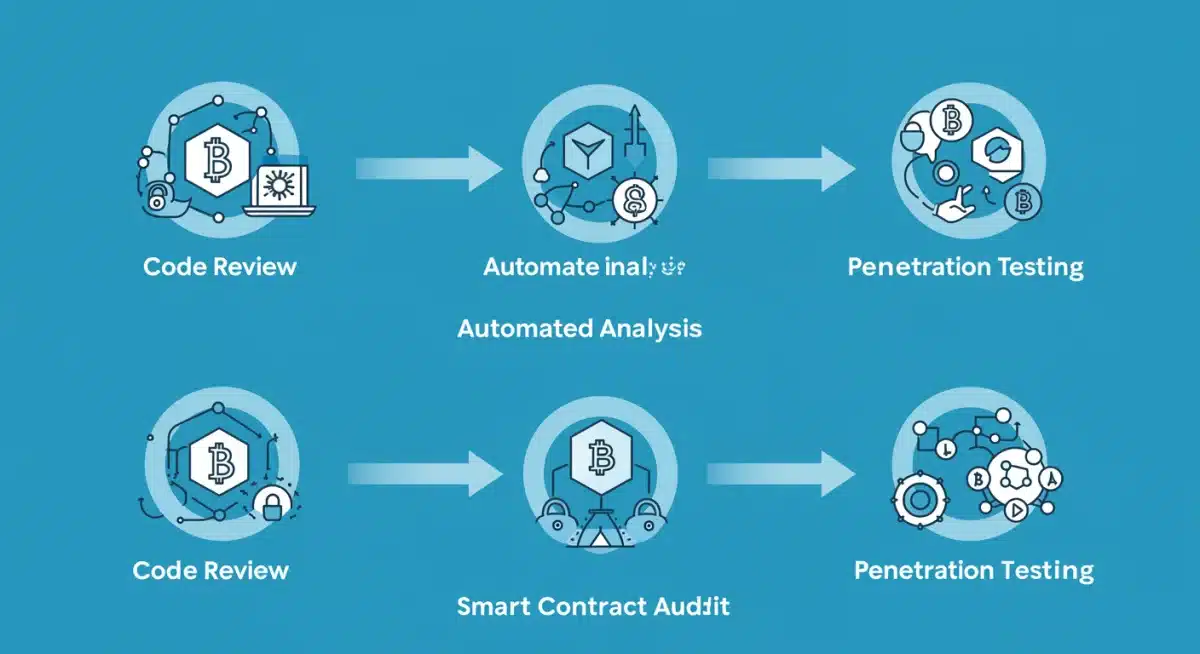
While static analysis and formal verification provide theoretical assurances, real-world security demands practical validation. Penetration testing and well-structured bug bounty programs are indispensable components of a comprehensive smart contract audit strategy. These methods actively simulate attacks and incentivize ethical hackers to find vulnerabilities before malicious actors do, providing a crucial ‘battle-testing’ phase for smart contracts.
Penetration testing involves security experts attempting to exploit a contract’s weaknesses, mimicking the tactics of real attackers. This hands-on approach can uncover vulnerabilities that automated tools might miss, especially those related to complex business logic or unexpected user interactions. Bug bounty programs, by democratizing vulnerability discovery, extend this testing to a global community of security researchers, leveraging collective intelligence to strengthen security.
Effective security validation strategies
- Red team engagements: Simulated attacks by an independent team to test the contract’s resilience and incident response capabilities.
- White box penetration testing: Testers have full knowledge of the contract’s code, allowing for deep dives into internal logic and potential exploits.
- Structured bug bounties: Clear rules, tiered rewards, and efficient communication channels to attract top talent and manage disclosures.
The combination of professional penetration testing and robust bug bounty programs provides a dynamic and continuous layer of security validation. This proactive approach is vital for US developers aiming to significantly reduce smart contract vulnerabilities and maintain a secure Web3 presence.
Establishing a continuous security assurance pipeline
Achieving a 30% reduction in smart contract vulnerabilities by 2026 necessitates moving beyond one-off audits to a model of continuous security assurance. In a rapidly iterating development environment, security cannot be an afterthought; it must be embedded throughout the entire software development lifecycle. This involves integrating security checks, audits, and monitoring into every stage, from design to deployment and ongoing operation.
A continuous security pipeline ensures that new code changes, dependencies, and integrations are immediately scrutinized for potential vulnerabilities. This proactive and iterative approach minimizes the window of opportunity for attackers and allows for rapid remediation of any identified weaknesses. For US developers, this paradigm shift is crucial for maintaining agility while upholding the highest security standards.
Components of continuous security
- DevSecOps integration: Embedding security practices directly into the development and operations workflow, making security everyone’s responsibility.
- Automated re-audits: Regularly scanning deployed contracts for new vulnerabilities or changes in dependencies that could introduce risk.
- Real-time monitoring: Implementing tools to detect anomalous contract behavior or potential attacks on deployed smart contracts.
By establishing a continuous security assurance pipeline, developers can ensure that their smart contracts remain robust and secure against an ever-evolving threat landscape. This ongoing commitment to security is foundational to achieving and sustaining a significant reduction in vulnerabilities.
Navigating regulatory compliance and industry standards in 2026
For US developers, reducing smart contract vulnerabilities by 30% by 2026 is not solely a technical challenge but also a regulatory one. The increasing maturity of the Web3 space is accompanied by an evolving landscape of compliance requirements and industry standards. Adhering to these regulations is crucial not only for legal reasons but also for building trust and credibility within the ecosystem.
Regulators are increasingly focused on consumer protection, financial stability, and anti-money laundering (AML)/know-your-customer (KYC) protocols within decentralized finance (DeFi) and other blockchain applications. Smart contract audits must therefore not only verify technical security but also ensure compliance with these complex legal frameworks. Failure to do so can result in hefty fines, legal battles, and a loss of user confidence.
Key compliance considerations
- SEC and CFTC guidelines: Understanding how decentralized protocols and tokens are classified and regulated in the US.
- OFAC sanctions compliance: Ensuring smart contracts do not facilitate transactions with sanctioned entities.
- Data privacy regulations: Adhering to standards like CCPA and potential new federal data protection laws for any personal data handled by contracts.
By proactively integrating regulatory compliance into their smart contract audit processes, US developers can mitigate legal risks, enhance their reputation, and pave the way for broader adoption of secure, compliant decentralized technologies. This holistic approach to security and compliance is indispensable for thriving in the 2026 Web3 environment.
| Key Aspect | Brief Description |
|---|---|
| AI & ML Integration | Automating vulnerability detection and predicting new attack vectors to enhance audit efficiency. |
| Advanced Verification | Utilizing static analysis and formal methods for mathematical proof of contract correctness and bug absence. |
| Continuous Security | Embedding security checks throughout the development lifecycle for ongoing assurance and rapid remediation. |
| Regulatory Compliance | Ensuring smart contracts adhere to evolving US legal frameworks, including SEC, CFTC, and data privacy. |
Frequently asked questions about smart contract audits
A 30% reduction signifies a critical improvement in the security posture of smart contracts, leading to greater trust, reduced financial losses from exploits, and broader adoption of Web3 technologies. It’s a measurable goal for enhanced digital security.
AI automates the detection of known vulnerabilities, identifies patterns in code that might indicate new exploits, and enhances fuzz testing. This allows human auditors to focus on complex logical flaws, significantly improving efficiency and coverage.
Formal verification uses mathematical methods to prove the correctness of smart contracts, ensuring they behave as intended under all conditions. It’s crucial for critical applications where even minor bugs can have catastrophic financial or operational consequences.
Absolutely. Bug bounty programs remain highly relevant as they leverage the collective intelligence of ethical hackers to find vulnerabilities that automated tools or internal audits might miss, providing continuous, real-world security validation.
US regulations, like those from SEC, CFTC, and data privacy laws, increasingly mandate compliance for decentralized applications. Audits must ensure smart contracts not only function securely but also adhere to legal frameworks, mitigating legal and financial risks for developers.
Conclusion
The journey towards a 30% reduction in smart contract vulnerabilities for US developers by 2026 is an ambitious yet achievable goal. It requires a multifaceted approach that integrates cutting-edge technologies like AI and machine learning with rigorous methodologies such as advanced static analysis and formal verification. Furthermore, a commitment to continuous security assurance, coupled with proactive engagement in penetration testing and bug bounty programs, forms the backbone of resilient decentralized systems. Navigating the complex landscape of regulatory compliance will also be paramount, ensuring not only technical security but also legal and ethical integrity. By embracing these strategies, US developers can significantly enhance the trustworthiness and stability of the Web3 ecosystem, fostering innovation while protecting assets and user confidence.