Web3 Innovations: DIDs Streamline US Business Transactions

Decentralized Identifiers (DIDs) are poised to significantly reduce operational costs for U.S. businesses by streamlining digital transactions, with projections indicating an average saving of 8% by 2026 through enhanced security and efficiency.
The financial impact of Web3 innovations is rapidly reshaping the landscape for U.S. businesses, with Decentralized Identifiers (DIDs) emerging as a pivotal technology for streamlining digital transactions. Imagine a future where identity verification is not only more secure but also significantly less costly. This isn’t a distant dream; it’s the near-term reality Web3, particularly DIDs, promises to deliver, with experts forecasting an average 8% reduction in operational costs by 2026.
Understanding Decentralized Identifiers (DIDs) in Web3
Decentralized Identifiers, or DIDs, represent a groundbreaking shift in how digital identities are managed and verified. Unlike traditional centralized systems where a single entity controls your data, DIDs empower individuals and organizations with self-sovereign control over their digital identities, leveraging the immutable and transparent nature of blockchain technology.
This innovative approach moves beyond the vulnerabilities of conventional identity management, which often relies on fragile, centralized databases prone to breaches and misuse. DIDs offer a robust, cryptographically verifiable method for proving identity, making digital interactions safer and more efficient across various sectors.
The Core Principles of DIDs
At their heart, DIDs are designed around user control and privacy. They are persistent, globally unique identifiers that do not require a centralized registry. Instead, they are resolved through decentralized networks, making them censorship-resistant and highly available.
- Self-sovereignty: Individuals and entities own and control their identity data.
- Interoperability: DIDs can be used across different platforms and services.
- Security: Cryptographic keys protect identities from unauthorized access.
- Privacy: Users selectively disclose only necessary information, reducing data exposure.
How DIDs Work: A Simplified Explanation
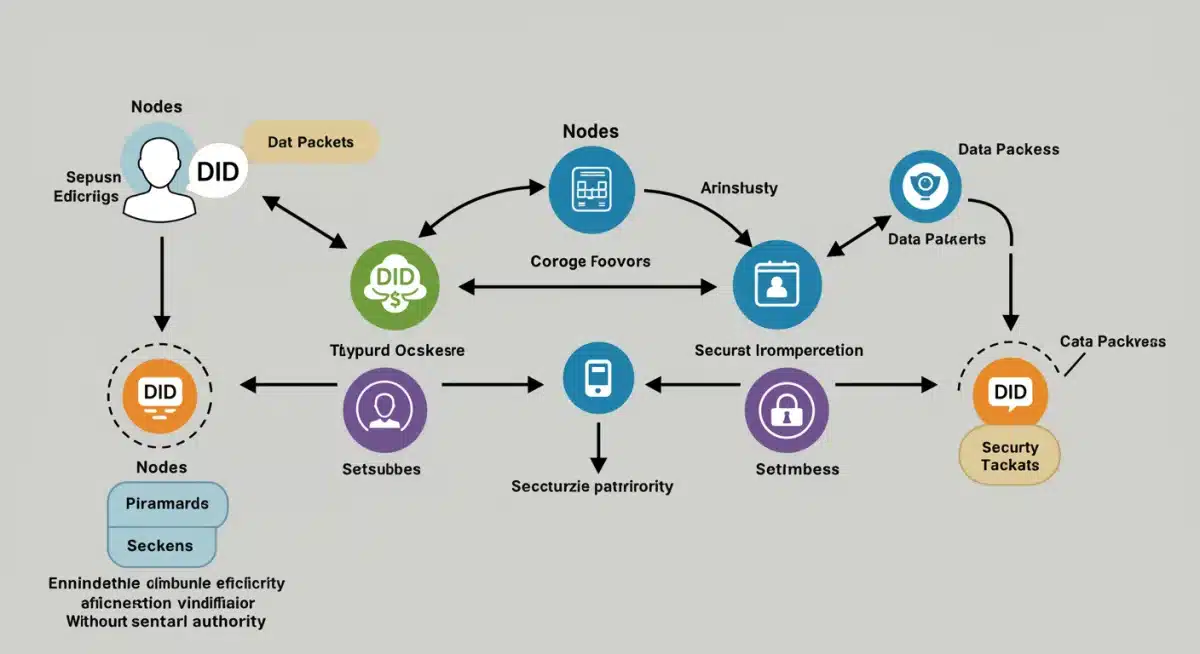
A DID is essentially a URI (Uniform Resource Identifier) that refers to a DID document. This document contains cryptographic material, service endpoints, and other information associated with the DID, enabling secure interactions. When a party needs to verify an identity, they resolve the DID to its corresponding DID document on a decentralized network, verifying the authenticity using cryptographic proofs.
This process eliminates the need for intermediaries to store and manage sensitive personal information, drastically reducing the attack surface for cybercriminals. For businesses, this translates into a more secure and less burdensome compliance environment, as they no longer need to be the sole custodians of vast amounts of customer data.
In essence, DIDs are not just a technological advancement; they represent a paradigm shift in digital trust. By decentralizing identity management, they lay the groundwork for a more secure, private, and efficient digital economy, particularly for U.S. businesses navigating an increasingly complex regulatory and cyber threat landscape.
Streamlining Digital Transactions: The DID Advantage
The application of Decentralized Identifiers (DIDs) in digital transactions offers a compelling pathway to enhanced efficiency and reduced friction for U.S. businesses. Traditional transaction processes often involve multiple layers of verification, each adding time, cost, and potential points of failure. DIDs promise to simplify this by enabling verifiable, secure, and private exchanges directly between parties.
Consider the typical Know Your Customer (KYC) and Anti-Money Laundering (AML) procedures. These are crucial for regulatory compliance but can be cumbersome and expensive. DIDs can transform these processes, allowing businesses to verify identities quickly and reliably without needing to store sensitive customer data themselves, thereby reducing their liability and operational overhead.
Enhanced Security and Fraud Reduction
One of the most significant advantages of DIDs in digital transactions is their inherent security. By leveraging cryptographic proofs and decentralized ledgers, DIDs make it incredibly difficult for fraudsters to impersonate individuals or organizations. Each transaction can be securely linked to a verifiable identity, drastically reducing the incidence of identity theft and financial fraud.
- Immutable Records: Transactions linked to DIDs are recorded on blockchain, providing an unalterable audit trail.
- Reduced Data Exposure: Businesses handle less sensitive data, minimizing the risk of data breaches.
- Authentic Verification: Cryptographic signatures ensure the authenticity of identities and transactions.
- Real-time Validation: DIDs can enable near real-time identity validation, speeding up transaction approvals.
Operational Efficiency and Cost Savings
The streamlining effect of DIDs extends directly to operational efficiency and cost savings. By automating and simplifying identity verification, businesses can process transactions faster, reduce manual review processes, and allocate resources more effectively. This efficiency gain is not merely theoretical; it translates into tangible financial benefits.
For example, onboarding new customers, which often involves extensive document checks and manual data entry, can be significantly expedited with DIDs. Customers can present verifiable credentials linked to their DID, allowing for instant and secure identity confirmation. This not only improves the customer experience but also lowers the labor costs associated with manual verification and compliance.
The ability to conduct secure, verifiable transactions without relying on costly third-party identity providers or maintaining extensive internal databases represents a substantial operational advantage. This efficiency is a direct contributor to the projected 8% operational cost savings for U.S. businesses by 2026, making DIDs a powerful tool for financial optimization.
Projected Cost Savings for U.S. Businesses by 2026
The introduction of Decentralized Identifiers (DIDs) into the operational frameworks of U.S. businesses is not just a technological upgrade; it’s a strategic move towards significant financial optimization. Industry analysts and Web3 economists project an average saving of 8% in operational costs by 2026, a figure that underscores the profound impact of this innovation.
These savings are multifaceted, stemming from various improvements across business functions. From reduced fraud losses to streamlined compliance and enhanced customer onboarding, the cumulative effect of DID adoption is expected to be substantial. Businesses currently allocate significant resources to managing identity-related risks and processes; DIDs offer a more efficient and secure alternative.
Primary Drivers of Cost Reduction
Several key areas contribute to the anticipated cost savings:
- Fraud Prevention: The robust security of DIDs drastically reduces instances of identity theft and fraudulent transactions, leading to direct financial savings from chargebacks and remediation efforts.
- Compliance Automation: Automated and verifiable identity checks simplify adherence to KYC/AML regulations, cutting down on manual labor and potential fines.
- Reduced Data Storage and Management: Businesses no longer need to store vast amounts of personal identifiable information (PII), lowering data storage costs and reducing the burden of data protection compliance.
- Improved Customer Onboarding: Faster, more secure onboarding processes lead to higher conversion rates and reduced customer acquisition costs.
- Streamlined Supply Chains: Verifiable credentials for partners and suppliers can reduce friction and enhance trust in complex supply chains.
Quantifying the 8% Saving
The 8% projection is an average, meaning some sectors or businesses with particularly high identity management overheads might experience even greater savings. This figure is derived from models that consider the current spending on identity verification, fraud detection, data security, and compliance across various U.S. industries. By shifting these expenditures to a more efficient, decentralized model, businesses can reallocate capital to growth-oriented initiatives.

For instance, financial institutions, which bear heavy costs for fraud and regulatory compliance, stand to benefit immensely. Similarly, e-commerce platforms can enhance security and reduce cart abandonment rates by offering seamless and trustworthy identity verification at checkout. The operational cost savings from DIDs are not just about cutting expenses; they are about unlocking new levels of efficiency and trust in the digital economy.
The projected 8% savings underscore DIDs as a critical component of a financially sound Web3 strategy for U.S. businesses. This transformation promises not only to make operations leaner but also to build stronger, more trusted relationships with customers and partners in the digital realm.
DIDs in Action: Real-World Business Applications
The theoretical benefits of Decentralized Identifiers (DIDs) translate into tangible advantages across a diverse range of real-world business applications. U.S. businesses are beginning to explore and implement DIDs to solve pressing challenges related to identity, trust, and efficiency in their digital operations. These applications showcase the versatility and power of self-sovereign identity.
From enhancing customer experiences to securing critical supply chains, DIDs are proving to be a foundational technology for a more secure and streamlined digital economy. Their ability to provide verifiable credentials without centralized control makes them ideal for scenarios requiring high levels of trust and data privacy.
Transforming Financial Services
In the financial sector, DIDs are poised to revolutionize how banks, lenders, and fintech companies manage customer identities and transactions. The implications for KYC/AML compliance, fraud prevention, and secure lending are profound.
- Instant Account Opening: Customers can use portable, verifiable credentials to open accounts quickly and securely across different institutions.
- Enhanced Loan Applications: Lenders can verify financial history and creditworthiness with greater accuracy and less friction.
- Secure Payments: DIDs can underpin more secure payment systems, reducing fraud and chargebacks.
- Regulatory Reporting: Streamlined data verification simplifies complex regulatory reporting requirements.
Improving Healthcare Data Management
Healthcare providers and patients often struggle with fragmented and insecure identity management. DIDs offer a path to a more coherent and private system.
Patients can control access to their medical records, granting specific providers temporary access to verifiable health credentials. This not only enhances privacy but also improves interoperability between different healthcare systems, leading to more coordinated and efficient care. The reduction in administrative overhead for verifying patient identities and insurance information can lead to significant cost savings.
Securing Supply Chains and Logistics
For businesses involved in global supply chains, verifying the authenticity of products, suppliers, and partners is a constant challenge. DIDs can provide an immutable, verifiable identity for every entity and item in the chain.
This enables transparent tracking of goods from origin to destination, ensuring product integrity and combating counterfeiting. Companies can instantly verify the credentials of new suppliers, speeding up onboarding and reducing risks associated with unverified partners. The efficiency gains in logistics and the reduction in losses due to fraud or counterfeit goods contribute directly to the financial bottom line.
These examples illustrate how DIDs are not just a futuristic concept but a practical solution already being deployed to address real business needs. The versatility of DIDs ensures their relevance across industries, driving efficiency and security in digital interactions.
Challenges and Considerations for DID Adoption
While the promise of Decentralized Identifiers (DIDs) for U.S. businesses is significant, the path to widespread adoption is not without its challenges. Implementing any new, transformative technology requires careful consideration of various factors, from technical integration to regulatory alignment and user acceptance. Addressing these challenges proactively will be crucial for realizing the full financial impact of Web3 innovations.
The complexity of integrating DIDs into existing legacy systems, the need for clear regulatory frameworks, and the importance of educating both businesses and consumers are all critical aspects that must be navigated. Successfully overcoming these hurdles will determine the speed and scale of DID deployment across the U.S. business landscape.
Technical Integration Complexities
One of the primary challenges lies in the technical integration of DID systems with current enterprise architectures. Many U.S. businesses operate on established, often disparate, IT infrastructures that were not designed with decentralized identity in mind. Integrating DIDs requires significant development work and a deep understanding of blockchain protocols.
- Interoperability: Ensuring DIDs work seamlessly across various blockchain networks and existing systems is a complex task.
- Scalability: Decentralized networks must be able to handle the transaction volume required by large enterprises.
- User Experience: Designing intuitive interfaces for managing DIDs and verifiable credentials is vital for user adoption.
- Security Audits: Rigorous security audits are necessary to build trust and prevent vulnerabilities in new DID implementations.
Regulatory and Legal Landscape
The evolving nature of Web3 technology means that regulatory frameworks are often playing catch-up. For DIDs to achieve broad acceptance, clear legal guidelines and regulatory support are essential. U.S. businesses need assurance that their DID implementations comply with existing and future data protection and identity verification laws.
Uncertainty around legal recognition of DIDs and verifiable credentials could hinder adoption. Collaboration between industry, technologists, and policymakers is crucial to establish standards and legal clarity that foster innovation while ensuring consumer protection and market stability. This includes addressing questions around liability, data ownership, and dispute resolution in a decentralized context.
User Education and Acceptance
Ultimately, the success of DIDs hinges on user education and acceptance. Both businesses and their customers need to understand the benefits and mechanics of decentralized identity. Shifting from familiar, albeit flawed, centralized systems to a new paradigm requires a significant change in mindset and behavior.
Educating employees on how to implement and manage DID solutions, and informing customers about the enhanced privacy and security DIDs offer, will be critical. Without broad understanding and trust, even the most technically sound DID system will struggle to gain traction. Investing in user-friendly interfaces and clear communication strategies will be key to fostering widespread adoption and unlocking the full potential of DIDs.
Addressing these challenges head-on will ensure that U.S. businesses can effectively leverage DIDs to achieve the projected operational cost savings and secure their place in the evolving Web3 economy.
The Future of Digital Identity and Transactions with DIDs
The trajectory of Decentralized Identifiers (DIDs) points towards a future where digital identity and transactions are fundamentally more secure, private, and efficient. For U.S. businesses, this isn’t just about incremental improvements; it’s about a foundational shift that promises to redefine how they operate, interact with customers, and manage their digital presence. The vision for 2026 and beyond sees DIDs as an integral part of the digital infrastructure.
As Web3 continues to mature, DIDs are expected to become the standard for verifiable digital interactions, moving beyond niche applications to widespread adoption across all sectors. This will foster an ecosystem where trust is built into the very fabric of digital exchanges, reducing friction and opening up new possibilities for innovation and economic growth.
Interoperability and Universal Acceptance
A key aspect of DID’s future success lies in achieving universal interoperability. As different industries and platforms adopt DID standards, the ability for verifiable credentials to be seamlessly used across various services will unlock unprecedented levels of efficiency. Imagine a single, self-sovereign digital identity that works for banking, healthcare, government services, and e-commerce.
- Global Standards: Continued development and adoption of open standards (e.g., W3C DID specification) will ensure broad compatibility.
- Cross-Industry Applications: DIDs will facilitate secure data exchange and identity verification across diverse sectors.
- Enhanced User Experience: A unified, user-controlled identity simplifies digital life, reducing password fatigue and improving security.
- New Business Models: The trust layer provided by DIDs will enable innovative services and marketplaces built on verifiable interactions.
Economic Empowerment and Inclusivity
Beyond efficiency and security, DIDs have the potential to foster greater economic empowerment and inclusivity. By providing individuals, particularly those currently underserved by traditional identity systems, with a portable and verifiable digital identity, DIDs can unlock access to financial services, education, and employment opportunities.
For U.S. businesses, this means expanding their potential customer base and engaging with a more diverse and globally connected market. The reduced barriers to entry and enhanced trust mechanisms will create a more vibrant and equitable digital economy, where businesses can operate with greater confidence and reach a broader audience.
The future of digital identity with DIDs is not merely about technological advancement; it’s about building a more secure, private, and fair digital world. U.S. businesses that embrace this innovation will not only reap significant financial benefits but also position themselves as leaders in the evolving Web3 landscape, shaping the future of digital interactions for decades to come.
| Key Aspect | Impact on US Businesses |
|---|---|
| Operational Cost Savings | Projected average 8% reduction by 2026 through streamlined processes. |
| Enhanced Security & Fraud Prevention | Cryptographically secure identities minimize fraud and data breaches. |
| Streamlined Digital Transactions | Faster, more efficient KYC/AML, customer onboarding, and payments. |
| User Control & Privacy | Individuals and businesses maintain self-sovereign control over their data. |
Frequently Asked Questions About DIDs and Web3 Financial Impact
DIDs are a new type of globally unique identifier that enables verifiable, decentralized digital identity. Unlike traditional identifiers, DIDs are controlled by the entity that owns them, providing enhanced privacy and security without relying on centralized authorities, thereby revolutionizing digital transactions and identity management.
DIDs streamline identity verification, reduce fraud, automate compliance processes, and lower data storage costs. By minimizing manual efforts and mitigating risks associated with centralized data management, U.S. businesses can expect an average 8% reduction in operational expenditures by 2026, improving overall financial health.
Sectors with high identity verification needs and significant fraud risks, such as financial services, healthcare, and e-commerce, stand to benefit most. DIDs can improve customer onboarding, secure patient data, and prevent online transaction fraud, creating more efficient and trustworthy digital ecosystems across these industries.
Challenges include integrating DIDs with existing legacy IT systems, navigating the evolving regulatory landscape, and educating both employees and customers on this new technology. Overcoming these hurdles requires strategic planning, significant investment, and collaboration between stakeholders to ensure successful implementation and adoption.
Digital transactions using DIDs are highly secure due to their reliance on cryptographic proofs and decentralized ledger technology. This design significantly reduces the risk of identity theft and fraud by ensuring that identities are verified directly and securely, without intermediaries, leading to a robust and trustworthy transaction environment.
Conclusion
The advent of Web3 innovations, particularly Decentralized Identifiers (DIDs), marks a transformative era for U.S. businesses. The anticipated average 8% reduction in operational costs by 2026 is a testament to the profound efficiency, security, and privacy benefits DIDs bring to digital transactions. By empowering individuals and organizations with self-sovereign control over their identities, DIDs are not merely optimizing existing processes but fundamentally reshaping the digital economy. While challenges in adoption and integration exist, the long-term financial advantages and the promise of a more secure, interoperable, and trustworthy digital landscape make DIDs an indispensable technology for businesses looking to thrive in the evolving Web3 era.