Auditing Smart Contracts in 2025: Essential Checks

Auditing Smart Contracts in 2025: Essential Checks to Prevent Over 15% of Common Exploits (PRACTICAL SOLUTIONS) is crucial for safeguarding digital assets and ensuring the reliability of decentralized applications in the rapidly evolving blockchain landscape.
As the Web3 ecosystem expands, the integrity of decentralized applications hinges on the security of their underlying smart contracts. Performing thorough smart contract auditing in 2025 is not just a best practice; it’s a critical shield against sophisticated exploits that can compromise over 15% of common vulnerabilities. This article delves into the essential checks and practical solutions necessary to fortify your smart contracts against future threats.
The evolving landscape of smart contract vulnerabilities
The world of smart contracts is dynamic, with new functionalities and complexities emerging constantly. This rapid innovation, while exciting, also introduces novel attack vectors and vulnerabilities that require continuous adaptation in auditing methodologies. Understanding the evolution of these threats is the first step towards effective prevention.
In the early days of blockchain, exploits often targeted simple logic errors or reentrancy issues. However, as smart contracts become more intricate, integrating with multiple protocols and handling diverse assets, the potential for sophisticated attacks has grown exponentially. Auditors must now contend with cross-chain vulnerabilities, oracle manipulation, and complex economic exploits that were once theoretical.
New attack vectors in DeFi and NFTs
Decentralized Finance (DeFi) and Non-Fungible Tokens (NFTs) have been particularly susceptible to exploits due to their high value and interconnected nature. Flash loan attacks, for instance, leverage uncollateralized loans to manipulate asset prices across different protocols, leading to significant losses. Similarly, vulnerabilities in NFT marketplaces or minting processes can result in unauthorized asset transfers or theft.
- Flash loan exploits: Manipulating asset prices through rapid borrowing and repayment.
- Oracle manipulation: Feeding false price data to smart contracts.
- Reentrancy attacks: Repeatedly calling a function before the first execution completes.
- Front-running: Exploiting pending transactions for profit.
The continuous emergence of these attack vectors necessitates a proactive and adaptive approach to auditing. Traditional security checks are no longer sufficient; auditors must anticipate future threats and develop methodologies to counter them before they can be exploited.
The evolving nature of smart contract vulnerabilities underscores the need for constant vigilance and continuous improvement in auditing practices. Staying ahead of attackers requires not only technical expertise but also a deep understanding of the economic and game-theoretic aspects of blockchain ecosystems.
Core auditing methodologies for 2025
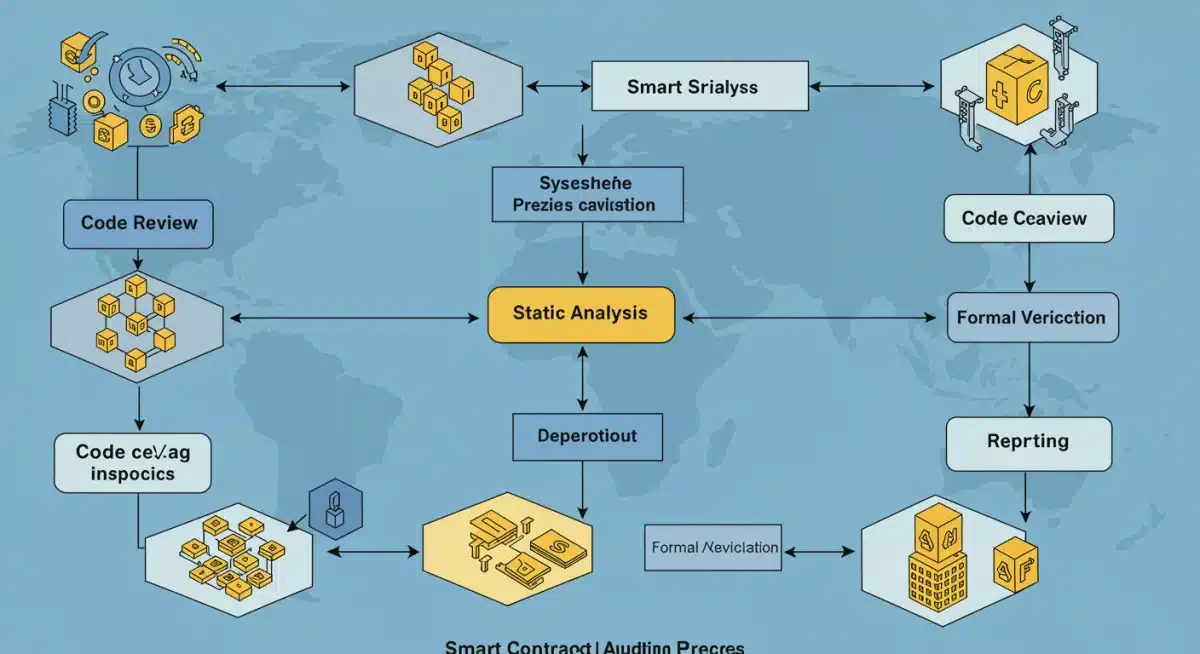
Effective smart contract auditing in 2025 relies on a multi-faceted approach, combining automated tools with rigorous manual review. This blend ensures comprehensive coverage, identifying both common and highly complex vulnerabilities that might otherwise go unnoticed. Each methodology plays a crucial role in a holistic security assessment.
Static analysis, dynamic analysis, and formal verification are pillars of modern smart contract auditing. While automated tools accelerate the initial scanning phase, human expertise remains indispensable for interpreting findings, identifying subtle logic flaws, and understanding the broader context of a contract’s interactions within the Web3 environment.
Automated analysis tools and their limitations
Automated tools are invaluable for quickly identifying known patterns of vulnerabilities and coding errors. They can scan vast amounts of code in a fraction of the time it would take a human, flagging issues like reentrancy, integer overflows, and unchecked external calls. Tools such as Slither, Mythril, and Ganache offer significant advantages in efficiency and early detection.
- Static analysis: Examines code without execution, identifying potential bugs.
- Dynamic analysis: Tests code during execution, observing behavior in real-time.
- Fuzz testing: Injects random data to uncover unexpected behavior.
- Unit testing: Verifies individual components of the contract.
However, automated tools have limitations. They often struggle with context-specific vulnerabilities, complex business logic flaws, or issues that arise from the interaction between multiple contracts. False positives can also be a challenge, requiring human intervention to distinguish genuine threats from benign warnings.
The indispensable role of manual code review
Manual code review by experienced auditors complements automated tools by providing a deeper understanding of the contract’s intent and potential attack surfaces. Human auditors can identify subtle logic errors, economic vulnerabilities, and design flaws that automated tools might miss. They also analyze the contract’s interactions with other protocols and its overall ecosystem.
This human touch is particularly critical for contracts handling significant value or those with complex governance mechanisms. A seasoned auditor brings not only technical prowess but also a hacker’s mindset, thinking creatively about how a contract might be exploited under various scenarios. The manual review phase often uncovers the most critical vulnerabilities, making it an irreplaceable part of the auditing process.
Combining automated efficiency with human insight provides the most robust defense against smart contract exploits. This dual approach ensures that both obvious coding errors and sophisticated logical flaws are addressed, leading to more secure and reliable decentralized applications.
Pre-audit preparations: setting the stage for success
A successful smart contract audit begins long before the first line of code is reviewed. Thorough preparation by the development team can significantly streamline the auditing process, reduce costs, and improve the overall quality of the security assessment. This involves clear documentation, comprehensive testing, and transparent communication.
Providing auditors with well-structured documentation and a clear understanding of the contract’s intended functionality allows them to focus on security assessment rather than deciphering code. This proactive approach helps in identifying potential issues early and resolving them efficiently.
Documentation and specification requirements
Clear and comprehensive documentation is paramount. This includes detailed specifications of the contract’s functionality, architecture, and any external dependencies. Flowcharts, state diagrams, and detailed explanations of complex logic are invaluable for auditors. A well-documented contract helps auditors understand the intended behavior and identify deviations or potential misuse.
Furthermore, providing a clear threat model outlining potential attack vectors and assumptions about the operating environment can guide the audit significantly. This demonstrates a proactive security mindset and helps auditors prioritize their efforts.
Comprehensive unit and integration testing
Before an audit, the development team should conduct extensive unit and integration testing. Unit tests verify the functionality of individual components, while integration tests ensure that different parts of the contract and its external dependencies work together as expected. A high test coverage indicates a mature codebase and helps auditors focus on security rather than basic functionality bugs.
Providing auditors with a robust test suite allows them to replicate scenarios, verify fixes, and conduct their own testing more effectively. Well-written tests act as a form of executable documentation, illustrating the intended behavior of the contract under various conditions.
Effective pre-audit preparations lay a strong foundation for a successful security review. By providing clear documentation and a thoroughly tested codebase, development teams can optimize the auditing process and enhance the overall security posture of their smart contracts.
Essential checks to prevent common exploits
Preventing smart contract exploits requires a meticulous approach, focusing on specific vulnerabilities that frequently lead to security breaches. By systematically checking for these common issues, auditors can significantly reduce the risk of over 15% of prevalent attacks. These checks cover various aspects, from reentrancy to access control, ensuring a robust defense.
Understanding the most common exploit patterns allows auditors to target their efforts effectively, providing practical solutions that directly address known weaknesses. This proactive identification and mitigation of risks are central to securing smart contracts in 2025.
Reentrancy and access control vulnerabilities
Reentrancy remains a classic vulnerability where an external contract can repeatedly call back into the original contract before its state is updated, leading to unintended behavior and asset drain. Auditors must meticulously check for proper use of the Checks-Effects-Interactions pattern and reentrancy guards.
Access control issues arise when unauthorized users can execute sensitive functions. This often stems from incorrect use of modifiers (like onlyOwner), or insufficient validation of the caller’s identity. Robust access control mechanisms are vital to restrict critical operations to authorized entities only.
Integer overflow/underflow and timestamp dependence
Integer overflow and underflow vulnerabilities occur when arithmetic operations result in numbers exceeding the maximum or falling below the minimum value for their data type, leading to unexpected and exploitable states. Auditors must verify that all arithmetic operations are safely handled, often through libraries like SafeMath or custom checks.
Timestamp dependence exploits happen when a contract’s logic relies on block.timestamp for critical operations. Malicious miners can manipulate timestamps within a small window, potentially influencing outcomes like random number generation or time-locked functions. Using decentralized oracle networks for time-sensitive operations is a recommended mitigation.
Front-running and denial-of-service attacks
Front-running occurs when an attacker observes a pending transaction and submits their own transaction with a higher gas price to be executed first, often to profit from price manipulation or gain an unfair advantage. Mitigation strategies include commit-reveal schemes, batching transactions, and using decentralized transaction relays.
Denial-of-Service (DoS) attacks aim to prevent legitimate users from interacting with a contract. This can be achieved by exhausting gas limits, creating infinite loops, or exploiting vulnerabilities that cause the contract to revert. Auditors must ensure contracts are resilient to such attacks, often by designing functions that limit iteration counts and avoid unbounded loops.
By focusing on these essential checks, auditors can proactively identify and mitigate a wide range of common smart contract exploits. This systematic approach forms the bedrock of secure smart contract development and deployment in the current blockchain landscape.
Post-audit procedures and continuous monitoring
A smart contract audit is not a one-time event; it’s part of an ongoing security lifecycle. Post-audit procedures and continuous monitoring are crucial for maintaining the integrity of deployed contracts, especially as the ecosystem evolves and new threats emerge. This includes bug bounty programs, incident response planning, and regular re-audits.
Even after a thorough audit, new vulnerabilities might be discovered or introduced with subsequent updates. Therefore, a robust post-deployment security strategy is essential to ensure long-term protection and trust in decentralized applications.
Implementing bug bounty programs
Bug bounty programs incentivize ethical hackers to discover and report vulnerabilities in live contracts. This crowdsourced approach leverages the collective intelligence of the security community, providing an additional layer of defense that complements formal audits. A well-structured bug bounty program can uncover issues that even the most rigorous audit might miss.
Establishing clear rules, reward tiers, and communication channels for bug bounty participants is vital for its success. This not only enhances security but also fosters a collaborative relationship with the broader security community.
Incident response and emergency upgrades
Despite best efforts, exploits can still occur. Having a well-defined incident response plan is crucial for minimizing damage and recovering quickly. This plan should include protocols for identifying, containing, and remediating exploits, as well as clear communication strategies for users and stakeholders.
The ability to perform emergency upgrades or pause critical contract functions is also important. While immutability is a core tenet of smart contracts, mechanisms for controlled upgrades (e.g., via proxy patterns) or pausing features can be lifelines in the event of a severe vulnerability, provided they are implemented securely and transparently.
Regular security updates and re-audits
The blockchain landscape is constantly changing, with new protocols, standards, and attack techniques emerging regularly. Therefore, smart contracts should undergo regular security updates and re-audits, especially after significant code changes or integrations with new protocols. This ensures that contracts remain secure against the latest threats.
Continuous monitoring tools can also track contract activity for unusual patterns or potential exploits, providing real-time alerts. This proactive surveillance, combined with periodic re-audits, forms a comprehensive strategy for long-term smart contract security.
By embracing post-audit procedures and continuous monitoring, projects can maintain a high level of security for their smart contracts, adapting to new challenges and reinforcing user trust in the decentralized ecosystem.
The future of smart contract security: AI and formal verification
Looking ahead to 2025 and beyond, the field of smart contract security is poised for significant advancements, driven by the increasing sophistication of AI and the broader adoption of formal verification techniques. These technologies promise to enhance auditing capabilities, making contracts more resilient to even the most complex attacks.
The integration of artificial intelligence and formal verification into auditing workflows represents a paradigm shift, moving towards more automated, precise, and provably secure smart contract development.
AI-powered auditing tools
AI and machine learning are increasingly being applied to smart contract auditing. AI-powered tools can analyze vast datasets of past exploits and code patterns, identifying subtle vulnerabilities that might elude traditional static analysis. These tools can learn from new exploits, continuously improving their detection capabilities and adapting to evolving threat landscapes.
Furthermore, AI can assist in predicting potential attack vectors by analyzing the economic implications of contract interactions, offering a more holistic view of security risks. This predictive capability can help auditors prioritize their efforts and focus on the most critical areas.
Advanced formal verification techniques
Formal verification involves mathematically proving the correctness of a smart contract’s code against its specifications. Unlike testing, which shows the presence of bugs, formal verification can prove the absence of certain classes of bugs. While historically complex and resource-intensive, advancements in tooling and methodologies are making it more accessible.
In 2025, we can expect wider adoption of formal verification for critical components of smart contracts, especially those handling significant value or governing core protocol logic. This approach offers the highest level of assurance, providing strong guarantees about a contract’s behavior under all possible conditions.
Integrating AI and formal methods
The true power lies in integrating AI with formal verification. AI can help automate parts of the formal verification process, such as generating formal specifications from natural language descriptions or identifying critical code sections that require rigorous proof. This synergy can democratize formal verification, making it more practical for a wider range of smart contract projects.
This convergence of advanced technologies promises a future where smart contracts are not only more secure but also provably correct, fostering unprecedented levels of trust and reliability in the decentralized world.
| Key Auditing Aspect | Brief Description |
|---|---|
| Evolving Threats | Understanding new attack vectors in DeFi, NFTs, and cross-chain interactions. |
| Core Methodologies | Combining automated tools with essential manual code review for comprehensive coverage. |
| Essential Checks | Focusing on reentrancy, access control, integer issues, and DoS prevention. |
| Future of Security | Leveraging AI and formal verification for advanced auditing and provable correctness. |
Frequently asked questions about smart contract auditing
Smart contract auditing is critical in 2025 due to the increasing complexity of decentralized applications and the constant emergence of sophisticated exploits. Audits help identify and fix vulnerabilities before deployment, safeguarding digital assets and maintaining user trust in the Web3 ecosystem.
Auditors primarily look for reentrancy, access control vulnerabilities, integer overflows/underflows, timestamp dependencies, front-running opportunities, and potential denial-of-service attack vectors. These represent a significant portion of known smart contract exploits.
Automated tools efficiently scan for known vulnerability patterns and coding errors, providing a quick initial scan. Manual review then offers deep insight into complex logic, context-specific issues, and potential economic exploits that automated tools often miss, ensuring comprehensive coverage.
AI will revolutionize smart contract security by enabling more intelligent vulnerability detection, predicting attack vectors, and assisting in formal verification processes. AI-powered tools learn from past exploits, continuously improving their ability to identify subtle and complex threats in evolving codebases.
No, a single audit is rarely sufficient. Smart contract security is an ongoing process. Projects should implement bug bounty programs, plan for incident response, and conduct regular re-audits, especially after significant code changes, to maintain long-term security against evolving threats.
Conclusion
Auditing Smart Contracts in 2025: Essential Checks to Prevent Over 15% of Common Exploits (PRACTICAL SOLUTIONS) is more than a technical exercise; it’s a fundamental commitment to the security and stability of the Web3 ecosystem. By embracing rigorous methodologies, performing essential checks, and leveraging future technologies like AI and formal verification, developers and auditors can build a more secure decentralized future. The continuous evolution of threats demands an equally dynamic and proactive approach to security, ensuring that smart contracts remain robust and trustworthy foundations for innovation.