Web3 Gaming Guilds 2025: Unlocking 15% More Value
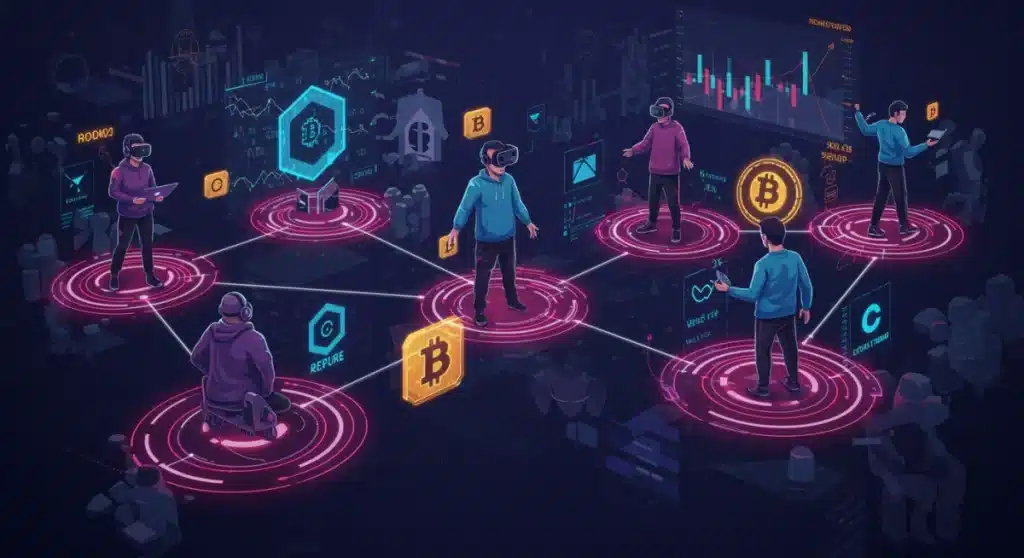
New Web3 gaming guild models for 2025 are poised to significantly enhance player and investor value, unlocking an estimated 15% more financial impact through innovative decentralized structures and enhanced economic opportunities within blockchain gaming.
The landscape of digital entertainment is undergoing a profound transformation, with Web3 gaming emerging as a pivotal force. As we look towards 2025, the evolution of gaming guilds is set to play a crucial role in unlocking 15% more value: new Web3 gaming guild models for 2025 and their financial impact, promising unprecedented opportunities for players and investors alike. This shift isn’t just about new games; it’s about entirely new economic paradigms.
The evolution of Web3 gaming guilds
Web3 gaming guilds have rapidly evolved from simple scholarship programs into complex, decentralized organizations. Initially, their primary function was to onboard new players into play-to-earn games by lending them NFTs, effectively lowering the barrier to entry. This model proved successful in games like Axie Infinity, allowing a broader demographic to participate and earn.
However, the industry is maturing. The initial models, while foundational, faced challenges related to sustainability, scalability, and equitable value distribution. As blockchain technology advances and the Web3 ecosystem expands, so too do the expectations and capabilities of these guilds. The focus is now shifting towards more robust, community-driven, and financially sophisticated structures that can withstand market fluctuations and foster long-term growth.
From scholarships to ecosystems
Early guilds focused almost exclusively on scholarship programs, where experienced players (managers) lent game assets (NFTs) to new players (scholars) in exchange for a percentage of their earnings. This created a symbiotic relationship that fueled growth in nascent play-to-earn economies.
- Initial model: Asset lending and profit sharing.
- Key benefit: Lowered entry barriers for new players.
- Main challenge: Centralized decision-making and potential for exploitation.
The next iteration saw guilds expanding their services beyond simple asset lending. They began offering training, community support, and even educational resources, transforming into comprehensive ecosystems that nurtured talent and fostered collective growth. This move was crucial for retaining players and building a loyal community around the guild’s brand.
The rise of decentralized autonomous organizations (DAOs)
A significant leap for Web3 gaming guilds has been their transition towards DAO structures. This decentralization empowers community members to participate in governance, making decisions on asset allocation, treasury management, and strategic partnerships. This shift addresses many of the centralization issues found in earlier models.
The move to DAOs not only enhances transparency and fairness but also aligns incentives across the entire guild ecosystem. When players and investors have a direct say in the guild’s direction, they become more invested in its success. This collective ownership fosters a stronger, more resilient community capable of adapting to the rapidly changing Web3 landscape.
The evolution from basic scholarship programs to sophisticated DAO-governed ecosystems highlights a fundamental understanding: sustainable growth in Web3 gaming requires shared ownership and decentralized governance. This foundation is critical for unlocking new levels of value and ensuring the longevity of these innovative organizations.
Innovative financial models for 2025
Looking ahead to 2025, Web3 gaming guilds are poised to adopt even more sophisticated financial models, moving beyond simple profit-sharing to embrace diverse revenue streams and value creation mechanisms. These innovations are designed to increase sustainability, attract a wider range of investors, and provide more stable and predictable returns for guild members.
The integration of advanced DeFi strategies, dynamic asset management, and novel tokenomics will be central to these new models. Guilds will no longer just be aggregators of players but sophisticated financial entities leveraging blockchain capabilities to optimize their operations and maximize value.
Yield farming and liquidity provision
Guilds are increasingly exploring DeFi opportunities to generate additional revenue from their treasuries and unused assets. By participating in yield farming protocols and providing liquidity to decentralized exchanges, guilds can earn passive income, which can then be reinvested into the guild or distributed to members.
- Yield farming: Staking or lending crypto assets to generate high returns.
- Liquidity provision: Supplying crypto assets to DEXs to facilitate trading, earning fees.
- Benefit: Diversifies income streams and enhances treasury growth.
This approach allows guilds to become more financially robust, reducing their sole reliance on in-game earnings. It also provides a buffer against the volatility often associated with play-to-earn game economies, ensuring a more stable financial footing for the guild and its members.
Dynamic NFT asset management
The traditional model of static NFT lending is giving way to dynamic NFT asset management. Guilds will employ sophisticated algorithms and data analytics to optimize the utilization and monetization of their NFT portfolios. This includes actively trading NFTs, upgrading them to enhance performance, and even fractionalizing them to increase liquidity and accessibility.
By treating NFTs as active investment assets rather than mere tools for gameplay, guilds can unlock significant additional value. This approach requires expertise in market analysis and blockchain mechanics, transforming guild operators into skilled digital asset managers.
Revenue sharing and token buybacks
New models will emphasize more equitable and transparent revenue-sharing mechanisms. Beyond direct profit splits, guilds may implement token buyback programs, where a portion of guild profits is used to repurchase and burn guild tokens, increasing their scarcity and value. This benefits all token holders and aligns their interests with the guild’s long-term success.
Furthermore, guilds might introduce tiered membership models, offering different levels of profit sharing and governance rights based on a member’s contributions, token holdings, or in-game performance. These innovative financial models are crucial for sustained growth and for attracting both traditional investors and dedicated Web3 gamers.
The impact on player earnings and opportunities
The evolution of Web3 gaming guild models directly translates into enhanced earnings and broader opportunities for players. As guilds become more financially sophisticated and diversified, they can offer more stable and lucrative pathways for gamers to earn a living or supplement their income through play-to-earn mechanics.
This transformation moves beyond the initial promise of simply earning crypto through gaming; it creates a professionalized environment where skilled players can truly thrive, access advanced resources, and participate in a shared economic future. The goal is to empower players, turning gaming into a viable career path for many.
Increased stability and higher returns
With guilds diversifying their revenue streams through DeFi and dynamic asset management, the reliance on a single game’s volatile economy decreases. This stability translates into more consistent earnings for players, reducing the risk associated with market downturns in specific games.
- Diversified guild income: Less exposure to single-game volatility.
- Optimized asset utilization: Better returns from NFT portfolios.
- Professionalization: Training and resources for higher-skilled gameplay.
Furthermore, optimized asset management means that the NFTs lent to players are often better maintained, upgraded, or strategically chosen to maximize in-game earning potential. This direct investment in player tools leads to higher average returns for scholars.
Expanded access to premium assets and training
As guilds grow and accumulate more capital, they can acquire a wider range of premium NFTs and in-game assets. This provides players with access to top-tier equipment and characters that would otherwise be prohibitively expensive, allowing them to compete at higher levels and achieve greater earnings.
Beyond assets, guilds are investing in comprehensive training programs, mentorship, and analytical tools. These resources help players improve their skills, understand game mechanics better, and optimize their earning strategies, effectively professionalizing the role of a Web3 gamer. This focus on player development is a key differentiator for the new guild models.
New career paths and community ownership
The new guild models open up diverse career paths within the Web3 gaming ecosystem. Beyond just playing, individuals can become community managers, asset managers, game strategists, content creators, or even contribute to guild governance as active DAO members. This broadens the scope of participation and allows individuals to leverage various skills.
Moreover, the shift towards DAO governance gives players a voice and a stake in the guild’s success. This sense of community ownership fosters loyalty and encourages long-term engagement, transforming players from mere participants into co-owners of a shared venture. This collective empowerment is a cornerstone of the value unlocked by new Web3 gaming guild models.
Investor perspectives: attracting institutional capital
The maturation of Web3 gaming guilds, particularly with their adoption of more robust financial and governance models, is making them increasingly attractive to institutional investors. This influx of traditional capital is crucial for scaling the industry and providing the necessary liquidity for sustainable growth.
Institutional investors seek stability, transparency, and predictable returns, qualities that earlier, more speculative guild models often lacked. The new models, with their emphasis on diversified revenue streams, professional management, and clear tokenomics, are specifically designed to meet these demands.
Mitigating risk through diversification
Institutional investors are inherently risk-averse. The diversified revenue strategies employed by modern Web3 gaming guilds—combining in-game earnings with DeFi yield, NFT trading, and other ventures—help to mitigate the concentration risk associated with single-game performance. This broader portfolio approach makes guilds a more palatable investment opportunity.
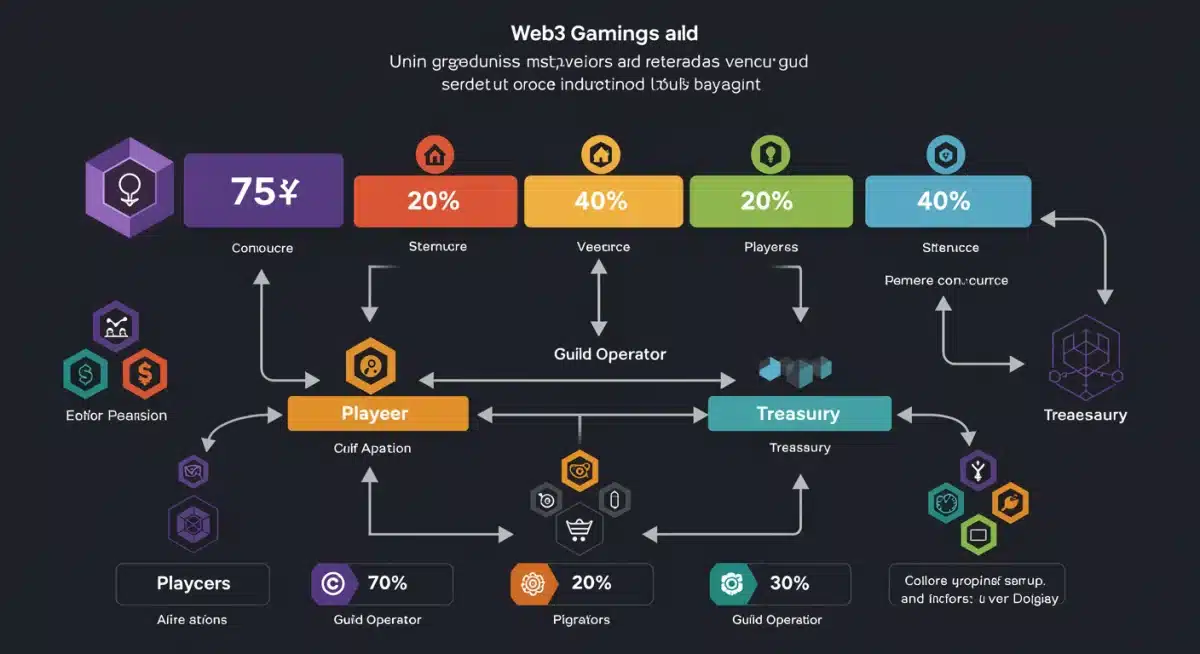

- Multi-game portfolios: Spreading investments across various promising titles.
- DeFi integration: Generating passive income from guild treasury assets.
- Asset-backed tokens: Providing tangible value to guild native tokens.
Furthermore, the ability of guilds to adapt their asset allocation based on market trends and game performance demonstrates a level of strategic acumen that appeals to sophisticated investors. This dynamic management reduces exposure to underperforming assets and capitalizes on emerging opportunities.
Transparency and governance via DAOs
The implementation of DAO structures provides a level of transparency and decentralized governance that is highly valued by institutional capital. Investors can scrutinize on-chain transactions, participate in key decisions, or at least monitor the decision-making process, ensuring accountability and reducing the risk of fraud or mismanagement.
Clear governance frameworks, often codified in smart contracts, define how funds are managed, how profits are distributed, and how strategic initiatives are approved. This institutional-grade transparency builds trust and confidence, which are essential for attracting significant capital injections into the Web3 gaming space.
Long-term growth potential and market size
The Web3 gaming market is still in its early stages, presenting immense long-term growth potential. Institutional investors recognize that guilds, as aggregators of talent and capital, are uniquely positioned to capture a significant share of this growth. The projected expansion of the metaverse and play-to-earn economies further solidifies this outlook.
Investing in guilds offers exposure to a diverse portfolio of games and assets, effectively becoming an index fund for the Web3 gaming sector. This broad exposure, coupled with professional management and innovative financial models, positions guilds as a compelling investment thesis for institutions looking to enter the nascent but rapidly expanding decentralized gaming market.
Technological innovations driving guild efficiency
The advancements in blockchain technology and ancillary tools are fundamentally enhancing the operational efficiency and strategic capabilities of Web3 gaming guilds. These innovations allow guilds to manage larger player bases, optimize asset deployment, and automate complex processes, all of which contribute to unlocking greater value.
From sophisticated analytics platforms to AI-driven asset allocation, technology is transforming how guilds operate, making them more streamlined, scalable, and ultimately, more profitable. The integration of these tools is a crucial factor in the projected 15% increase in value for 2025.
Advanced analytics and AI-driven insights
Guilds are increasingly adopting advanced data analytics platforms to track player performance, asset utilization, and market trends. These tools provide actionable insights, allowing guild managers to make data-driven decisions on asset procurement, player recruitment, and strategic game choices.
- Performance tracking: Monitoring scholar earnings and efficiency.
- Market analysis: Identifying profitable NFTs and game opportunities.
- AI-driven allocation: Optimizing asset distribution for maximum returns.
The next step involves integrating AI to automate decision-making processes, such as dynamically adjusting NFT rental rates, identifying top-performing scholars, or even predicting future game meta shifts. This level of technological sophistication significantly enhances a guild’s competitive edge.
Cross-chain interoperability and scalability solutions
The fragmented nature of the blockchain ecosystem has been a challenge for guilds operating across multiple games and networks. However, advancements in cross-chain interoperability solutions are allowing guilds to manage assets and deploy strategies seamlessly across different blockchains. This reduces friction and expands the universe of games guilds can effectively participate in.
Scalability solutions, such as Layer 2 networks and sharding, are also reducing transaction costs and increasing throughput, making it more economically viable for guilds to conduct a higher volume of micro-transactions and manage larger communities without incurring prohibitive fees or delays. These technological improvements are foundational to the future growth and profitability of guilds.
Automated management and smart contract evolution
Smart contracts are evolving to handle increasingly complex operations, allowing guilds to automate many of their core functions. This includes automated profit distribution, NFT lending and return protocols, and even dynamic adjustments to scholarship terms based on predefined conditions. Automation reduces operational overhead and minimizes human error.
Furthermore, the development of more flexible and upgradeable smart contracts means that guilds can adapt their rules and mechanisms without requiring complete redeployments, ensuring agility in a fast-changing environment. These technological leaps are not just about convenience; they are about building a more resilient, efficient, and scalable foundation for Web3 gaming guilds.
Challenges and risks for guild models in 2025
While the future of Web3 gaming guilds appears promising, it is not without its challenges and risks. For these new models to truly unlock their potential and achieve the projected 15% value increase, they must navigate a complex landscape of regulatory uncertainties, market volatility, and operational hurdles. Awareness and proactive strategies are key to overcoming these obstacles.
The nascent nature of the Web3 space means that many frameworks are still being established. Guilds must remain adaptable and innovative to thrive amidst these evolving conditions, ensuring they build resilient and compliant operations.
Regulatory uncertainty and compliance
One of the most significant challenges for Web3 gaming guilds is the evolving regulatory landscape. Governments worldwide are still grappling with how to classify and regulate digital assets, NFTs, and play-to-earn economies. This uncertainty can create legal ambiguities regarding guild operations, token offerings, and financial activities.
- Asset classification: Are guild tokens securities or utility tokens?
- Taxation: Clear guidelines for player earnings and guild profits.
- Consumer protection: Ensuring fair practices for guild members.
Guilds will need to invest in legal counsel and proactively engage with regulatory bodies to ensure compliance, potentially leading to increased operational costs. Failure to comply could result in severe penalties, impacting the guild’s financial stability and reputation.
Market volatility and game dependence
Despite diversification efforts, Web3 gaming guilds remain susceptible to the inherent volatility of the cryptocurrency market and the performance of individual games. A sudden downturn in the broader crypto market or a decline in player interest for a key game can significantly impact guild revenues and asset values.
While multi-game portfolios help, the success of many guilds is still tied to the sustained popularity and economic viability of a few prominent titles. Guilds must continuously monitor game ecosystems, adapt their strategies, and be prepared to pivot rapidly if a game’s economy becomes unsustainable.
Scalability and operational complexities
As guilds grow, managing thousands of players, tracking countless NFTs, and processing numerous transactions becomes incredibly complex. While technological innovations are helping, maintaining efficient operations at scale requires robust infrastructure, skilled personnel, and sophisticated management systems.
Ensuring fair and transparent profit distribution, resolving disputes, and providing adequate support to a global community of players presents significant operational challenges. Guilds must invest in scalable solutions and strong community management to avoid bottlenecks and maintain member satisfaction, which is crucial for long-term success.
The future outlook: 15% more value and beyond
The trajectory for Web3 gaming guilds in 2025 points towards a significant increase in value, driven by innovative models, technological advancements, and a maturing ecosystem. The estimated 15% more value isn’t just an arbitrary number; it reflects the compounding impact of enhanced financial strategies, improved player opportunities, and greater investor confidence.
This growth signifies a transition from an experimental phase to a more established and professionalized industry. The future involves deeper integration with the broader Web3 landscape, creating a more interconnected and economically vibrant digital world.
Integration with the broader Web3 ecosystem
Future guild models will likely see deeper integration with other Web3 verticals. This could include partnerships with metaverse projects, DeFi platforms for advanced financial instruments, or even decentralized social networks for community building. This interconnectedness will create new avenues for value creation and distribution.
Imagine guilds not just operating within games, but also owning virtual land, developing proprietary tools, or even launching their own mini-games within the metaverse. This expansion beyond traditional gaming roles will diversify revenue and solidify their position as key players in the decentralized economy.
Community-driven innovation and IP ownership
The DAO structure will continue to empower communities, fostering an environment where innovation is driven from within. Guild members will not only play games but also contribute to game design, asset creation, and even intellectual property (IP) development. This collective ownership of IP could lead to entirely new gaming experiences and revenue streams.
Guilds could evolve into decentralized game publishers or developers, leveraging their community’s talent and capital to create games that are truly owned and governed by their players. This paradigm shift represents the ultimate realization of the Web3 ethos.
Sustainable growth and mainstream adoption
The innovations in financial models, governance, and technology are all geared towards achieving sustainable growth. As guilds become more transparent, stable, and profitable, they will attract a broader audience of both players and investors, accelerating mainstream adoption of Web3 gaming. The 15% value increase is a stepping stone towards a future where play-to-earn is a recognized and respected economic activity.
The long-term outlook for Web3 gaming guilds is one of continuous evolution, pushing the boundaries of digital ownership, decentralized finance, and community-driven entertainment. By addressing challenges proactively and embracing innovation, guilds are set to become cornerstones of the internet’s next iteration.
| Key Aspect | Brief Description |
|---|---|
| DAO Governance | Decentralized decision-making empowers members, increasing transparency and aligning incentives. |
| Diversified Revenue | Beyond P2E, guilds leverage DeFi, NFT trading, and other ventures for stable income. |
| Player Empowerment | Enhanced access to assets, training, and new career paths for gamers. |
| Institutional Appeal | Robust models, transparency, and growth potential attract significant capital. |
Frequently asked questions about Web3 gaming guilds
A Web3 gaming guild is a decentralized organization that pools resources, typically NFTs, to enable players to participate in play-to-earn games. They offer scholarships, training, and community support, allowing members to earn cryptocurrency and digital assets through gameplay, fostering a shared economic ecosystem.
Guilds generate value through various means: profit-sharing from player earnings, yield farming on their treasury assets, dynamic NFT trading and management, and potentially through token buybacks. These diversified strategies aim to create sustainable and growing revenue streams for the guild and its members.
Players benefit from reduced entry barriers (access to expensive NFTs), enhanced earning potential through optimized assets and training, community support, and often a voice in guild governance. Guilds provide a professional pathway for gamers to thrive in the play-to-earn ecosystem.
DAOs provide decentralized governance, transparency, and collective ownership. They empower community members to participate in decision-making, aligning incentives and fostering a more resilient and fair ecosystem. This structure enhances trust and attracts institutional investment by ensuring accountability.
Key challenges include regulatory uncertainty around digital assets and P2E economies, market volatility affecting crypto and NFT values, and the operational complexities of managing large, global communities. Guilds must adapt to these factors to ensure long-term sustainability and growth.
Conclusion
The evolution of Web3 gaming guilds towards more sophisticated and decentralized models by 2025 marks a pivotal moment for the industry. By embracing advanced financial strategies, empowering players, and leveraging technological innovations, these guilds are not just participating in the future of gaming; they are actively shaping it. The projected 15% increase in value reflects a maturing ecosystem that promises greater financial impact and opportunities for all stakeholders, solidifying Web3 gaming as a significant force in the digital economy.