Zero-Knowledge Proofs: Boosting Web3 Privacy for US Developers

In the rapidly evolving landscape of Web3, the promise of decentralization, transparency, and user control has captivated developers and enthusiasts alike. However, alongside these advancements, the critical issue of privacy has emerged as a paramount concern. How can we ensure that users maintain control over their data and identities in a world built on public ledgers? The answer, increasingly, lies in the sophisticated cryptographic technique known as Zero-Knowledge Proofs (ZKP). For US developers, understanding and implementing ZKP is no longer optional; it’s a necessity for building the next generation of secure and private decentralized applications.
Three months into 2026, the trajectory of ZKP integration within Web3 projects is accelerating at an unprecedented pace. This article will delve deep into the current impact of Zero-Knowledge Proofs on Web3 privacy, offering a comprehensive update for US developers navigating this complex yet rewarding field. We’ll explore the underlying principles, recent breakthroughs, practical applications, and the challenges that lie ahead, all with a keen eye on the specific opportunities and regulatory considerations pertinent to the United States market.
Understanding Zero-Knowledge Proofs: The Foundation of Web3 Privacy
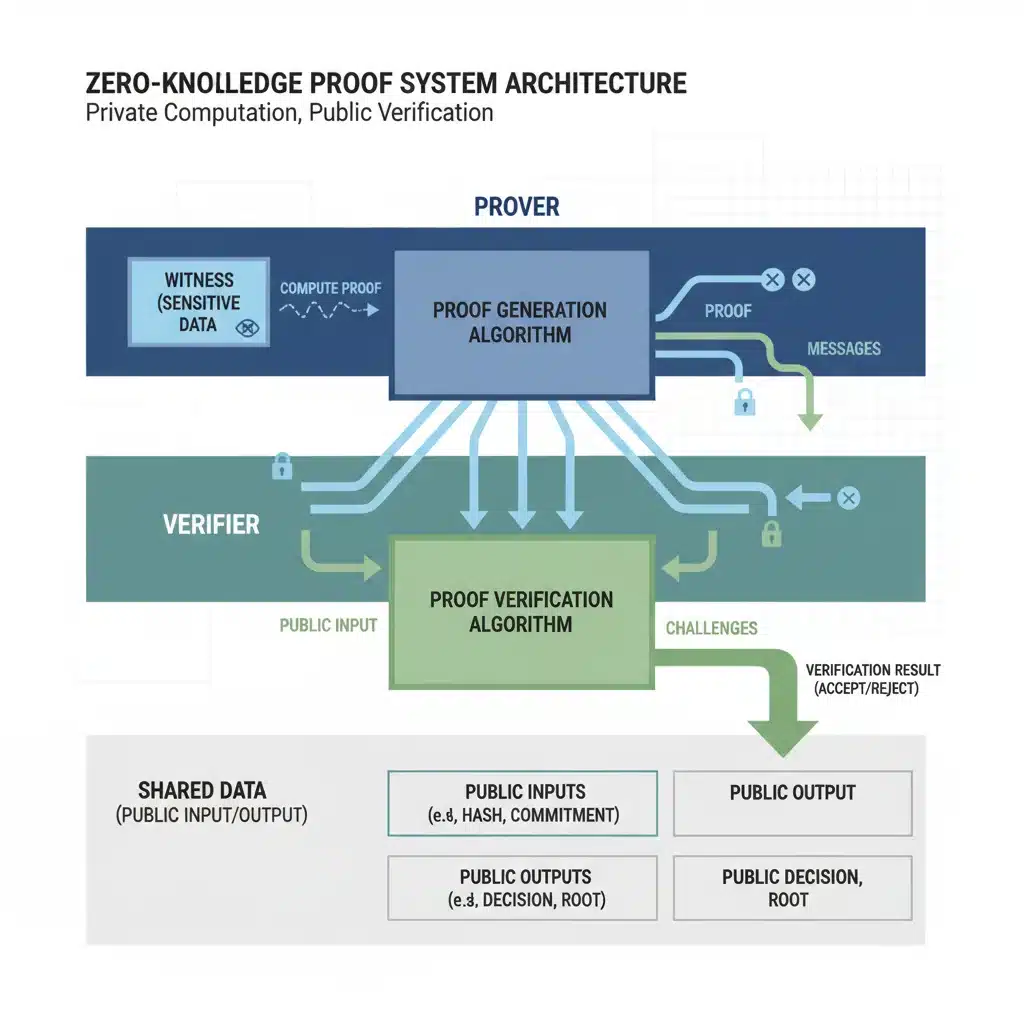
At its core, a Zero-Knowledge Proof (ZKP) is a method by which one party (the prover) can prove to another party (the verifier) that a given statement is true, without revealing any information beyond the veracity of the statement itself. Imagine being able to prove you are over 21 without showing your birthdate, or proving you own a certain amount of cryptocurrency without revealing your exact balance. This seemingly magical capability has profound implications for Web3, where transactions and interactions often occur on public blockchains, inherently exposing data.
The principles of ZKP are rooted in advanced mathematics and cryptography. While the technical details can be intricate, the fundamental properties that make ZKPs so powerful are:
- Completeness: If the statement is true, an honest prover can convince an honest verifier.
- Soundness: If the statement is false, no dishonest prover can convince an honest verifier.
- Zero-Knowledge: If the statement is true, the verifier learns nothing beyond the fact that the statement is true.
These properties allow for verifiable computation and private transactions, key elements for addressing the privacy deficits of traditional blockchain designs. For US developers building decentralized finance (DeFi) platforms, supply chain solutions, or identity management systems, ZKP offers a robust framework to embed privacy by design.
The Evolution of ZKP Technologies
The concept of ZKP has been around for decades, but recent advancements in computational efficiency and practical implementations have brought it to the forefront of Web3 development. Early ZKP schemes were often computationally intensive, making them impractical for widespread use. However, the emergence of more efficient constructions like zk-SNARKs (Zero-Knowledge Succinct Non-Interactive Argument of Knowledge) and zk-STARKs (Zero-Knowledge Scalable Transparent Argument of Knowledge) has revolutionized their applicability.
- zk-SNARKs: These proofs are small and quick to verify, making them ideal for on-chain applications where gas fees and block space are at a premium. Projects like Zcash were early adopters, demonstrating the power of zk-SNARKs for private transactions. However, they require a trusted setup, which can be a point of concern for some.
- zk-STARKs: Offering scalability and transparency (no trusted setup), zk-STARKs are gaining traction for applications requiring higher throughput and greater decentralization. They are particularly well-suited for scaling solutions like StarkWare’s StarkNet, enabling complex computations off-chain while maintaining on-chain verifiable integrity.
The ongoing research and development in ZKP cryptography continue to push the boundaries, with new schemes and optimizations constantly emerging. For US developers, staying abreast of these cryptographic innovations is crucial for selecting the right ZKP solution for their specific use cases, ensuring both efficiency and robust Web3 privacy.
Current Impact of Zero-Knowledge Proofs on Web3 Privacy in 2026
As of early 2026, the impact of Zero-Knowledge Proofs on Web3 privacy is multifaceted and profound. We are witnessing a paradigm shift where privacy is no longer an afterthought but a foundational layer in the design of decentralized applications. This shift is particularly relevant for US developers given the increasing scrutiny on data privacy regulations and consumer demand for greater control over personal information.
Enhanced Transaction Privacy in DeFi
One of the most immediate and significant impacts of ZKP is in decentralized finance (DeFi). Public blockchains, by their very nature, expose all transaction details, including sender, receiver, and amount. While this transparency is beneficial for auditability, it compromises user privacy, making financial activities traceable and potentially exposing users to front-running, censorship, or even personal security risks. ZKP addresses this by allowing users to prove ownership of funds and authorize transactions without revealing the underlying details.
Several leading DeFi protocols are now integrating ZKP to enable private transactions, anonymous trading, and confidential asset management. This not only protects users from malicious actors but also makes DeFi more appealing to institutional investors and privacy-conscious individuals who were previously hesitant due to privacy concerns. For US developers, this opens up a vast market for building privacy-preserving DeFi tools and services that comply with evolving financial regulations while upholding the ethos of decentralization.
Scalable and Private Layer 2 Solutions
Beyond transaction privacy, ZKP plays a pivotal role in scaling blockchain networks. Layer 2 solutions, such as rollups, leverage ZKP to bundle hundreds or thousands of transactions off-chain and then submit a single cryptographic proof to the main chain. This significantly increases transaction throughput and reduces costs, addressing one of the major bottlenecks of early blockchain architectures. Critically, ZKP-based rollups (zk-rollups) inherit the security of the underlying Layer 1 blockchain while also offering enhanced privacy features.
With zk-rollups, the details of individual transactions within a batch can remain private on the Layer 2, with only the proof of their validity being published on the main chain. This approach is transforming the user experience on major networks, making dApps faster, cheaper, and more private. US developers are at the forefront of building and optimizing these zk-rollup solutions, contributing to a more scalable and private Web3 ecosystem.
Decentralized Identity and Verifiable Credentials
The concept of self-sovereign identity (SSI) is central to Web3, empowering users to own and control their digital identities. Zero-Knowledge Proofs are indispensable in achieving true SSI and enabling verifiable credentials without compromising privacy. Instead of sharing sensitive personal data (e.g., your full ID, address, or credit score) with every service, ZKP allows you to prove specific attributes about yourself without revealing the underlying data.
For instance, a user could prove they are over 18 for an age-restricted service, or that they are an accredited investor, without disclosing their exact birthdate or financial details. This capability is revolutionary for compliance, KYC (Know Your Customer), and AML (Anti-Money Laundering) processes in Web3. US developers are actively exploring ZKP-powered decentralized identity solutions, aiming to create a future where individuals have granular control over their digital footprint, meeting regulatory requirements while preserving privacy.
Confidential Computing and Data Marketplaces
The application of ZKP extends to confidential computing, where data can be processed or analyzed without being revealed to the computing entity. This has massive implications for data marketplaces and collaborative data analysis in Web3. Companies can share encrypted datasets and perform computations on them, with ZKP ensuring the integrity of the computation and the privacy of the underlying data. This could unlock new business models and foster secure data collaboration across industries.
Imagine proving that your AI model was trained on a specific, verified dataset without revealing the dataset itself, or participating in a medical research study where your health data contributes to insights without being exposed. These are just a few examples of how ZKP is enabling a new era of secure and private data utilization in Web3, a domain where US developers, particularly those in the enterprise sector, are finding significant opportunities.
Challenges and Opportunities for US Developers
While the benefits of ZKP are clear, their adoption and implementation are not without challenges. For US developers, navigating these complexities presents both hurdles and immense opportunities.
Technical Complexity and Developer Tooling
One of the primary challenges is the inherent technical complexity of ZKP cryptography. Developing and deploying ZKP-based applications requires a deep understanding of advanced mathematics, cryptography, and specialized programming languages (e.g., Circom, Cairo). The learning curve can be steep, and the pool of skilled ZKP developers is still relatively small.
However, this challenge also presents a significant opportunity. There is a growing demand for developer tools, frameworks, and educational resources that abstract away the cryptographic complexities, making ZKP more accessible. US developers who focus on building these foundational tools, libraries, and SDKs will play a crucial role in accelerating ZKP adoption across Web3. Furthermore, specialized ZKP engineering talent is highly sought after, leading to lucrative career opportunities.
Regulatory Landscape in the US
The regulatory environment surrounding blockchain and cryptocurrency in the United States is continuously evolving. While ZKP enhances privacy, it also introduces complexities for regulators concerned with illicit activities and compliance. Striking a balance between privacy and regulatory oversight is a delicate act.
US developers must be keenly aware of existing and forthcoming regulations, particularly concerning anti-money laundering (AML), know your customer (KYC), and data privacy laws (e.g., CCPA, potential federal privacy frameworks). Developing ZKP solutions that offer ‘selective transparency’ – allowing for proof of compliance without revealing sensitive data – will be key. This involves designing systems where specific proofs can be generated for auditors or regulators when necessary, without compromising general user privacy. This area is ripe for innovation, with US developers having the chance to set global standards for privacy-preserving compliance.
Interoperability and Standardization
The Web3 ecosystem is fragmented, with numerous blockchains and Layer 2 solutions. Ensuring interoperability between ZKP-enabled dApps across different networks is another significant challenge. Developers need to consider how ZKP schemes can be standardized or made compatible to allow for seamless interaction and asset transfer.
Efforts towards common libraries, proof aggregation techniques, and cross-chain communication protocols that incorporate ZKP are underway. US developers contributing to these standardization efforts will be instrumental in creating a more cohesive and efficient Web3. This includes working on universal proof systems or bridging solutions that can verify proofs generated on different ZKP circuits.

The Road Ahead: What to Expect in Late 2026 and Beyond
Looking towards the latter half of 2026 and beyond, the role of Zero-Knowledge Proofs in Web3 privacy is poised for even greater expansion and sophistication. Several key trends are expected to dominate the landscape for US developers:
Wider Adoption of ZKP in Mainstream Applications
As ZKP tooling matures and becomes more accessible, we can expect to see its integration extend beyond niche cryptographic projects to more mainstream Web3 applications. This includes social media platforms, gaming, and enterprise supply chain solutions where verifiable privacy is crucial. The ease of implementing ZKP will be a major driver, shifting from specialized cryptographic engineering to a more generalized development task.
Advancements in Hardware Acceleration for ZKP
The computational demands of generating ZKP, especially complex ones, can still be significant. We anticipate further advancements in hardware acceleration (e.g., specialized ASICs, GPUs, FPGAs) designed specifically for ZKP computation. This will drastically reduce proof generation times and costs, making ZKP practical for an even broader range of real-time applications. US developers working at the intersection of hardware and cryptography will find exciting opportunities in this space.
Zero-Knowledge Machine Learning (ZKML)
A burgeoning field is Zero-Knowledge Machine Learning (ZKML), which allows for the verifiable execution of AI models without revealing the input data or the model parameters. This has immense potential for privacy-preserving AI, where users can prove they received a certain output from an AI model, or that a model was trained ethically, without disclosing proprietary information. ZKML could revolutionize industries from healthcare to finance, and US developers with expertise in both AI and ZKP will be highly sought after.
Increased Focus on User Experience (UX) for Privacy
While ZKP provides the underlying cryptographic guarantees, the user experience of interacting with privacy-preserving dApps still needs refinement. Future development will increasingly focus on intuitive interfaces and seamless integrations that make ZKP-powered privacy effortless for the end-user. This involves designing wallets, identity solutions, and application front-ends that abstract away the technical complexities, making privacy a default rather than an opt-in feature. US developers skilled in UX/UI design with a strong understanding of Web3 principles will be critical in this evolution.
Conclusion: Zero-Knowledge Proofs as a Cornerstone for Web3 Privacy
The journey of Web3 is inextricably linked with the quest for robust privacy. As of early 2026, Zero-Knowledge Proofs have firmly established themselves as a cornerstone technology, fundamentally reshaping how privacy is conceived and implemented in decentralized systems. For US developers, this is a pivotal moment. The skills and expertise in ZKP are becoming indispensable for building secure, scalable, and user-centric applications that will define the future of the internet.
From revolutionizing DeFi transaction privacy and enabling scalable Layer 2 solutions to empowering self-sovereign identity and fostering confidential computing, ZKP’s impact is broad and transformative. While challenges related to technical complexity, regulatory navigation, and interoperability persist, they are overshadowed by the immense opportunities for innovation and leadership. US developers who embrace ZKP will not only contribute to a more private and equitable Web3 but will also position themselves at the very forefront of technological advancement. The future of Web3 privacy is here, and it is powered by Zero-Knowledge Proofs.