2026 Crypto Phishing: Identifying & Mitigating New US Scams
The 2026 threat landscape for US crypto users is evolving rapidly, necessitating a proactive approach to identifying and mitigating sophisticated new phishing scams that target digital assets.
As the digital asset space continues its meteoric rise, so too does the ingenuity of malicious actors seeking to exploit unsuspecting users. For US crypto enthusiasts and investors, understanding the 2026 threat landscape: identifying and mitigating new phishing scams targeting US crypto users is not just recommended, it’s absolutely critical. The sophistication of these attacks is reaching unprecedented levels, demanding a constant evolution in our defense mechanisms.
The Evolving Nature of Crypto Phishing in 2026
The year 2026 marks a significant shift in the tactics employed by cybercriminals targeting cryptocurrency users. Traditional phishing emails are still prevalent, but they are now augmented by highly personalized and technologically advanced methods. Attackers leverage AI-driven tools to craft more convincing narratives, making it increasingly difficult for even vigilant users to discern legitimate communications from malicious ones.
This evolution is driven by several factors, including the increasing value of digital assets, the growing adoption of Web3 technologies, and the ever-present human element of trust. Phishing attacks are no longer generic; they are tailored, exploiting publicly available information to create a sense of familiarity and urgency, often leading to devastating financial losses for the victims.
AI-Enhanced Social Engineering
Artificial intelligence is now a formidable weapon in the phisher’s arsenal. AI-powered tools can analyze vast amounts of data to identify potential targets, craft highly personalized messages, and even mimic voices or writing styles. This makes social engineering attacks far more effective than in previous years.
- Deepfake Voice Scams: Attackers can synthesize the voices of trusted individuals (e.g., exchange support, project founders) to trick users into revealing sensitive information or authorizing transactions.
- Generative Text Phishing: AI generates grammatically perfect and contextually relevant phishing emails, making them indistinguishable from genuine communications, often bypassing traditional spam filters.
- Behavioral Mimicry: AI algorithms study user behavior online to predict vulnerabilities and tailor attack vectors that are most likely to succeed.
Sophisticated Impersonation Techniques
Impersonation has always been a cornerstone of phishing, but in 2026, it has reached new heights. Attackers are not just copying logos; they are creating entire cloned websites, applications, and even customer support experiences that are nearly identical to legitimate services. This makes verification a multi-layered challenge.
The rise of decentralized autonomous organizations (DAOs) and decentralized finance (DeFi) platforms has also opened new avenues for impersonation. Phishers create fake governance proposals, liquidity pools, or token offerings to lure users into approving malicious smart contracts.
The evolving nature of crypto phishing in 2026 demands a heightened sense of awareness and a proactive approach to security. Users must be educated on these new tactics to effectively protect their digital assets from increasingly sophisticated attacks.
Emerging Phishing Vectors Targeting US Crypto Users
The landscape of phishing attacks is constantly shifting, with new vectors emerging to exploit the latest technological advancements and user behaviors. For US crypto users, this means being aware of less conventional, yet highly effective, methods designed to compromise their digital security. These new vectors often leverage the interconnectedness of Web3, blurring the lines between legitimate interactions and malicious traps.
Deceptive DApp and Wallet Integrations
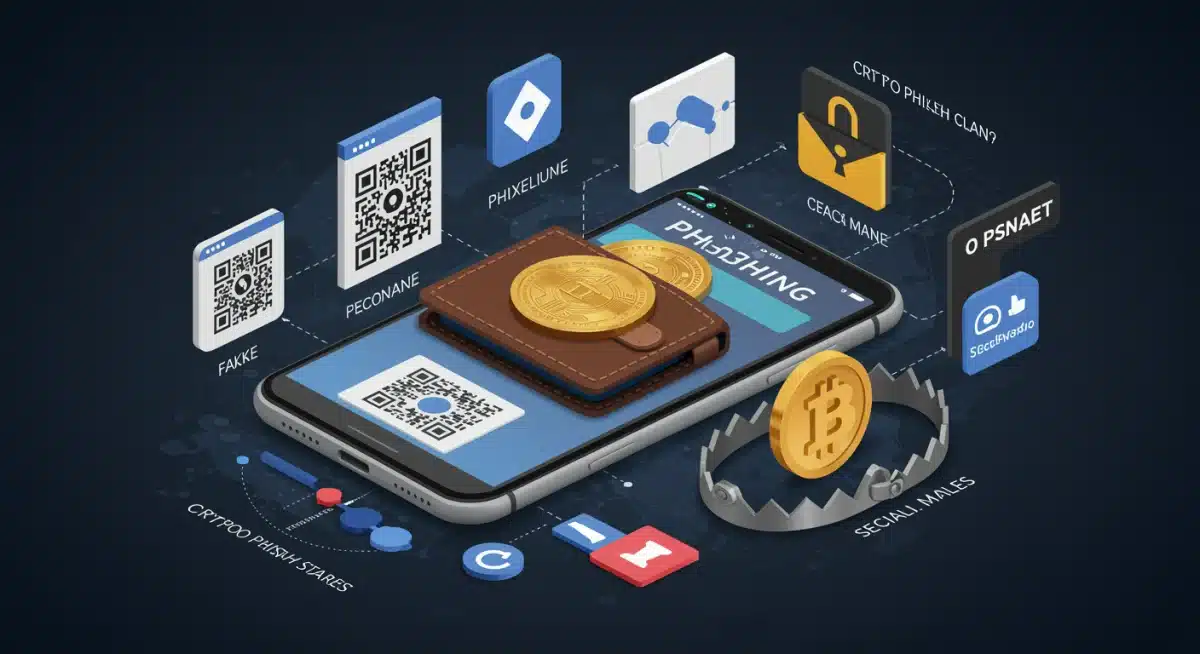
With the proliferation of decentralized applications (DApps) and browser-based crypto wallets, a new class of phishing attack has emerged. These involve malicious DApps that request excessive permissions or fake wallet extensions designed to steal seed phrases and private keys. Users are often tricked into connecting their legitimate wallets to these deceptive platforms, granting attackers unauthorized access.
Another common tactic involves fraudulent QR codes, often displayed in public places or on compromised websites, which direct users to phishing sites or initiate malicious transactions. The ease and speed of QR code scanning make them a prime target for exploitation.
Social Media and Influencer Scams
Social media platforms continue to be fertile ground for phishing. In 2026, this has escalated beyond simple fake giveaways. Attackers compromise legitimate influencer accounts or create highly convincing fake profiles to promote fraudulent investment opportunities, pump-and-dump schemes, or direct users to phishing websites under the guise of exclusive access or limited-time offers.
- Direct Message Phishing: Personalized messages from seemingly legitimate accounts or “support staff” asking for wallet verification or private information.
- Comment Section Lures: Bots flooding comment sections with links to fake airdrops or investment platforms.
- Compromised Accounts: Taking over popular crypto accounts to spread malicious links to a trusting audience.
The emergence of these new phishing vectors underscores the need for constant vigilance and critical evaluation of all digital interactions. US crypto users must develop a skeptical mindset, particularly when engaging with new DApps, wallet integrations, or social media promotions.
Advanced Mitigation Strategies for US Crypto Users
Protecting digital assets in 2026 requires more than just basic security practices; it demands advanced, multi-layered mitigation strategies. As phishing scams become increasingly sophisticated, US crypto users must adopt a proactive and comprehensive approach to safeguard their investments. This involves a combination of technological tools, behavioral awareness, and continuous education.
The goal is not just to react to threats, but to anticipate them, building a robust defense that can withstand the evolving tactics of cybercriminals. This means moving beyond simple password protection and embracing a holistic security posture.
Hardware Wallet Adoption and Secure Seed Phrase Management
Hardware wallets remain one of the most secure methods for storing cryptocurrencies. By keeping private keys offline, they significantly reduce the risk of remote attacks. However, their effectiveness is compromised if the seed phrase is not managed securely.
- Offline Storage: Store seed phrases physically, away from any internet-connected device. Consider using metal plates or fireproof containers.
- Never Digitalize: Absolutely avoid storing seed phrases on computers, cloud services, or taking photos of them.
- Multiple Locations: Distribute parts of your seed phrase across different secure, offline locations to guard against single points of failure.
Enhanced Authentication Protocols
Beyond traditional two-factor authentication (2FA), users should embrace more robust authentication methods. This includes physical security keys (e.g., FIDO2-compliant devices) for exchanges and wallets, which offer a higher level of protection against phishing and credential stuffing attacks.
Consider using multi-signature (multisig) wallets for significant holdings, which require multiple approvals before a transaction can be executed. While more complex, multisig adds a critical layer of security against unauthorized access.
Implementing advanced mitigation strategies is paramount for US crypto users navigating the 2026 threat landscape. By combining secure hardware, robust authentication, and diligent seed phrase management, users can significantly reduce their vulnerability to phishing attacks.
The Role of Decentralized Identity and Web3 Security Tools
The rise of Web3 technologies presents both new opportunities and new challenges for digital security. In 2026, decentralized identity (DID) solutions and specialized Web3 security tools are becoming increasingly vital in the fight against phishing. These innovations aim to empower users with greater control over their digital presence and provide more robust methods for verifying authenticity in a decentralized environment.
Traditional centralized identity systems are prone to single points of failure, making them attractive targets for attackers. Web3 security, conversely, focuses on distributing trust and leveraging cryptographic proofs to verify interactions, offering a more resilient defense against impersonation and fraud.
Decentralized Identity (DID) for Authentication
Decentralized identity systems allow users to own and control their digital identities, rather than relying on centralized providers. This can significantly reduce the effectiveness of phishing by making it harder for attackers to impersonate legitimate entities or trick users into revealing personal information.
When interacting with DApps or services, DIDs can provide verifiable credentials that prove authenticity without exposing underlying personal data. This shifts the power back to the user, making it more difficult for phishers to create convincing fake identities.
Specialized Web3 Anti-Phishing Tools
A new generation of security tools specifically designed for the Web3 ecosystem is emerging. These tools go beyond traditional antivirus software and browser extensions, offering protection tailored to the unique challenges of blockchain interactions.
- Wallet Security Scanners: These tools analyze smart contract interactions before execution, warning users of potential malicious code or excessive permissions requests.
- DeFi Transaction Simulators: Before confirming a transaction, these simulators show the user exactly what will happen to their assets, preventing unexpected token drains or approvals to malicious contracts.
- Reputation Systems: Decentralized reputation protocols help users identify trusted DApps, exchanges, and smart contracts, reducing the risk of interacting with fraudulent platforms.
Leveraging decentralized identity and specialized Web3 security tools is crucial for US crypto users to navigate the complexities of the 2026 digital landscape. These technologies provide enhanced authentication and proactive threat detection, empowering users to interact more securely within the decentralized web.
User Education and Best Practices in a High-Threat Environment
While technological solutions are essential, the human element remains the weakest link in the security chain. In 2026, comprehensive user education and the consistent application of best practices are non-negotiable for US crypto users facing an increasingly sophisticated phishing threat. Knowledge is power, and an informed user is the first and best line of defense against scams.
Educating oneself on the latest phishing tactics, understanding the red flags of suspicious communications, and adopting a disciplined approach to asset management can significantly reduce vulnerability. This continuous learning process is vital to staying ahead of attackers.
Recognizing Red Flags and Verifying Information
Users must cultivate a skeptical mindset and actively look for red flags in all digital communications related to their crypto assets. This includes scrutinizing email addresses, URL links, and sender identities.
- Check URLs Carefully: Always manually type URLs or verify them through trusted bookmarks. Phishing sites often use subtle misspellings or subdomains.
- Examine Email Headers: Learn to read email headers for inconsistencies in sender information, even if the display name appears legitimate.
- Be Wary of Urgency: Phishing scams often create a false sense of urgency to pressure users into making hasty decisions. Legitimate services rarely demand immediate action without prior warning.
Regular Security Audits and Updates
Regularly auditing one’s security setup is crucial. This involves reviewing all connected DApps, checking wallet permissions, and ensuring all software (operating systems, browsers, wallet applications) is up-to-date. Software updates often contain critical security patches that protect against newly discovered vulnerabilities.
Consider using dedicated, clean devices for crypto transactions, separate from devices used for general browsing or email. This creates an air-gapped layer of security for sensitive operations.
User education and the adoption of best practices are fundamental pillars of security for US crypto users in 2026. By fostering a culture of vigilance and continuous learning, individuals can significantly enhance their resilience against evolving phishing threats.
The Future of Anti-Phishing: Collaborative Defense and Regulatory Support
Looking ahead, the battle against crypto phishing in 2026 and beyond will increasingly rely on a collaborative defense strategy and supportive regulatory frameworks. Individual efforts, while crucial, are often insufficient against organized and well-funded cybercriminal networks. A unified approach involving industry players, government agencies, and the user community is essential to create a more secure digital asset ecosystem.
Regulatory bodies in the US are beginning to recognize the scale of the problem and are exploring measures to protect consumers, but these efforts need to be harmonized with technological advancements to be truly effective. The future of anti-phishing lies in shared intelligence and coordinated action.
Industry Collaboration and Threat Intelligence Sharing
Cryptocurrency exchanges, wallet providers, and blockchain analytics firms must enhance their collaboration to share threat intelligence more effectively. This includes sharing details of new phishing campaigns, malicious addresses, and attack methodologies in real-time.
Standardized protocols for reporting and blacklisting phishing sites and wallets could significantly reduce the lifespan and impact of these attacks. Industry-wide initiatives to educate users and develop common security standards are also vital.
Regulatory Frameworks and Consumer Protection
Government agencies have a critical role to play in establishing clear regulatory frameworks that enhance consumer protection in the crypto space. This could include:
- Stronger Reporting Mechanisms: Easier and more effective ways for victims of crypto phishing to report incidents and seek recourse.
- Enforcement Against Scammers: Increased resources and international cooperation to track down and prosecute cybercriminals.
- Mandatory Security Standards: Requiring crypto service providers to adhere to minimum security standards and implement robust anti-phishing measures.
The future of anti-phishing in 2026 will be shaped by a combination of technological innovation, collaborative industry efforts, and supportive regulatory action. By working together, stakeholders can build a more resilient and trustworthy environment for US crypto users, effectively mitigating the threat of new phishing scams.
| Key Aspect | Brief Description |
|---|---|
| AI-Enhanced Phishing | Sophisticated scams using AI for personalized messages and deepfake impersonations, bypassing traditional defenses. |
| New Attack Vectors | Deceptive DApps, malicious QR codes, and compromised social media accounts are common entry points. |
| Advanced Mitigation | Hardware wallets, multisig, and FIDO2 keys are crucial, alongside secure seed phrase management. |
Frequently Asked Questions About 2026 Crypto Phishing
In 2026, the most significant threats include AI-powered social engineering, such as deepfake voice scams and generative text phishing, as well as highly sophisticated impersonation of DApps, wallets, and social media influencers. These methods leverage advanced technology to create extremely convincing fraudulent interactions.
Protecting against AI-driven phishing requires enhanced vigilance. Always verify identities through multiple channels, use hardware wallets, enable strong multi-factor authentication, and be extremely skeptical of unsolicited communications, especially those creating urgency or requesting sensitive information. Never trust a voice or text message at face value.
Hardware wallets remain a critical component of crypto security, as they keep private keys offline. However, their effectiveness hinges on secure seed phrase management and user awareness. Phishers now target seed phrases directly through deceptive DApp integrations or social engineering, so hardware wallets must be combined with other security practices.
Decentralized identity (DID) gives users control over their digital identity, making impersonation harder. Web3 security tools, like wallet scanners and transaction simulators, specifically analyze smart contract interactions for malicious intent before execution, providing a proactive defense layer against new DApp-based phishing threats.
Best practices include continuous education on new scam tactics, meticulous verification of all links and sender identities, using dedicated devices for crypto, implementing strong authentication beyond 2FA, and regularly auditing security settings and connected DApps. A skeptical and informed approach is your strongest defense.
Conclusion
The 2026 threat landscape for US crypto users is undeniably complex, characterized by increasingly sophisticated phishing scams that leverage advanced AI and exploit the nuances of Web3. Protecting digital assets demands a multi-faceted approach, combining robust technological defenses like hardware wallets and specialized Web3 security tools with continuous user education and stringent best practices. As cybercriminals evolve, so too must our collective and individual defenses. By fostering a culture of vigilance, embracing innovative security solutions, and promoting collaborative efforts across the industry and regulatory bodies, we can build a more resilient and secure environment for all crypto enthusiasts in the United States, safeguarding their investments against the ever-present threat of digital theft.