Web3 Innovations: Deploying Custom zk-Rollups for Enterprise by Q2 2025

Deploying custom zk-Rollup solutions for enterprise use cases by Q2 2025 represents a significant leap in Web3 innovation, offering enhanced scalability and privacy for complex business operations. This guide outlines the essential steps and considerations for successful implementation.
The landscape of decentralized technologies is rapidly evolving, and enterprises are increasingly looking towards Web3 for transformative solutions. Among these, Web3 Innovations: A Step-by-Step Guide to Deploying a Custom zk-Rollup Solution for Enterprise Use Cases by Q2 2025 stands out as a critical area for achieving scalability, privacy, and efficiency in blockchain applications. This guide will walk you through the intricacies of integrating this cutting-edge technology into your business operations.
Understanding zk-Rollups and Their Enterprise Value
Zero-knowledge Rollups, or zk-Rollups, are a Layer 2 scaling solution for blockchains that bundle hundreds of transactions off-chain into a single transaction. A cryptographic proof, known as a zero-knowledge proof, is then generated for this bundle and submitted to the mainnet. This significantly reduces the computational load on the main blockchain, leading to higher throughput and lower transaction costs.
For enterprises, the value proposition of zk-Rollups is immense. They offer a pathway to leverage the security and immutability of public blockchains without being constrained by their inherent scalability limitations. Furthermore, the privacy features of zero-knowledge proofs can be particularly attractive for businesses dealing with sensitive data, allowing for verification of information without revealing the underlying details.
The Core Mechanics of zk-Rollups
At its heart, a zk-Rollup operates by moving computation and state storage off-chain. This allows for a massive increase in transaction processing capacity. The integrity of these off-chain computations is guaranteed by mathematical proofs.
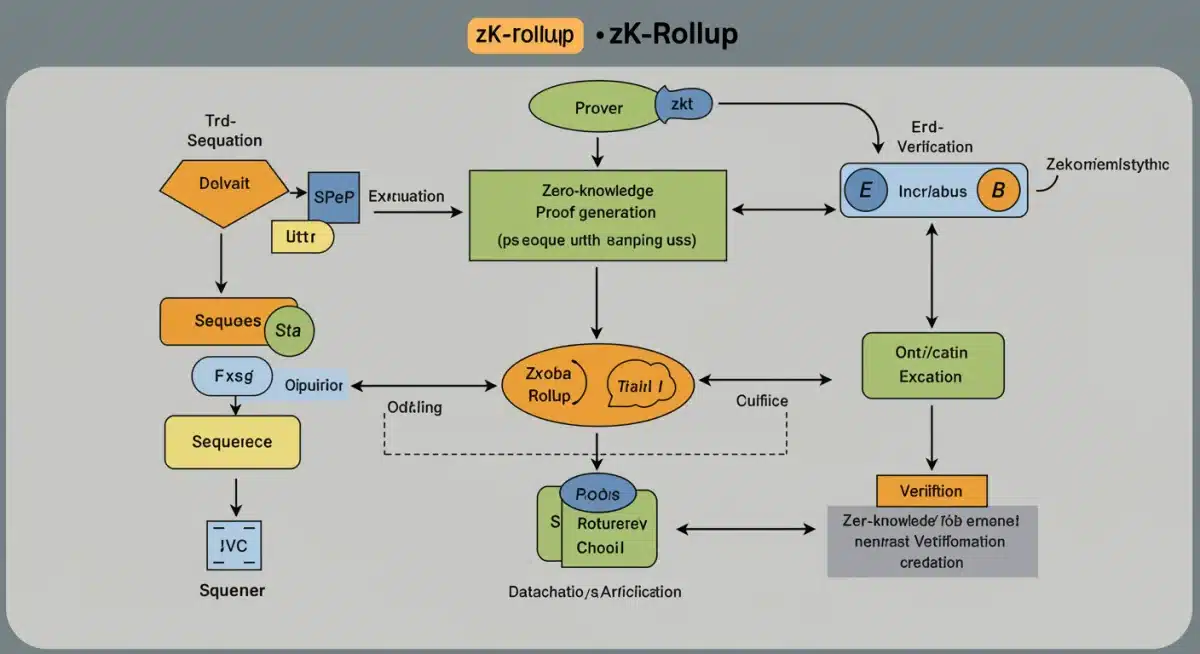
- Off-chain Execution: Transactions are processed and aggregated on a separate Layer 2 network.
- Zero-Knowledge Proof Generation: A succinct cryptographic proof (e.g., SNARK or STARK) is created to attest to the validity of all off-chain transactions.
- On-chain Verification: This single proof is then submitted to the main blockchain, where a smart contract verifies its correctness, thereby updating the mainnet’s state.
- Data Availability: While transactions are executed off-chain, a small amount of data for each transaction is typically posted on-chain, ensuring that anyone can reconstruct the rollup’s state if needed.
The combination of these elements provides a powerful solution for enterprises seeking to build scalable and privacy-preserving decentralized applications. It addresses key bottlenecks that have historically hindered broader enterprise adoption of blockchain technology.
In essence, zk-Rollups represent a sophisticated blend of cryptography and distributed systems design, offering a robust foundation for next-generation enterprise Web3 applications. Their ability to maintain strong security guarantees while drastically improving performance positions them as a cornerstone technology for future decentralized ecosystems.
Strategic Planning and Use Case Identification
Before diving into technical implementation, a thorough strategic planning phase is crucial. This involves identifying specific enterprise use cases where a custom zk-Rollup solution can deliver tangible benefits. Not every business process will benefit equally from this technology, so careful analysis is warranted.
Begin by assessing existing pain points within your current operations that could be alleviated by blockchain’s immutability, transparency, or decentralization, but are currently hampered by scalability or privacy concerns. Focus on areas where high transaction volume or sensitive data exchanges are prevalent.
Identifying Key Enterprise Use Cases
Consider the following examples where zk-Rollups can be particularly impactful:
- Supply Chain Management: Tracking goods with high frequency, ensuring authenticity and provenance without revealing sensitive supplier or customer data to all participants.
- Financial Services: Processing micro-transactions, enabling secure and private cross-border payments, or facilitating complex derivative trading with enhanced privacy for trade details.
- Gaming and Metaverse: Handling millions of in-game transactions, NFT mints, and virtual asset transfers with minimal latency and cost.
- Healthcare Data Management: Securely sharing parts of patient data for research or administrative purposes, verifying credentials without exposing full personal health information.
Once potential use cases are identified, conduct a detailed feasibility study. This includes evaluating the technical complexity, potential return on investment (ROI), and alignment with overall business objectives. Engage stakeholders from various departments, including IT, legal, finance, and operations, to gather diverse perspectives and ensure broad organizational buy-in.
The strategic phase lays the groundwork for a successful deployment. It ensures that the technical efforts are aligned with concrete business needs and that the chosen use cases are genuinely poised to benefit from the unique capabilities of a custom zk-Rollup solution. A well-defined strategy minimizes risks and maximizes the potential for a high-impact implementation.
Architectural Design and Blockchain Selection
With a clear understanding of the use cases, the next step involves designing the architecture of your custom zk-Rollup and selecting the underlying Layer 1 blockchain. This decision will significantly impact the security, performance, and long-term viability of your solution.
The architectural design must consider various components, including the sequencer (who bundles transactions), the prover (who generates proofs), and the verifier (the smart contract on the Layer 1). Each component needs to be designed with resilience, efficiency, and security in mind.
Choosing the Right Layer 1 Blockchain
The choice of the base layer blockchain is paramount. Factors to consider include:
- Security: The robustness and decentralization of the Layer 1 directly impacts the security of your zk-Rollup. Ethereum is a popular choice due to its battle-tested security and large developer community.
- Cost: Transaction fees on the Layer 1 for submitting proofs can vary. Evaluate the gas costs associated with your chosen chain.
- Developer Ecosystem: A vibrant ecosystem with extensive tooling, documentation, and community support can accelerate development and reduce maintenance overhead.
- Compatibility: Consider how easily your existing systems and desired functionalities can integrate with the chosen Layer 1’s smart contract environment.
Beyond the Layer 1, the design of the zk-Rollup itself requires decisions on proof systems (SNARKs vs. STARKs), data availability mechanisms, and dispute resolution protocols. Customization here allows for tailoring the rollup to specific enterprise requirements, such as enhanced privacy features or specific throughput targets. Engaging with experienced blockchain architects and cryptographers is highly recommended during this phase to ensure a robust and future-proof design.
A well-thought-out architectural design, coupled with an informed Layer 1 blockchain selection, provides the technical blueprint for your custom zk-Rollup. This phase translates strategic objectives into concrete technical specifications, setting the stage for development and implementation.
Development and Proof-of-Concept Implementation
After finalizing the architectural design, the development phase begins. This involves coding the smart contracts for both the Layer 1 (verifier) and the Layer 2 (sequencer, prover, and rollup logic), as well as integrating any necessary off-chain components. Starting with a Proof-of-Concept (PoC) is often the most prudent approach.
A PoC allows for agile iteration and validation of core functionalities without committing extensive resources to a full-scale deployment immediately. It helps in identifying potential technical challenges early on and refining the design based on real-world performance.

Key Development Milestones for a Custom zk-Rollup
- Smart Contract Development: Write and rigorously test the verifier contract on the Layer 1 and the rollup logic on Layer 2.
- Prover Implementation: Develop or integrate a specialized prover component capable of generating zero-knowledge proofs efficiently.
- Sequencer Development: Build the sequencer responsible for aggregating transactions and submitting them to the rollup.
- Off-chain Infrastructure: Set up the necessary servers and databases for off-chain computation and data storage.
- API and SDK Development: Create interfaces for enterprise applications to interact with the zk-Rollup.
Security audits are paramount throughout the development process. Given the cryptographic complexity of zk-Rollups, engaging with reputable third-party auditors is essential to identify and mitigate vulnerabilities. Regular code reviews, penetration testing, and formal verification methods should be employed to ensure the integrity and security of the solution.
The development and PoC phase is where the theoretical design transforms into a functional system. It’s a period of intense coding, testing, and refinement, ultimately leading to a robust and secure custom zk-Rollup solution ready for broader deployment.
Integration, Testing, and Security Audits
Once the core components of the custom zk-Rollup are developed, the focus shifts to integrating it with existing enterprise systems and conducting comprehensive testing. This phase is critical for ensuring that the solution functions seamlessly within the broader IT infrastructure and meets all performance and security requirements.
Integration often involves developing adapters or connectors to bridge the zk-Rollup with legacy databases, ERP systems, and other internal applications. This ensures data flow is smooth and consistent across the enterprise, minimizing disruption to existing workflows.
Rigorous Testing Protocols
- Unit Testing: Verify individual components of the zk-Rollup (smart contracts, prover, sequencer) function as expected.
- Integration Testing: Ensure seamless communication and data exchange between different components of the zk-Rollup and with external enterprise systems.
- Performance Testing: Stress test the rollup to measure its throughput, latency, and scalability under various load conditions, ensuring it meets the defined enterprise requirements.
- Security Testing: Conduct vulnerability assessments, penetration testing, and fuzz testing to identify and rectify potential security flaws.
- User Acceptance Testing (UAT): Involve end-users and business stakeholders to validate that the solution meets their functional and operational needs.
Following internal testing, a comprehensive external security audit by specialized blockchain security firms is non-negotiable. These audits provide an independent review of the codebase, cryptography, and overall system design, identifying any critical vulnerabilities that might have been overlooked. The findings from these audits should be addressed promptly and thoroughly.
This phase is about confidence building. Through meticulous integration, rigorous testing, and independent security audits, the enterprise ensures that its custom zk-Rollup solution is not only functional but also secure, reliable, and ready for production deployment.
Deployment, Monitoring, and Iteration
The final stage involves deploying the custom zk-Rollup solution to a production environment, establishing robust monitoring systems, and planning for continuous iteration and improvement. Deployment should be a phased approach, starting with a controlled rollout to a limited user base before a full-scale launch.
A phased deployment allows for real-world validation of the solution’s performance and stability, providing an opportunity to address any unforeseen issues in a controlled manner. Clear communication with stakeholders and end-users throughout this process is crucial for managing expectations.
Post-Deployment Operations and Maintenance
- Continuous Monitoring: Implement comprehensive monitoring tools to track the health, performance, and security of the zk-Rollup. This includes observing transaction throughput, proof generation times, and Layer 1 interactions.
- Incident Response: Establish clear protocols for identifying, responding to, and resolving any operational or security incidents.
- Regular Upgrades and Maintenance: Plan for periodic upgrades to the zk-Rollup’s components, smart contracts, and underlying cryptography to incorporate new features, optimizations, and security patches.
- Performance Optimization: Continuously analyze performance data to identify bottlenecks and implement optimizations to further enhance scalability and efficiency.
- Community Engagement (if applicable): For public-facing enterprise applications, engaging with the broader Web3 community can foster adoption and provide valuable feedback.
The Web3 space is constantly evolving, and a custom zk-Rollup solution should be viewed as a living system that requires ongoing attention. Regular iteration, driven by performance data, user feedback, and emerging technological advancements, will ensure the solution remains competitive and continues to deliver value to the enterprise. This continuous improvement mindset is key to maximizing the long-term benefits of deploying a custom zk-Rollup.
Successful deployment is not the end, but rather the beginning of a journey of continuous optimization and adaptation. By embracing a proactive approach to monitoring and iteration, enterprises can ensure their zk-Rollup solution remains a powerful asset in their Web3 strategy.
| Key Aspect | Brief Description |
|---|---|
| Strategic Planning | Identify essential enterprise use cases benefiting from zk-Rollup scalability and privacy. |
| Architectural Design | Define rollup structure, select base Layer 1 blockchain, and design components. |
| Development & Testing | Code smart contracts, build prover/sequencer, integrate, and conduct rigorous security audits. |
| Deployment & Monitoring | Phased rollout, continuous performance monitoring, and iterative improvements. |
Frequently Asked Questions About zk-Rollups for Enterprise
zk-Rollups offer significant scalability improvements by processing transactions off-chain, drastically reducing costs and increasing throughput. They also enhance privacy through zero-knowledge proofs, allowing businesses to verify information without exposing sensitive data, which is crucial for compliance and competitive advantage.
Choosing a Layer 1 involves assessing its security, transaction costs, developer ecosystem, and compatibility with your enterprise’s existing infrastructure. Ethereum is a common choice due to its proven security and robust community, but other chains may suit specific technical or business requirements.
Security is paramount. It requires rigorous smart contract audits, robust cryptographic proof generation, and secure off-chain infrastructure. Independent third-party security audits are essential to identify and mitigate vulnerabilities, ensuring the integrity and trustworthiness of the rollup solution.
The timeline can vary significantly based on complexity and customization. Typically, it involves several months for strategic planning, architectural design, and initial PoC development. Full integration, testing, and deployment can extend this to 9-18 months, with continuous iteration post-launch.
Long-term success hinges on continuous monitoring, regular maintenance, and iterative improvements. Staying abreast of Web3 advancements, responding to user feedback, and proactively optimizing performance are crucial. A dedicated team for ongoing support and development is highly recommended.
Conclusion
The journey to deploying a custom zk-Rollup solution for enterprise use cases by Q2 2025 is multifaceted, demanding strategic foresight, meticulous technical execution, and a commitment to continuous improvement. As Web3 innovations continue to redefine digital interactions, zk-Rollups stand as a testament to the power of cryptographic solutions in addressing real-world enterprise challenges. By carefully navigating the steps from strategic planning to post-deployment monitoring, businesses can unlock unparalleled scalability, privacy, and efficiency, positioning themselves at the forefront of the decentralized economy. This transformative technology offers a robust pathway for enterprises to fully embrace the potential of blockchain, ensuring secure and high-performance operations in an increasingly decentralized future.