Altcoin Ecosystems Explored: Cross-Chain Solutions in 2026
Altcoin ecosystems are poised for a significant transformation by mid-2026, driven by the emergence of advanced cross-chain interoperability solutions designed to facilitate seamless communication and asset transfers across diverse blockchain networks.
The cryptocurrency landscape is continuously evolving, and by mid-2026, a pivotal shift is anticipated as altcoin ecosystems explored: a deep dive into cross-chain interoperability solutions launching in mid-2026 takes center stage. This upcoming wave of innovation promises to dissolve existing blockchain silos, fostering a more connected, efficient, and user-friendly Web3 environment.
The emerging need for cross-chain interoperability
The blockchain world, while revolutionary, has long been characterized by a fragmented ecosystem. Each blockchain operates as an independent ledger, often making it challenging to transfer assets or information between them. This isolation hinders scalability, limits liquidity, and complicates the user experience, particularly for developers building decentralized applications (dApps) that could benefit from leveraging features across multiple chains.
As the number of altcoins and specialized blockchains has exploded, the demand for seamless communication and asset transfer has become critical. Users and developers alike are seeking solutions that can unlock the full potential of Web3, moving beyond the limitations of single-chain environments. The vision is a future where a token minted on one blockchain can be effortlessly used in a dApp on another, or where smart contracts can trigger actions across different networks without complex intermediaries.
This drive for interconnectedness is not just about convenience; it’s about fostering innovation. When blockchains can communicate, developers gain a broader palette of tools and functionalities, enabling the creation of more sophisticated and powerful decentralized applications that were previously impossible. The economic implications are also significant, as increased liquidity and accessibility can unlock new markets and investment opportunities within the crypto space.
In essence, the fragmented nature of today’s blockchain landscape acts as a bottleneck for mass adoption and advanced functionality. The solutions emerging by mid-2026 aim to dismantle these barriers, paving the way for a truly integrated and efficient decentralized internet.
Understanding the core of cross-chain solutions
Cross-chain interoperability refers to the ability of different blockchain networks to communicate, exchange data, and transfer assets with each other. This is a fundamental challenge in the decentralized space, as blockchains often use different consensus mechanisms, programming languages, and data structures. Overcoming these disparities requires sophisticated technological bridges and protocols.
The goal is to create a seamless experience for users, where they don’t need to be aware of the underlying complexities of different chains. Imagine being able to use a stablecoin from Ethereum to pay for a service on a Solana-based platform, or transferring an NFT from Polygon to an Avalanche-powered metaverse. These capabilities are at the heart of the next generation of Web3 applications.
Key architectural approaches
- Blockchain bridges: These are protocols that connect two disparate blockchains, allowing assets and data to flow between them. They typically involve locking assets on one chain and minting wrapped versions on the other.
- Interoperability protocols: More advanced solutions, such as Polkadot’s parachains or Cosmos’s IBC, are designed from the ground up to allow for native communication and shared security between multiple chains within their ecosystems.
- Layer 0 solutions: These foundational layers aim to provide a common infrastructure upon which different blockchains can be built and communicate, offering a more generalized approach to interoperability.
The development of these solutions is a complex endeavor, requiring robust security measures to prevent exploits and ensure the integrity of cross-chain transactions. As these technologies mature, they will form the backbone of a more unified and functional decentralized internet experience.
Innovations driving cross-chain development by mid-2026
The period leading up to mid-2026 is witnessing an acceleration in the development and deployment of groundbreaking cross-chain technologies. These innovations are not merely incremental improvements but represent fundamental shifts in how blockchains will interact. The focus is on enhancing security, increasing transaction speed, and significantly improving user experience, making cross-chain operations more accessible to a broader audience.
One of the most significant advancements is the maturation of zero-knowledge (ZK) proofs in the context of cross-chain communication. ZK-proofs allow one party to prove to another that a statement is true, without revealing any information beyond the validity of the statement itself. When applied to bridges, this can significantly enhance privacy and security, as transaction details can be verified across chains without exposing sensitive data.
Emerging technological breakthroughs
- Atomic swaps with enhanced security: New protocols are emerging that facilitate trustless, peer-to-peer exchanges of cryptocurrencies between different blockchains without the need for an intermediary, incorporating advanced cryptographic techniques for greater security and reliability.
- Generalized message passing: Beyond just asset transfers, solutions are being developed to allow for the arbitrary exchange of data and complex smart contract calls across chains. This opens up entirely new possibilities for dApp development, allowing components of an application to reside on different blockchains while interacting seamlessly.
- Decentralized oracle networks for cross-chain data: Oracles that can securely and reliably feed off-chain data onto multiple blockchains are becoming increasingly sophisticated, enabling smart contracts on one chain to react to events or data originating from another.
These innovations are designed to address the inherent challenges of security, scalability, and decentralization that have plagued earlier attempts at cross-chain solutions. By mid-2026, many of these advanced protocols are expected to be fully operational, dramatically reshaping the interoperability landscape.
Major players and their interoperability solutions
Several prominent projects are leading the charge in developing robust cross-chain interoperability solutions, each with its unique approach and architectural philosophy. Understanding these key players provides insight into the diverse strategies being employed to connect the fragmented blockchain ecosystem. These projects are not just building technology; they are fostering entire ecosystems designed for seamless interaction.
Polkadot, for instance, focuses on a sharded model with a central Relay Chain coordinating multiple parachains. These parachains, which are independent blockchains, can communicate securely within the Polkadot ecosystem, sharing security and achieving high throughput. Cosmos, on the other hand, utilizes the Inter-Blockchain Communication (IBC) protocol, allowing independent blockchains (Zones) to transfer tokens and data directly with each other, fostering a ‘network of networks’ approach.
Leading interoperability projects
- LayerZero: A prominent infrastructure for omnichain dApps, LayerZero enables direct and secure communication between various blockchains, facilitating asset transfers and message passing without intermediate bridges.
- Axelar Network: Providing a secure, universal overlay network, Axelar aims to connect all blockchains, allowing dApps to interact with any chain, asset, or user. It emphasizes security and decentralization in its cross-chain message routing.
- Wormhole: A generic message-passing protocol that connects multiple blockchains, Wormhole allows developers to build applications that span across different ecosystems, supporting token and NFT transfers, and general data messaging.
These projects, along with others like Chainlink’s Cross-Chain Interoperability Protocol (CCIP), are not just competing but often collaborating to establish a set of standards and best practices for cross-chain communication. Their success will largely determine the pace of Web3 adoption and the realization of a truly interconnected digital economy.
Security challenges and mitigation strategies
While the promise of cross-chain interoperability is immense, it also introduces significant security challenges. Connecting disparate blockchain networks creates new attack vectors, making bridges and cross-chain protocols attractive targets for malicious actors. The history of crypto is unfortunately replete with incidents of bridge exploits, resulting in substantial financial losses. Therefore, robust security measures are paramount for the widespread adoption of these solutions.
The primary concern revolves around the integrity of asset transfers and data relayed between chains. If a bridge is compromised, assets locked on one side could be stolen, or fraudulent messages could be injected into the recipient chain. This necessitates a multi-layered approach to security, combining cryptographic assurances with decentralized governance and continuous auditing.
Addressing cross-chain security
- Decentralized validators and consensus: Moving away from centralized intermediaries to a distributed network of validators that collectively secure cross-chain transactions reduces single points of failure.
- Audits and bug bounties: Rigorous security audits by independent firms and active bug bounty programs are crucial for identifying and patching vulnerabilities before they can be exploited.
- Time-locked upgrades and emergency halts: Protocols are implementing mechanisms that allow for controlled upgrades and, in extreme cases, emergency halts to prevent further damage during an active exploit.
Furthermore, the development of fraud proofs and challenge periods in some cross-chain designs allows for the verification of transactions by network participants, adding an additional layer of security. As these solutions mature by mid-2026, the focus on battle-tested security architectures will be a key differentiator for successful interoperability platforms.
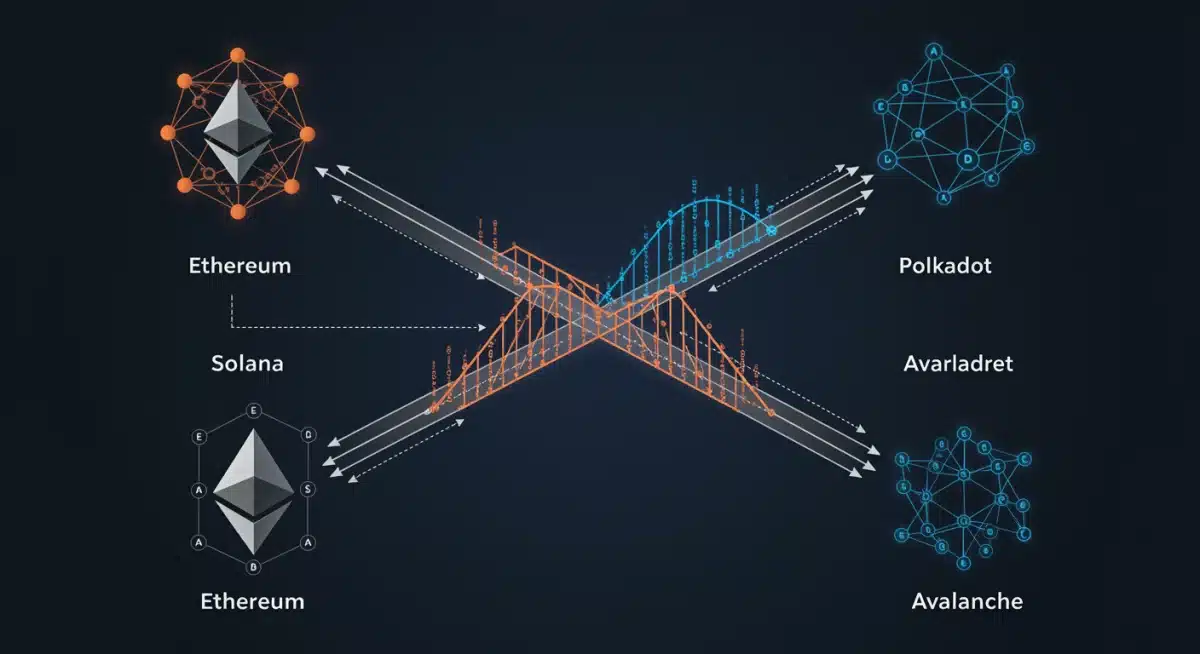
The impact on altcoin ecosystems and Web3 adoption
The widespread implementation of advanced cross-chain interoperability solutions by mid-2026 is set to profoundly impact altcoin ecosystems and accelerate the mainstream adoption of Web3 technologies. By breaking down the barriers between blockchains, these solutions will unlock unprecedented levels of liquidity, utility, and innovation, fundamentally reshaping the digital economy.
For altcoins, this means increased accessibility and exposure. A token previously confined to a single ecosystem can now be utilized across multiple platforms, driving demand and enhancing its overall value proposition. Developers will no longer be forced to choose a single blockchain for their dApps but can instead leverage the unique strengths of various chains, leading to more robust and feature-rich applications. This flexibility will foster a more competitive and innovative environment, benefiting users with better services and experiences.
Transformative effects on Web3
- Enhanced user experience: Users will enjoy a more fluid and intuitive experience, able to move assets and interact with dApps across chains without cumbersome manual processes or reliance on centralized exchanges.
- Increased liquidity and capital efficiency: Capital will flow more freely between ecosystems, improving market efficiency and reducing fragmentation, which can lead to more stable asset prices and better trading opportunities.
- New use cases and dApp designs: Developers can build truly composable applications that integrate functionalities from different blockchains, allowing for novel and complex dApps that were previously impossible.
Ultimately, a more interconnected blockchain landscape will pave the way for a truly decentralized internet where digital assets and data move freely, empowering users and fostering a new era of digital innovation. The vision of a seamless Web3 experience, where blockchain boundaries are largely invisible to the end-user, will become a reality by mid-2026.
| Key Aspect | Brief Description |
|---|---|
| Need for Interoperability | Addresses blockchain fragmentation to enable seamless asset and data exchange, crucial for Web3 growth. |
| Core Solutions | Includes blockchain bridges, interoperability protocols (like IBC), and Layer 0 networks for cross-chain communication. |
| Driving Innovations | ZK-proofs, enhanced atomic swaps, and generalized message passing are advancing cross-chain capabilities. |
| Security Focus | Decentralized validators, rigorous audits, and emergency protocols are vital to protect against exploits. |
Frequently asked questions about cross-chain interoperability
Cross-chain interoperability essentially means different blockchain networks can talk to each other. It allows users to transfer assets and data between various blockchains, like moving a token from Ethereum to Solana, without needing complex conversions or intermediaries. This creates a more connected and efficient crypto ecosystem for everyone.
For altcoins, interoperability unlocks greater utility and liquidity. It means an altcoin can be used in more decentralized applications (dApps) across different blockchains, increasing its reach and potential value. This fosters innovation, as developers can build more complex applications by combining features from various chains, leading to broader adoption.
The primary types include blockchain bridges, which connect two specific chains for asset transfer, and interoperability protocols like Cosmos IBC or Polkadot’s parachains, designed for native communication within a network of chains. Newer Layer 0 solutions aim to provide a foundational layer for universal blockchain interaction, enhancing overall connectivity.
The main concern is the vulnerability of bridges to exploits, leading to asset theft or fraudulent transactions. Solutions address this through decentralized validators, rigorous security audits, bug bounty programs, and emergency shutdown mechanisms. The goal is to minimize single points of failure and ensure the integrity of cross-chain operations.
By mid-2026, advanced interoperability will significantly enhance the Web3 user experience, making it more seamless and intuitive. It will boost liquidity across altcoin ecosystems, foster new dApp designs, and ultimately accelerate mainstream adoption by making blockchain technology more accessible and functional for a wider audience. The fragmented nature of Web3 will largely diminish.
Conclusion
The journey towards a truly interconnected blockchain universe is rapidly advancing, with altcoin ecosystems explored: a deep dive into cross-chain interoperability solutions launching in mid-2026 marking a critical inflection point. These innovations are not just technical marvels but fundamental enablers of a more efficient, secure, and user-friendly Web3. As the barriers between disparate blockchains fall, we anticipate an explosion of new applications, enhanced liquidity, and a more robust digital economy, making the decentralized future a tangible reality for millions. The coming years promise a transformative shift in how we interact with and perceive blockchain technology.