Smart Contract Oracle Integration 2026: Top 5 U.S. Providers Analyzed

Understanding smart contract oracle integration in 2026 is vital for U.S. projects, as secure and reliable external data feeds are fundamental for decentralized applications to function effectively and maintain trust.
Welcome to 2026, where the digital landscape is increasingly shaped by decentralized technologies. For U.S. projects aiming to leverage the full potential of blockchain, robust smart contract oracle integration is no longer a luxury but a necessity. This article dives deep into the top five leading oracle providers, offering a data-backed analysis to guide your strategic decisions in this rapidly evolving Web3 era.
The Crucial Role of Oracles in 2026’s Decentralized Ecosystem
In 2026, smart contracts are the backbone of countless decentralized applications (dApps), automating agreements and transactions without intermediaries. However, their inherent limitation lies in their inability to directly access real-world data outside their native blockchain. This is where oracles become indispensable, acting as secure bridges that feed external information into smart contracts, enabling them to react to events in the physical world.
The demand for reliable and secure oracle solutions has exploded, driven by the expansion of DeFi, NFTs, supply chain management, and enterprise blockchain solutions. Without accurate, tamper-proof data feeds, smart contracts are essentially blind, unable to execute agreements contingent on off-chain events like market prices, weather conditions, or verified identities.
The integrity of data provided by oracles directly impacts the security and trustworthiness of smart contracts. A compromised oracle can lead to significant financial losses or system failures, making the selection of a robust provider a critical decision for any U.S. project.
- Security: Oracles must withstand various attack vectors, including data manipulation and denial-of-service.
- Reliability: Data feeds need to be consistently available and updated in a timely manner.
- Decentralization: To maintain the trustless nature of blockchain, oracles themselves should ideally be decentralized.
- Accuracy: The data provided must be correct and verifiable from multiple sources.
The evolution of oracle technology in 2026 has focused heavily on these pillars, with providers investing in advanced cryptographic proofs and decentralized network architectures to minimize single points of failure. This ensures that the data underpinning billions of dollars in digital assets and services remains unassailable.
Chainlink: The Industry Standard for Oracle Solutions
Chainlink continues its dominance as a leading provider for smart contract oracle integration in 2026, particularly for U.S. projects. Its robust, decentralized network of oracle nodes delivers highly reliable and tamper-proof real-world data to smart contracts across various blockchains. Chainlink’s extensive adoption stems from its proven track record, comprehensive suite of services, and unwavering commitment to security and decentralization.
The platform’s Data Feeds remain its flagship product, providing aggregated price data for cryptocurrencies, commodities, and FX markets, crucial for DeFi applications. Beyond price feeds, Chainlink’s VRF (Verifiable Random Function) and Keepers services have seen widespread adoption, facilitating provably fair gaming, NFT minting, and automated smart contract execution.
Key Advantages and Recent Innovations
Chainlink’s strength lies in its decentralized network of independent oracle operators, which collectively source, validate, and deliver data. This multi-source, multi-node architecture significantly reduces the risk of data manipulation and offers high availability. In 2026, Chainlink has further enhanced its capabilities with improved cross-chain interoperability solutions, allowing smart contracts on one blockchain to securely access data and even trigger actions on others.
- Data Feeds: Most widely used for DeFi, providing high-quality, aggregated market data.
- VRF (Verifiable Random Function): Secure and verifiable randomness for gaming, NFTs, and randomized processes.
- Keepers: Automates smart contract functions based on predefined conditions, acting as a decentralized DevOps service.
- Functions: A new service allowing smart contracts to connect to any web2 API, expanding their utility significantly.
For U.S. enterprises and developers, Chainlink offers unparalleled flexibility and security, making it a go-to choice for complex smart contract oracle integration requirements. Its continuous innovation ensures it remains at the forefront of the oracle landscape.
Band Protocol: Scalability and Customization for Diverse Needs
Band Protocol emerges as a strong contender in the 2026 oracle space, particularly appealing to U.S. projects that prioritize scalability and customization for their smart contract oracle integration. Built on the Cosmos SDK, Band Protocol offers a highly performant and developer-friendly framework for creating custom oracle scripts and data feeds. This flexibility allows projects to tailor their data requirements precisely, sourcing information from virtually any public API.
Its architecture emphasizes decentralization at the data source level, enabling a diverse set of data providers to contribute information. This approach enhances resilience and reduces reliance on a single data aggregator, a crucial factor for ensuring data integrity in sensitive applications. Band Protocol’s cross-chain compatibility has also improved significantly, making it a viable option for projects operating across multiple blockchain ecosystems.
Technical Prowess and Use Cases
Band Protocol’s unique delegated proof-of-stake (DPoS) consensus mechanism empowers its network, allowing token holders to stake their BAND tokens and participate in network security by delegating to validators. These validators are responsible for fetching data, aggregating it, and making it available to smart contracts. The economic incentives are designed to promote accurate and timely data reporting.
- Customizable Data Feeds: Projects can define specific data sources and aggregation methods.
- Scalability: High transaction throughput supports demanding dApp environments.
- Cross-Chain Compatibility: Integrates with various blockchains, including Ethereum, Binance Smart Chain, and Polkadot.
- Developer-Friendly: SDK and tools simplify the creation of tailored oracle solutions.
For U.S. projects requiring niche data sets or seeking greater control over their oracle infrastructure, Band Protocol presents a compelling alternative to more generalized solutions. Its focus on developer autonomy and network performance positions it well for future growth in the decentralized landscape.

API3: Direct Data Provisioning and Quantum Resistance
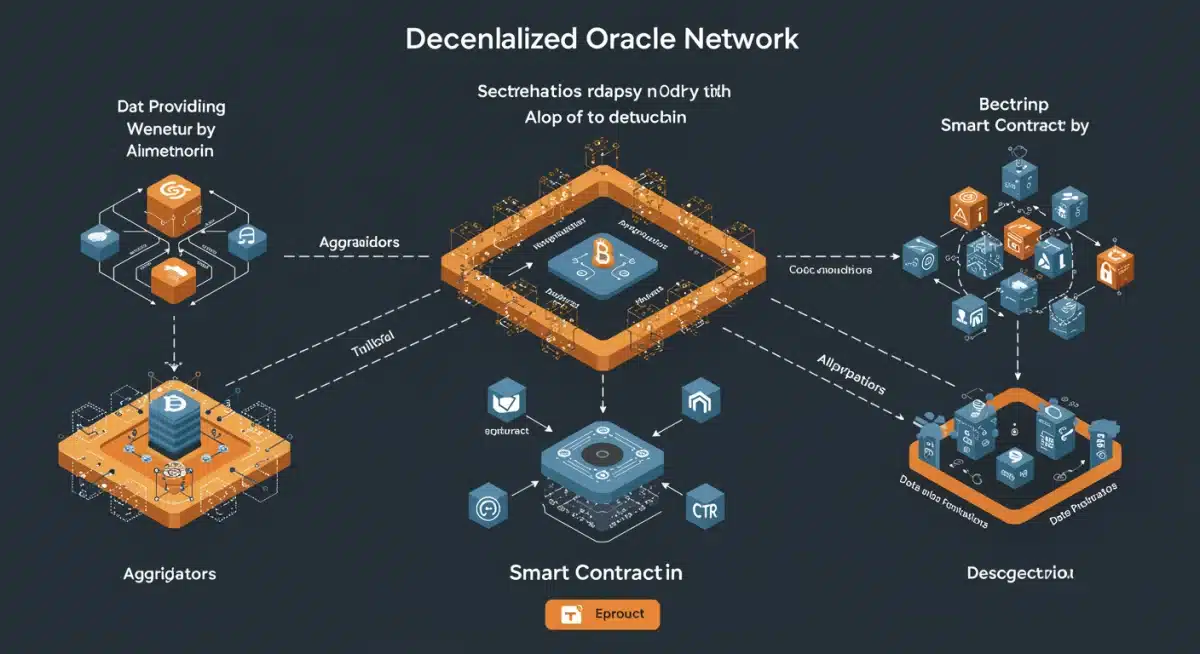
API3 stands out in the 2026 landscape of smart contract oracle integration by championing a novel approach: first-party oracles. Unlike traditional third-party oracle networks where data is fetched by intermediaries, API3 enables API providers themselves to directly operate their own oracles (known as Airnodes). This eliminates middlemen, reducing operational costs, minimizing attack vectors, and providing a more transparent and verifiable data source for U.S. projects.
The project’s focus on data provenance and security is particularly relevant in an era where data manipulation is a constant threat. By empowering API providers to sign their data on-chain, API3 offers a higher degree of trust and accountability. Furthermore, API3 has been actively exploring quantum-resistant cryptographic solutions, positioning itself for the long-term security challenges of the post-quantum computing era.
Airnodes and Decentralized APIs
The core of API3’s offering is the Airnode, a lightweight, self-contained oracle node that can be deployed by any API provider. This allows smart contracts to directly query data from the source, bypassing the complexities and potential vulnerabilities of multi-hop oracle networks. This direct connection simplifies the data supply chain and enhances the overall security posture.
- First-Party Oracles: API providers directly sign and deliver data on-chain.
- Reduced Attack Surface: Eliminates intermediaries, minimizing points of failure.
- Transparent Data Provenance: Clear chain of custody for all data.
- Quantum Resistance Initiatives: Future-proofing against advanced cryptographic threats.
For U.S. projects requiring high-assurance data feeds and a direct link to the original data source, API3 offers a distinct advantage. Its innovative model is set to disrupt how smart contracts interact with the off-chain world, fostering a more direct and trust-minimized integration.
Pyth Network: High-Fidelity Data for Financial Markets
The Pyth Network has solidified its position as a premier provider for smart contract oracle integration, especially for U.S. projects deeply embedded in financial markets. Specializing in high-fidelity, sub-second latency data, Pyth aggregates price feeds directly from major exchanges, trading firms, and market makers. This direct-from-source approach ensures data accuracy and timeliness, which are paramount for sophisticated DeFi protocols, derivatives markets, and algorithmic trading applications.
Operating across multiple blockchains, including Solana, Ethereum, and various EVM-compatible chains, Pyth’s reach is extensive. Its unique architecture allows data publishers to directly submit their price data on-chain, and an aggregation mechanism combines these diverse inputs into a single, robust, and reliable price feed. This minimizes reliance on any single entity and provides a more representative market price.
Real-Time Data and Publisher Network
Pyth’s strength lies in its network of reputable data publishers, which includes leading financial institutions and trading firms. These publishers contribute their proprietary data directly to the network, creating a highly granular and up-to-the-second view of market conditions. This real-time capability is a game-changer for applications where even slight delays can lead to significant arbitrage opportunities or liquidation risks.
- High-Fidelity Data: Sub-second updates for critical financial assets.
- Direct from Source: Data provided by leading exchanges and market makers.
- Cross-Chain Availability: Supports a wide range of blockchain ecosystems.
- Decentralized Aggregation: Combines multiple publisher inputs for robust price feeds.
For U.S. financial projects that demand the utmost precision and speed in their data feeds, Pyth Network offers an unparalleled solution for smart contract oracle integration. Its commitment to institutional-grade data makes it an indispensable tool for the future of decentralized finance.
Witnet: Decentralized Randomness and Data Requests
Witnet represents a compelling option for smart contract oracle integration in 2026, particularly for U.S. projects requiring highly decentralized and censorship-resistant data feeds, as well as provable randomness. Unlike some oracle solutions that rely on a fixed set of nodes, Witnet operates as a truly decentralized network of independent nodes that collectively retrieve, attest to, and deliver data to smart contracts. This design significantly enhances its resistance to manipulation and single points of failure.
The network’s unique random selection process for data request fulfillment ensures that no single node or small group of nodes can consistently influence the data outcome. This makes Witnet an excellent choice for applications where impartiality and resistance to collusion are paramount, such as gaming, lotteries, and fair distribution mechanisms for NFTs.
Autonomous Data Retrieval and DRAND Integration
Witnet’s nodes autonomously retrieve data from web sources, process it, and reach a consensus on its validity before delivering it to smart contracts. This distributed approach guarantees a high degree of data integrity. Furthermore, Witnet has integrated with DRAND, a distributed randomness beacon, to provide truly unbiased and verifiable random numbers directly to smart contracts, addressing a critical need for many decentralized applications.
- Censorship Resistance: Fully decentralized network of independent nodes.
- Provable Randomness: Integration with DRAND for secure random number generation.
- Autonomous Data Retrieval: Nodes fetch and attest to data without central coordination.
- Cost-Effective: Designed to offer competitive pricing for data requests.
For U.S. projects that prioritize deep decentralization, robust security against manipulation, and the need for verifiable randomness, Witnet offers a powerful and reliable solution for their smart contract oracle integration needs. Its architecture is built for long-term resilience and trust.
Emerging Trends and Future Outlook for Oracles in 2026
The landscape of smart contract oracle integration in 2026 is dynamic, driven by continuous innovation and the increasing sophistication of Web3 applications. Several key trends are shaping the future of oracles, impacting how U.S. projects will interact with off-chain data and services. One significant trend is the rise of composable oracle solutions, allowing developers to combine different oracle services and data sources to create highly customized and resilient data feeds.
Another area of intense development is the integration of zero-knowledge proofs (ZKPs) into oracle networks. ZKPs can enable oracles to provide data to smart contracts while preserving privacy, a crucial feature for enterprise applications and sensitive personal data. This allows verification of data without revealing the underlying information, opening up new possibilities for confidential computing on blockchain.
Cross-Chain Interoperability and AI Integration
Cross-chain interoperability remains a paramount concern. Oracles are evolving to not only provide data to multiple chains but also to facilitate secure communication and asset transfers between them. This is vital for a truly interconnected Web3 ecosystem, where dApps can seamlessly operate across different blockchain environments without fragmentation.
- Composable Oracles: Building custom data feeds from various sources and services.
- Zero-Knowledge Proofs: Enabling private and verifiable data delivery to smart contracts.
- Enhanced Cross-Chain Capabilities: Secure data and asset transfer across diverse blockchains.
- AI-Powered Data Validation: Using AI to detect anomalies and enhance data integrity.
Furthermore, the integration of artificial intelligence (AI) into oracle networks is gaining traction. AI can be used for advanced data validation, anomaly detection, and even predictive analytics, further enhancing the reliability and utility of oracle services. As these trends mature, the capabilities of smart contract oracle integration will expand dramatically, enabling a new generation of decentralized applications in the U.S. and globally.
| Provider | Key Strength |
|---|---|
| Chainlink | Decentralized data feeds, VRF, Keepers for broad use cases. |
| Band Protocol | Scalability and customization for diverse data needs. |
| API3 | First-party oracles, direct data provisioning, enhanced security. |
| Pyth Network | High-fidelity, low-latency data for financial market applications. |
Frequently Asked Questions about Smart Contract Oracles
A smart contract oracle is a third-party service that connects smart contracts to real-world data and off-chain systems. Since smart contracts cannot directly access information outside their blockchain, oracles act as secure bridges, feeding external data for contract execution.
For U.S. projects in 2026, robust oracle integration is essential because it allows smart contracts to interact with real-world events, enabling advanced functionalities in DeFi, supply chains, and regulatory compliance. Without it, dApps remain isolated from critical external data.
Decentralized oracles enhance security by distributing data fetching and validation across multiple independent nodes. This multi-source, multi-node architecture prevents a single point of failure and makes data manipulation significantly more difficult, ensuring data integrity for smart contracts.
Smart contract oracles provide diverse data types, including market prices for cryptocurrencies and commodities, weather data, sports results, identity verification, and real-world event confirmations. They can also provide verifiable randomness for gaming and NFT minting.
For U.S. financial market applications in 2026, Pyth Network is often considered best due to its specialization in high-fidelity, sub-second latency data aggregated directly from major exchanges and trading firms, providing critical accuracy and timeliness for DeFi and trading.
Conclusion
The imperative for robust smart contract oracle integration in 2026 for U.S. projects cannot be overstated. As the Web3 ecosystem matures, the reliability and security of off-chain data feeds become the bedrock upon which trustless applications are built. Our analysis of leading providers—Chainlink, Band Protocol, API3, Pyth Network, and Witnet—reveals a diverse landscape of solutions, each offering distinct strengths tailored to specific project requirements. From Chainlink’s broad utility to Pyth’s financial market precision and API3’s direct data provisioning, developers have an array of powerful tools at their disposal. The ongoing evolution of oracle technology, with advancements in cross-chain interoperability, ZKPs, and AI integration, promises an even more secure and versatile future for decentralized applications, ensuring that smart contracts can reliably interact with the real world.