Leveraging Oracles for Dynamic Smart Contracts: A 2025 Playbook
Oracles are pivotal for dynamic smart contracts, enabling seamless integration of real-world data onto blockchains, thus unlocking advanced functionalities and practical solutions across various industries in 2025.
The blockchain landscape is rapidly evolving, and the ability of smart contracts to interact with off-chain data is no longer a luxury but a necessity. Leveraging oracles for dynamic smart contracts represents a critical evolution, bridging the gap between the immutable world of blockchain and the ever-changing real world, paving the way for a new generation of decentralized applications that are truly responsive and intelligent.
Understanding the Oracle Imperative for Smart Contracts
Smart contracts are self-executing agreements with the terms directly written into code. While powerful, their inherent design dictates that they can only access information stored on their native blockchain. This isolation, a cornerstone of their security and immutability, also presents a significant limitation when real-world conditions or external data are required to trigger or execute contract clauses.
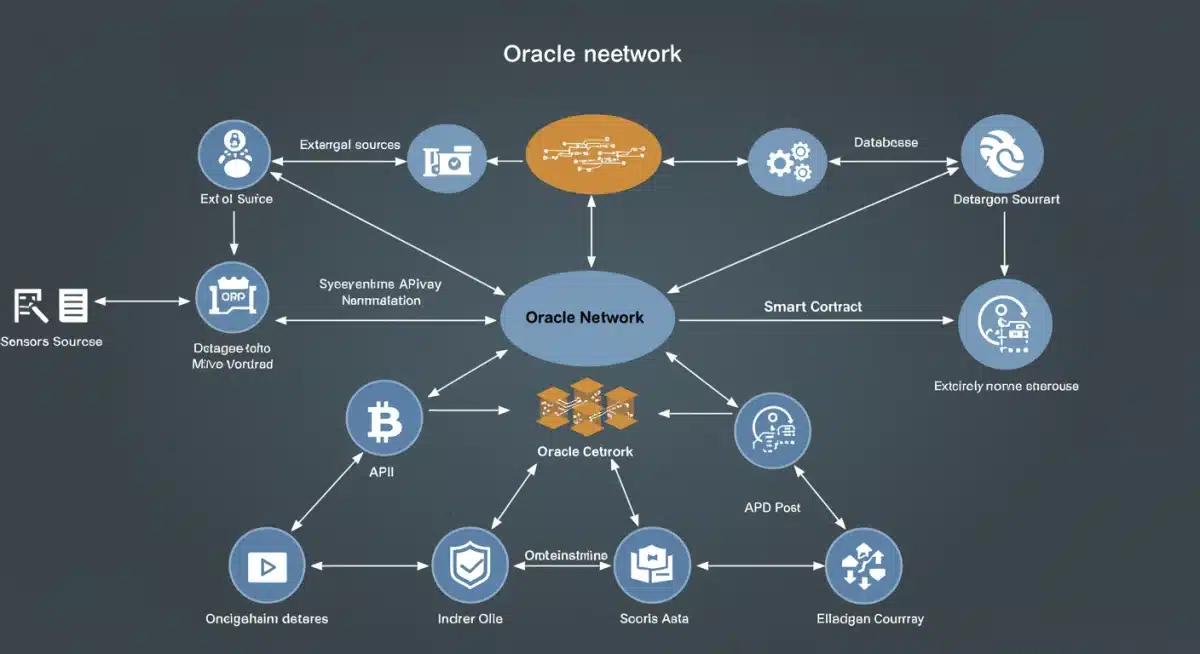
This is where oracles become indispensable. An oracle acts as a secure, reliable bridge, feeding external information into smart contracts, thereby expanding their utility far beyond on-chain data. Without oracles, smart contracts would remain largely confined to processing internal blockchain data, hindering their potential to automate complex real-world agreements.
The Data Disconnect: Why Oracles are Essential
- Blockchain Isolation: Blockchains are deterministic and cannot directly query external APIs or databases.
- Real-World Events: Many contractual agreements depend on events outside the blockchain, such as stock prices, weather conditions, or sports results.
- Information Verification: Oracles provide a mechanism for verifying the authenticity and integrity of off-chain data before it’s used by a smart contract.
- Expanded Use Cases: They unlock possibilities for DeFi, insurance, supply chain, gaming, and countless other applications.
The imperative for oracles stems from this fundamental data disconnect. As smart contracts mature and become integral to more sophisticated processes, their reliance on accurate, timely, and tamper-proof external data grows exponentially. Oracles are not just an add-on; they are foundational infrastructure for truly dynamic and practical smart contract applications.
Types of Oracles and Their Mechanisms
Not all oracles are created equal. The diverse needs of smart contracts necessitate various types of oracles, each with specific mechanisms to ensure data integrity and reliability. Understanding these distinctions is crucial for designing robust decentralized applications in 2025.
The primary classification often differentiates between software and hardware oracles, and further subdivides them based on their data source and aggregation methods. Each type addresses different challenges in bringing off-chain data to the blockchain securely.
Software Oracles: The Digital Gateway
Software oracles connect smart contracts to digital data sources like web APIs, databases, and other blockchains. They are prevalent in DeFi for price feeds, in gaming for random number generation, and in insurance for event validation.
- API Oracles: Fetch data from web APIs, such as market prices from exchanges or flight information from airline databases.
- Computation Oracles: Perform off-chain computations and return the result to the smart contract, useful for complex calculations that are too expensive or impossible to do on-chain.
- Cross-Chain Oracles: Enable smart contracts on one blockchain to access data or trigger actions on another blockchain.
Hardware Oracles: Bridging Physical and Digital
Hardware oracles are designed to bring real-world, physical event data onto the blockchain. This often involves sensors, RFID tags, or other IoT devices that monitor physical conditions or locations.
- IoT Sensors: Temperature, humidity, location data from sensors can trigger smart contract actions in supply chain or environmental monitoring.
- Supply Chain Trackers: RFID or GPS data confirming product location or delivery, ensuring transparency and automating payments.
Regardless of type, a critical aspect of oracle mechanics is data aggregation and reputation systems. To mitigate single points of failure and ensure data accuracy, many oracle networks employ multiple independent oracles, aggregate their data feeds, and use cryptographic proofs or economic incentives to validate information. This multi-layered approach enhances the trustworthiness of the data provided to smart contracts.
Key Challenges in Oracle Integration for 2025
While oracles offer immense potential, their integration into dynamic smart contracts is not without significant challenges. As we look towards 2025, addressing these hurdles will be paramount for widespread adoption and the development of truly resilient decentralized applications.
The primary concerns revolve around data integrity, security, and the economic incentives that drive oracle networks. A single point of failure or manipulation in the oracle mechanism can compromise the entire smart contract, undermining the very trust that blockchain technology aims to establish.
The Oracle Problem: Trust and Security
The fundamental challenge, often termed the “oracle problem,” is how to trust the data provided by an oracle. If a smart contract is immutable and relies on external data, that data must be as reliable and tamper-proof as the blockchain itself.
- Data Tampering: Malicious actors could feed incorrect data to an oracle, leading to incorrect smart contract execution.
- Single Point of Failure: A centralized oracle is a single point of failure, vulnerable to attack or downtime.
- Data Latency: Timely data delivery is crucial for many applications, especially those sensitive to market fluctuations.
- Cost of Data: Fetching and verifying data can incur significant transaction fees, especially on busy blockchains.
Solutions being explored and refined for 2025 include decentralized oracle networks (DONs), where multiple independent oracles collaborate and validate data through consensus mechanisms. Furthermore, cryptographic proofs, such as zero-knowledge proofs, are being integrated to verify data authenticity without revealing sensitive information. Economic incentives, like staking and penalties, encourage honest behavior among oracle node operators, while reputation systems help users identify reliable data providers. These advancements are critical to mitigating the inherent risks associated with off-chain data integration.
Practical Solutions for Robust Oracle Implementations
Building robust dynamic smart contracts in 2025 requires not just understanding oracles, but also implementing practical, secure solutions. This involves careful selection of oracle providers, strategic design of data requests, and continuous monitoring of oracle performance to ensure the integrity and reliability of decentralized applications.
The emphasis is on decentralization, redundancy, and cryptographic security to minimize risks associated with external data dependencies. Developers must move beyond simplistic oracle integrations to embrace a more sophisticated, multi-faceted approach.
Decentralized Oracle Networks (DONs)
Decentralized Oracle Networks (DONs) like Chainlink are at the forefront of providing secure and reliable data feeds. They achieve this by aggregating data from multiple independent nodes, ensuring that no single node can compromise the data integrity.
- Multiple Data Sources: Data is sourced from various reputable APIs to reduce reliance on any single provider.
- Node Operator Decentralization: A large network of independent node operators prevents collusion and censorship.
- Cryptographic Proofs: Techniques like TLSNotary or Town Crier are used to cryptographically prove the authenticity of data fetched from web servers.
- Reputation Systems: Node operators earn reputation based on their performance and accuracy, incentivizing good behavior.
Hybrid Smart Contracts and Oracle Data
The concept of hybrid smart contracts, where on-chain logic combines with off-chain oracle data and computation, is gaining traction. This allows for complex, real-world applications that leverage the best of both worlds: blockchain’s security and immutability, and oracle’s access to external information.
Developers should consider integrating multiple oracle solutions for critical data points, creating a layer of redundancy. Furthermore, implementing circuit breakers or fallback mechanisms within smart contracts can prevent catastrophic failures if an oracle feed becomes unreliable. Regular audits of oracle smart contracts and data feeds are also essential to maintain high security standards. These practical steps ensure that the integration of oracles enhances, rather than compromises, the robustness of dynamic smart contracts.
Emerging Trends and Innovations in Oracle Technology
The oracle landscape is far from static; it’s a dynamic field constantly innovating to meet the evolving demands of Web3. As we approach 2025, several key trends and innovations are shaping the future of how smart contracts interact with the real world, promising even more sophisticated and secure data integration.
These advancements are focused on improving decentralization, privacy, and the types of data that can be securely brought on-chain, pushing the boundaries of what dynamic smart contracts can achieve.
Zero-Knowledge Oracles (ZKO)
Zero-Knowledge Oracles (ZKO) are a groundbreaking innovation that allows oracles to prove the validity of off-chain data without revealing the data itself. This is crucial for privacy-preserving applications where sensitive information needs to be verified without being exposed on the public blockchain.
- Privacy Enhancement: Verifies data authenticity without disclosing underlying sensitive details.
- Compliance: Enables smart contracts to interact with regulated data sources while maintaining privacy.
- Scalability: Can potentially reduce the amount of data stored on-chain, improving efficiency.
Intent-Based Architectures and AI Integration
The rise of intent-based architectures in Web3 suggests that users will increasingly express their desired outcomes, and underlying protocols, including oracles, will work to fulfill those intents. Integrating AI into oracle networks can enhance data analysis, predictive capabilities, and anomaly detection, making data feeds even more intelligent and reliable.
Furthermore, the development of oracle networks that can provide arbitrary off-chain computation, beyond simple data feeds, is expanding the utility of smart contracts. This allows for complex business logic to be executed off-chain and then securely verified on-chain, significantly broadening the scope of decentralized applications. These emerging trends underscore a future where oracles are not just data providers, but intelligent, privacy-preserving computational layers that empower truly dynamic and adaptive smart contracts.
The Future Impact of Oracles on Decentralized Applications
The continuous evolution and improved integration of oracles are set to profoundly impact the landscape of decentralized applications (dApps) by 2025 and beyond. As oracle technology matures, the capabilities of smart contracts will expand exponentially, leading to a new era of innovation across various sectors.
This impact will be felt in the sophistication of automated agreements, the breadth of real-world use cases, and the overall reliability and trustworthiness of the Web3 ecosystem.
Unlocking New DeFi Primitives
In Decentralized Finance (DeFi), advanced oracles will enable more complex financial products and derivatives that react dynamically to a wider array of real-world market conditions, not just simple price feeds. This includes sophisticated insurance products, algorithmic stablecoins, and predictive markets that leverage diverse data inputs.
- Dynamic Lending Protocols: Adjust interest rates or collateral requirements based on real-time economic indicators.
- Parametric Insurance: Automate payouts based on verified external events like weather data or flight delays.
- Tokenized Real-World Assets: Integrate accurate valuations for real estate, commodities, or other tokenized assets.
Transforming Supply Chains and IoT
Oracles will be instrumental in creating truly transparent and efficient supply chains, allowing smart contracts to verify conditions at every step of a product’s journey. Combined with IoT, they will enable machines to interact and transact autonomously, ushering in new models of automation.
Beyond these specific sectors, the overarching impact is the enhanced trustworthiness and utility of smart contracts. By enabling secure and verifiable access to real-world data, oracles empower dApps to move beyond speculative financial instruments and into applications that solve tangible problems across industries. This shift from purely on-chain logic to hybrid smart contracts capable of interacting with the physical world is the defining characteristic of the next wave of Web3 innovation, making decentralized applications more robust, reliable, and deeply integrated into our daily lives.
| Key Aspect | Brief Description |
|---|---|
| Oracle Definition | Secure bridge connecting smart contracts to off-chain, real-world data and computation. |
| Types of Oracles | Software (APIs, computation) and Hardware (IoT sensors) for diverse data needs. |
| Key Challenges | Trust, security, single points of failure, data latency, and cost of data feeds. |
| Future Trends | Zero-Knowledge Oracles, intent-based architectures, and AI integration for enhanced privacy and intelligence. |
Frequently Asked Questions about Oracles and Smart Contracts
The primary function of an oracle is to act as a bridge, securely feeding external, real-world data into smart contracts. This allows smart contracts, which are inherently isolated to their blockchain, to react to events and information happening off-chain, making them dynamic and useful for a wider range of applications.
Oracles are crucial because they overcome the blockchain’s inability to access external data directly. Dynamic smart contracts need to respond to real-world conditions like market prices, weather, or supply chain events to execute their logic. Without oracles, these contracts would be severely limited in their practical applications.
The main security concerns include data tampering, where malicious actors could feed incorrect data, and the risk of a single point of failure if an oracle is centralized. These issues can lead to incorrect smart contract execution and undermine trust in the decentralized application.
DONs address challenges by using multiple independent nodes and data sources to aggregate and validate information through consensus. This decentralization mitigates single points of failure, enhances data accuracy, and employs cryptographic proofs and economic incentives to ensure data integrity and reliability.
Zero-Knowledge Oracles will play a vital role in enhancing privacy for smart contracts. They allow for the verification of off-chain data without revealing the sensitive underlying information itself. This is critical for applications in regulated industries and for maintaining user privacy in decentralized ecosystems.
Conclusion
The journey of smart contracts from isolated on-chain logic to dynamic, real-world responsive agreements is fundamentally powered by the evolution of oracles. As we progress into 2025, the ability to securely and reliably integrate external data will not only expand the utility of smart contracts but also solidify their position as a cornerstone of the decentralized future. Addressing the challenges of trust, security, and scalability through innovations like decentralized oracle networks and zero-knowledge proofs is paving the way for a robust and interconnected Web3 ecosystem, transforming how we envision and interact with digital agreements across every industry.