Beyond Ethereum: Top Altcoins for Scalable dApps in 2026
Beyond Ethereum: Top Altcoins for Scalable dApps in 2026
The blockchain landscape is evolving at an unprecedented pace. For years, Ethereum has reigned supreme as the undisputed king of decentralized applications (dApps), pioneering smart contracts and fostering a vibrant ecosystem. However, its success has also exposed its Achilles’ heel: scalability and high transaction fees. As we look towards 2026, the demand for more efficient, faster, and cheaper blockchain solutions for dApps is growing exponentially. Developers and users alike are actively seeking alternatives that can handle mass adoption without compromising performance or breaking the bank. This article delves into the transformative world of scalable dApp altcoins, exploring four promising contenders poised to redefine the future of decentralized computing.
The Scalability Trilemma and Ethereum’s Challenge
Before diving into the alternatives, it’s crucial to understand the fundamental challenge facing blockchain networks: the scalability trilemma. This concept posits that a blockchain can only achieve two out of three desirable properties simultaneously: decentralization, security, and scalability. Ethereum, in its current Proof-of-Work (PoW) and even post-Merge Proof-of-Stake (PoS) iterations, prioritizes decentralization and security, often at the expense of scalability. While significant upgrades like sharding are underway, their full implementation and impact are still years away.
Why Scalability Matters for dApps
For dApps to achieve mainstream adoption, they need to offer a user experience comparable to traditional web applications. This means:
- Fast Transactions: Users expect near-instantaneous confirmation of their actions, whether it’s a financial transaction, a game move, or an NFT mint.
- Low Fees: High gas fees make micro-transactions impractical and can price out a significant portion of potential users, stifling innovation and usage.
- High Throughput: Networks must be able to process thousands, if not millions, of transactions per second (TPS) to support large-scale applications with many concurrent users.
- Reliability: Network congestion leading to failed transactions or long wait times severely degrades the user experience.
Ethereum’s limitations in these areas have created a fertile ground for new blockchain protocols – the scalable dApp altcoins – to emerge and offer compelling solutions. These projects are not merely incremental improvements; they represent fundamental shifts in blockchain architecture, consensus mechanisms, and economic models designed to overcome the scalability trilemma.
The Rise of Next-Generation Blockchain Architectures
The altcoin landscape is diverse, with various approaches to achieving scalability. Some focus on novel consensus mechanisms, others on sharding, sidechains, or entirely new data structures. The key is to find a balance that maintains decentralization and security while dramatically increasing throughput and reducing costs. For dApp developers, choosing the right platform is paramount, as it dictates the user experience, development complexity, and long-term viability of their applications.
Evaluating Altcoins for dApp Scalability
When assessing potential scalable dApp altcoins for 2026, several factors come into play:
- Transaction Throughput (TPS): How many transactions can the network handle per second?
- Transaction Costs (Fees): What is the average cost of a transaction, and how does it compare to Ethereum?
- Finality: How quickly are transactions considered irreversible?
- Developer Ecosystem: Is there a robust community, good documentation, and developer tools available?
- Decentralization: Does the scaling solution compromise the network’s decentralization?
- Security: Is the network secure against attacks, and how is security maintained at scale?
- Interoperability: Can the platform easily communicate with other blockchains?
With these criteria in mind, let’s explore four prominent altcoins that are making significant strides in providing superior scalability and lower fees for dApps by 2026.
1. Solana: The Speed Demon with a Focus on Throughput
Solana has consistently positioned itself as a high-performance blockchain designed for massive scale. It aims to solve the scalability trilemma by introducing a unique combination of innovative technologies, most notably Proof-of-History (PoH), an ordered ledger of events that allows for high transaction throughput without sacrificing decentralization.
Solana’s Core Innovations for Scalability
- Proof-of-History (PoH): This is not a consensus mechanism itself, but a cryptographic clock that provides a verifiable order of events, allowing validators to process transactions in parallel. This significantly reduces the time required to reach consensus.
- Tower BFT: A PoH-optimized version of Practical Byzantine Fault Tolerance (PBFT), which leverages PoH to achieve consensus quickly and efficiently.
- Turbine: A block propagation protocol that breaks down blocks into smaller packets, allowing for faster data transfer across the network.
- Sealevel: The world’s first parallel smart contracts runtime, enabling concurrent execution of non-overlapping transactions. This is a game-changer for dApps requiring high computational power.
- Gulf Stream: A mempool-less transaction forwarding protocol that allows validators to execute transactions ahead of time, reducing confirmation latency.
Benefits for dApp Developers and Users
For dApp developers, Solana offers an environment where applications can run with incredibly low latency and high transaction capacity. This makes it ideal for:
- Decentralized Exchanges (DEXs): Enabling near real-time trading experiences akin to centralized exchanges.
- Gaming: Supporting complex in-game economies and fast-paced interactions without lag or high fees.
- Social Media Platforms: Facilitating high volumes of user interactions and content creation.
- DeFi Protocols: Allowing for more intricate financial instruments and high-frequency trading strategies.
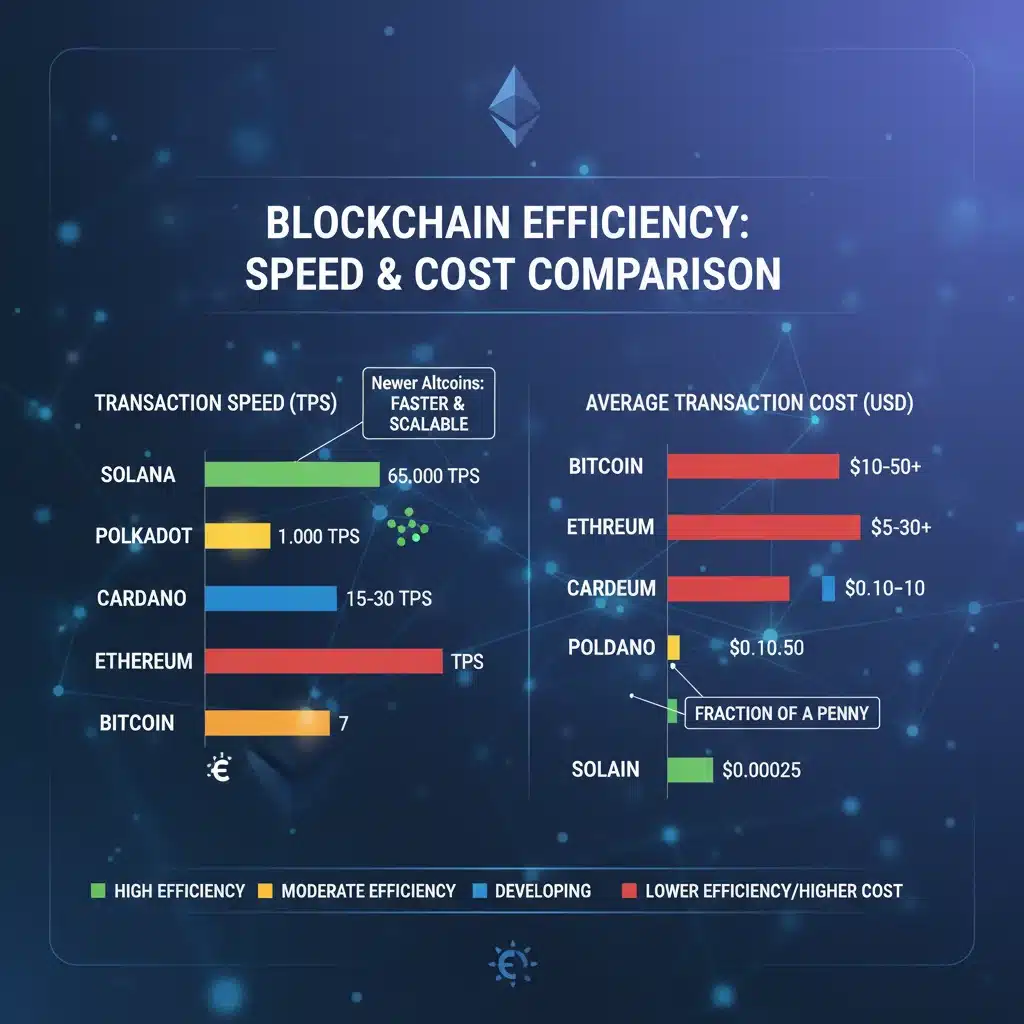
Users benefit from transaction fees that are typically fractions of a cent, making micro-transactions viable and enhancing the overall user experience. While Solana has faced criticisms regarding occasional network outages, its development team is actively addressing these issues, and its potential as a leading scalable dApp altcoin remains immense for 2026.
2. Polkadot: The Interoperable Multi-Chain Ecosystem
Polkadot takes a different approach to scalability by focusing on a multi-chain architecture, enabling independent blockchains (parachains) to connect to a central Relay Chain. This design allows for specialized blockchains that can optimize for specific use cases while benefiting from the shared security and interoperability of the Polkadot network.
Polkadot’s Architecture for Scalability and Interoperability
- Relay Chain: The central chain of Polkadot, responsible for network security, consensus, and interoperability between parachains. It processes a limited number of transaction types, such as governance, staking, and parachain auctions.
- Parachains: These are independent, application-specific blockchains that can have their own state, logic, and even consensus mechanisms. They connect to the Relay Chain, inheriting its security and gaining the ability to communicate with other parachains. This allows for massive parallel transaction processing.
- Parathreads: A more flexible and cost-effective way for blockchains to connect to Polkadot on a pay-as-you-go basis, suitable for projects with less consistent block production needs.
- Bridges: Facilitate communication and asset transfer between Polkadot and external networks like Ethereum.
Advantages for dApp Development
Polkadot’s architecture makes it an excellent choice for dApps that require:
- Customization: Developers can design their own parachains with specific functionalities, tailored to their dApp’s needs, without being constrained by a general-purpose blockchain.
- Specialized Scalability: Each parachain can achieve high throughput for its specific use case, contributing to the overall network’s ability to handle a vast number of transactions in parallel.
- Shared Security: All parachains benefit from the collective security of the Relay Chain, eliminating the need for individual projects to bootstrap their own security models.
- Cross-Chain Communication: The ability for dApps on different parachains to interact seamlessly opens up new possibilities for complex decentralized ecosystems. For example, a gaming dApp on one parachain could interact with a DeFi protocol on another.
By 2026, Polkadot’s ecosystem of specialized and interconnected parachains is expected to offer a highly scalable and flexible environment for a new generation of dApps, making it a strong contender among scalable dApp altcoins.
3. Avalanche: The Subnet-Powered Scalability Solution
Avalanche is another prominent blockchain platform that tackles scalability through a novel architecture, primarily leveraging what it calls ‘subnets’. Unlike monolithic blockchains, Avalanche is composed of multiple independent blockchains, with each subnet being a custom blockchain network that can define its own rules, validators, and tokenomics.
Avalanche’s Multi-Chain Design for Performance
- Primary Network: This is a special subnet that includes three built-in blockchains: the X-Chain (for asset creation and exchange), the C-Chain (an EVM-compatible chain for smart contracts and dApps), and the P-Chain (for coordinating validators and subnets).
- Subnets: These are custom, application-specific blockchains that can be launched by anyone. Each subnet is validated by its own dynamic, permissioned or permissionless set of validators. This allows for horizontal scaling, as more subnets can be created to handle increased demand.
- Avalanche Consensus Protocol: A groundbreaking consensus mechanism that is fast, secure, and scalable. It uses a probabilistic approach where validators repeatedly sample a small, random subset of other validators until a high degree of certainty is reached.
Why Avalanche Excels for dApps
Avalanche’s subnet architecture offers compelling advantages for dApp developers seeking scalable dApp altcoins:
- Customization and Control: Developers can launch their own subnets, gaining complete control over network parameters, gas fees, and even the native token used for transactions. This is ideal for enterprises or specific dApps with unique requirements.
- High Throughput and Low Latency: The Avalanche Consensus Protocol, combined with the ability to launch specialized subnets, allows for extremely high transaction throughput and near-instant transaction finality.
- EVM Compatibility (C-Chain): The C-Chain is fully compatible with the Ethereum Virtual Machine (EVM), making it incredibly easy for developers to migrate existing Ethereum dApps or build new ones using familiar tools and languages like Solidity.
- Interoperability: While subnets are independent, they can communicate with each other and with the Primary Network, fostering a rich and interconnected ecosystem.
- Dynamic Validator Sets: Subnets can have their own validator sets, allowing for permissioned environments suitable for institutional use cases, or permissionless ones for public dApps.
By 2026, Avalanche’s flexible subnet model is expected to attract a diverse range of dApps, from enterprise blockchain solutions to high-volume gaming and DeFi platforms, cementing its position as a top scalable dApp altcoin.
4. Near Protocol: Sharding for Mass Adoption
Near Protocol is a layer-one blockchain designed with usability and scalability at its core. Its primary scaling solution is sharding, a technique that divides the blockchain’s state and processing load into smaller, more manageable segments called ‘shards’. This allows the network to process transactions in parallel, significantly increasing throughput.
Near’s Approach to Sharding and Usability
- Nightshade Sharding: Near implements a unique sharding approach called Nightshade, where each shard produces a ‘chunk’ of the next block. These chunks are then aggregated into a single block on the main chain. This allows the network to scale linearly with the number of shards.
- Doomslug Consensus: A fast, finality-guaranteed consensus mechanism that allows validators to reach agreement on blocks quickly and efficiently.
- Developer-Friendly Environment: Near focuses heavily on developer experience, offering human-readable account names, a JavaScript SDK, and a strong emphasis on ease of use for building dApps.
- Rainbow Bridge: A bridge connecting Near to Ethereum, allowing seamless asset transfers and smart contract calls between the two networks.
- Aurora: An EVM-compatible layer built on Near, providing an Ethereum-like experience with Near’s underlying scalability and low fees.
Why Near is a Strong Contender for dApps
Near Protocol’s design principles make it particularly attractive for dApp developers and users:
- Massive Scalability: Nightshade sharding is designed to scale with demand, theoretically allowing Near to process millions of transactions per second as more shards are added.
- Low Transaction Costs: The efficient sharding mechanism keeps gas fees consistently low, making it economical for users to interact with dApps frequently.
- Enhanced User Experience: Features like human-readable account IDs and simplified transaction signing aim to make blockchain interactions as intuitive as traditional web experiences.
- EVM Compatibility (Aurora): Developers can easily deploy their Solidity contracts on Aurora, benefiting from Near’s scalability without rewriting their code. This significantly lowers the barrier to entry for Ethereum developers looking for a more scalable environment.
- Progressive Decentralization: Near is committed to progressively decentralizing its network, ensuring long-term security and censorship resistance as it scales.
By 2026, Near Protocol’s sharding capabilities and focus on usability are expected to attract a large influx of dApps and users, positioning it as a leading scalable dApp altcoin for mass adoption.

The Future of dApps: Beyond Ethereum’s Shadow
While Ethereum continues to evolve with its 2.0 upgrades, the competitive landscape for dApps is rapidly diversifying. The altcoins discussed – Solana, Polkadot, Avalanche, and Near Protocol – each offer distinct and powerful solutions to the scalability and fee challenges that have long plagued the blockchain space. They represent the vanguard of a new era, where dApps can finally achieve the performance and cost-efficiency required for widespread adoption.
Key Takeaways for 2026 and Beyond
- Specialization and Interoperability: The future likely involves a multi-chain ecosystem where specialized blockchains (like Polkadot’s parachains or Avalanche’s subnets) cater to specific needs, all interconnected for seamless user experiences.
- Developer Experience is King: Platforms that prioritize ease of development, robust tooling, and EVM compatibility will attract the most talent and, consequently, the most innovative dApps.
- User Experience Drives Adoption: Low fees, fast transactions, and intuitive interfaces will be critical for onboarding the next billion users into the decentralized web.
- Continuous Innovation: The blockchain space is dynamic. These altcoins are not static; their roadmaps include ongoing improvements and new features to maintain their competitive edge.
As we approach 2026, the narrative is shifting from a single dominant blockchain to a rich tapestry of interconnected networks, each contributing to the overall strength and utility of the decentralized web. For dApp developers and investors, understanding these emerging scalable dApp altcoins is not just about staying informed; it’s about positioning themselves for the next wave of innovation in the blockchain industry.
Conclusion
The quest for scalability and lower fees for dApps is driving significant innovation across the blockchain ecosystem. While Ethereum laid the groundwork, its current limitations have opened the door for formidable contenders. Solana, with its unparalleled transaction speed; Polkadot, with its vision for an interoperable multi-chain future; Avalanche, with its flexible subnet architecture; and Near Protocol, with its sharding-based scalability and focus on usability, are all demonstrating viable paths forward.
These scalable dApp altcoins are not just competing with Ethereum; they are expanding the possibilities of what decentralized applications can achieve. By offering environments capable of handling mass adoption, they are paving the way for a more efficient, accessible, and user-friendly decentralized internet. As 2026 approaches, the dApp landscape will undoubtedly be more diverse, more powerful, and more inclusive, largely thanks to the groundbreaking work being done by these innovative blockchain platforms.
Choosing the right platform will depend on the specific needs of a dApp, but the options are becoming increasingly robust and compelling. The era of the truly scalable and affordable dApp is not just a distant dream; it’s rapidly becoming a reality, powered by these next-generation altcoins.