EVM-Compatible Smart Contracts: 2026 Roadmap for U.S. Blockchain Scaling

The 2026 roadmap for EVM-compatible smart contracts is essential for scaling U.S. blockchain applications, focusing on recent technological updates and practical solutions for enhanced efficiency and adoption across the Web3 ecosystem.
The landscape of blockchain technology is evolving at an unprecedented pace, with EVM-compatible smart contracts emerging as a cornerstone for decentralized application development. As we navigate the complexities of 2026, understanding the roadmap for scaling U.S. blockchain applications becomes paramount. This article delves into the recent updates and practical solutions that are shaping the future of Web3 infrastructure, particularly within the United States.
The foundational role of EVM compatibility in U.S. blockchain
EVM compatibility refers to the ability of a blockchain network to execute smart contracts written for the Ethereum Virtual Machine (EVM). This characteristic is not merely a technical detail; it represents a significant advantage for developers and projects aiming to leverage existing tools, codebases, and developer communities. In the U.S., where regulatory clarity and institutional adoption are increasingly becoming a focus, the versatility offered by EVM compatibility is proving invaluable.
The widespread adoption of Ethereum has fostered a robust ecosystem of development tools, programming languages like Solidity, and a vast pool of experienced developers. For new blockchain platforms or Layer 2 solutions, achieving EVM compatibility means they can seamlessly integrate with this established environment. This significantly reduces the barrier to entry for decentralized applications (dApps) and allows for quicker deployment and iteration.
Bridging existing infrastructure with new innovations
EVM compatibility acts as a critical bridge. It allows projects built on newer, often more scalable or specialized blockchains to tap into the liquidity and user base of the Ethereum mainnet, while also benefiting from the performance enhancements of their native chains. This dual advantage is particularly attractive for U.S. enterprises and startups looking to deploy blockchain solutions without reinventing the wheel.
- Developer Familiarity: Existing Ethereum developers can easily transition to EVM-compatible chains, accelerating development cycles.
- Tooling Ecosystem: Access to battle-tested tools like Truffle, Hardhat, and MetaMask simplifies the development and user experience.
- Interoperability Potential: Facilitates cross-chain communication and asset transfers, crucial for a fragmented blockchain landscape.
- Security Audits: Leverages established security best practices and auditing firms familiar with EVM bytecode.
In essence, EVM compatibility is not just about running Ethereum code. It’s about participating in a larger, interconnected Web3 economy. For the U.S., this means fostering an environment where innovation can flourish on a foundation of proven technology, attracting investment and talent to the blockchain sector.
Scaling solutions: Layer 2 networks and beyond for U.S. dApps
The inherent limitations of Layer 1 blockchains, particularly Ethereum’s transaction throughput, have necessitated the emergence of advanced scaling solutions. For U.S. blockchain applications, these solutions are not just about speed; they are about enabling real-world use cases at a commercial scale, where high transaction volumes and low fees are non-negotiable. Layer 2 networks, such as optimistic rollups and zero-knowledge (ZK) rollups, are at the forefront of this evolution.
Optimistic rollups, like Arbitrum and Optimism, process transactions off-chain and then post a summary to the Ethereum mainnet, assuming transactions are valid unless challenged. ZK rollups, employed by projects like zkSync and StarkNet, use cryptographic proofs to verify off-chain transactions before submitting them to the mainnet. Both approaches significantly increase transaction capacity and reduce costs, making them ideal for high-frequency applications.
The rise of modular blockchains and app-specific chains
Beyond traditional Layer 2s, the concept of modular blockchains is gaining traction. This architectural paradigm separates the core functions of a blockchain – execution, settlement, consensus, and data availability – into distinct layers. This allows for greater specialization and scalability, as each layer can be optimized independently. App-specific chains, built using frameworks like Cosmos SDK or Polkadot’s Substrate, offer customized environments tailored to the unique needs of a particular application, providing unparalleled performance and control.
- Optimistic Rollups: Provide significant scalability by processing transactions off-chain with a fraud-proof mechanism.
- ZK Rollups: Offer enhanced security and finality through cryptographic validity proofs, ideal for financial applications.
- Modular Blockchains: Decouple blockchain functions for specialized optimization and increased throughput.
- App-Specific Chains: Deliver tailored performance and governance for dedicated dApps, crucial for enterprise adoption.
These scaling strategies collectively represent a multi-pronged attack on blockchain’s scalability dilemma. For U.S. businesses and developers, selecting the right scaling solution depends on specific application requirements, including security needs, transaction volume, and cost considerations. The continued innovation in this space is vital for the widespread adoption of blockchain technology across various industries within the United States.
Regulatory landscape and its impact on EVM adoption in the U.S.
The regulatory environment in the United States plays a crucial role in shaping the adoption and development of EVM-compatible smart contracts. As blockchain technology matures, regulators are increasingly scrutinizing its applications, particularly concerning securities, commodities, and consumer protection. Clarity in regulation can either accelerate or hinder innovation, and the U.S. is actively working towards establishing frameworks that balance protection with technological advancement.
Recent legislative discussions and proposals indicate a growing understanding among policymakers regarding the nuances of digital assets. The distinction between utility tokens, security tokens, and stablecoins has significant implications for how smart contracts are designed and deployed. Projects leveraging EVM compatibility must navigate these complexities, ensuring compliance while maximizing the benefits of decentralization.
Navigating compliance and innovation
For developers and companies operating in the U.S., understanding the Securities and Exchange Commission (SEC), Commodity Futures Trading Commission (CFTC), and other regulatory bodies’ stances is essential. Smart contracts, by their immutable and self-executing nature, introduce unique challenges for compliance, especially when they involve financial instruments or data handling. EVM-compatible platforms are often favored due to their established security models and the availability of auditing tools that can help demonstrate regulatory adherence.
- SEC Guidance: Provides insights into classifying digital assets as securities, impacting token offerings and smart contract design.
- CFTC Oversight: Focuses on derivatives and commodities, influencing decentralized finance (DeFi) protocols and their underlying smart contracts.
- State-Level Regulations: Various states are developing their own blockchain-specific laws, adding layers of complexity.
- Compliance Tools: Emergence of tools for identity verification (KYC/AML) and transaction monitoring on EVM chains.
The ongoing dialogue between innovators and regulators is critical. As the U.S. strives to maintain its position as a global leader in technological innovation, a balanced regulatory approach that fosters growth while mitigating risks will be key to unlocking the full potential of EVM-compatible smart contracts.
Decentralized finance (DeFi) and NFTs on EVM-compatible chains in 2026
Decentralized finance (DeFi) and Non-Fungible Tokens (NFTs) have been driving forces behind the recent surge in blockchain adoption, and their continued evolution on EVM-compatible chains is expected to define much of the Web3 landscape in 2026. The U.S. market, with its significant capital and tech-savvy population, is a primary playground for these innovations. EVM compatibility provides the necessary infrastructure for these applications to thrive, offering both security and a broad user base.
DeFi protocols, ranging from lending and borrowing platforms to decentralized exchanges (DEXs), rely heavily on the robust and programmable nature of smart contracts. EVM-compatible chains allow these protocols to inherit the battle-tested security standards of Ethereum while often offering lower transaction fees and higher throughput. This combination is crucial for attracting mainstream users and institutional players who demand efficiency and cost-effectiveness.
The expanding utility of NFTs and their integration
NFTs have moved beyond mere digital collectibles, finding utility in gaming, digital identity, real estate, and supply chain management. EVM-compatible chains facilitate the creation, trading, and integration of NFTs into various applications. The standardization provided by EVM allows for seamless interaction between different NFT marketplaces and dApps, enhancing liquidity and utility across the ecosystem. In the U.S., creators and businesses are increasingly exploring how NFTs can revolutionize ownership and digital experiences.
The synergy between DeFi and NFTs is also becoming more pronounced. Financial instruments collateralized by NFTs, fractionalized NFTs, and NFT lending protocols are emerging, creating new avenues for value creation and liquidity. EVM-compatible smart contracts are the backbone for these complex interactions, ensuring transparent and trustless execution. This dynamic interplay is set to further solidify the position of EVM-compatible chains as essential infrastructure for the future of Web3.
Security challenges and advancements for EVM smart contracts
As the complexity and value locked in EVM-compatible smart contracts grow, so too do the security challenges. The immutable nature of smart contracts means that vulnerabilities, once deployed, can be extremely difficult or impossible to fix without significant disruption. In 2026, the focus on robust security measures and advanced auditing practices is more critical than ever, especially for U.S. applications handling sensitive data or substantial financial assets.
Recent years have seen numerous high-profile exploits, ranging from reentrancy attacks to flash loan manipulations. These incidents underscore the need for a multi-layered approach to smart contract security. This includes rigorous code audits by independent firms, formal verification methods, bug bounty programs, and continuous monitoring of deployed contracts. The developer community is also actively working on safer programming patterns and languages to minimize common vulnerabilities.
Innovative security protocols and tools
Beyond proactive measures, the industry is seeing the development of innovative security protocols specifically designed for EVM environments. These include on-chain security modules that can pause or upgrade contracts in emergencies, decentralized insurance protocols that cover smart contract exploits, and advanced threat detection systems that leverage AI and machine learning to identify suspicious activity. For U.S. enterprises, adopting these advanced security frameworks is not just about protecting assets; it’s about building trust and ensuring the long-term viability of their blockchain initiatives.
- Code Audits: Comprehensive reviews by security experts to identify vulnerabilities before deployment.
- Formal Verification: Mathematical proof of contract correctness, ensuring adherence to specifications.
- Bug Bounty Programs: Incentivizing ethical hackers to find and report vulnerabilities.
- Decentralized Insurance: Protocols offering coverage against smart contract exploits, reducing financial risk.
The commitment to enhancing security will be a defining characteristic of successful EVM-compatible projects in 2026. As the U.S. increasingly embraces blockchain for critical infrastructure and financial services, the integrity and resilience of smart contracts will be paramount.
The future outlook: Interoperability and mainstream adoption in the U.S.
Looking ahead to 2026, the future of EVM-compatible smart contracts in the U.S. is intrinsically linked to two key themes: enhanced interoperability and accelerated mainstream adoption. While significant strides have been made in scaling individual chains and securing smart contracts, the true potential of Web3 will only be realized when diverse blockchains can communicate seamlessly and when blockchain technology becomes an invisible, yet indispensable, part of everyday life.
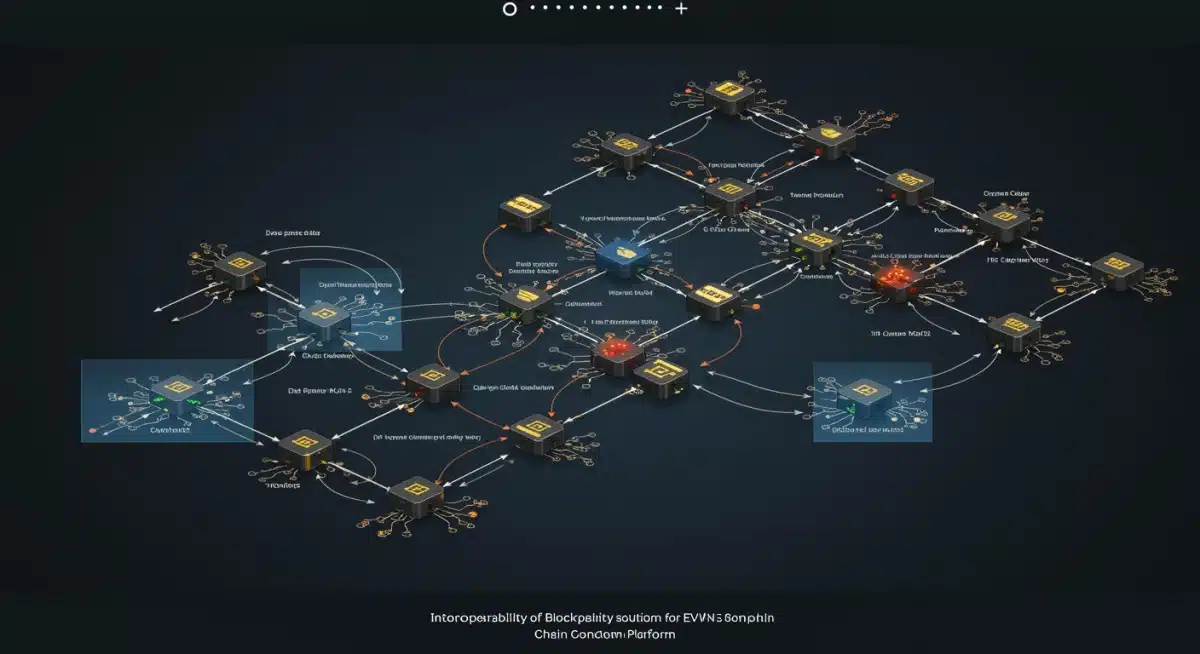
Interoperability solutions, such as cross-chain bridges and generalized message-passing protocols, are becoming more sophisticated. These technologies allow assets and data to flow freely between different EVM-compatible chains, and even non-EVM chains, creating a more unified and liquid ecosystem. For U.S. businesses, this means greater flexibility in choosing the optimal blockchain for specific use cases without sacrificing connectivity.
Driving mainstream integration and user experience
Mainstream adoption hinges not just on technological prowess but also on user experience. Simplifying onboarding processes, improving wallet interfaces, and abstracting away the complexities of gas fees and private keys are crucial steps. Projects focusing on account abstraction, where smart contracts manage user accounts, are poised to revolutionize how users interact with dApps. Furthermore, integrating blockchain capabilities into familiar applications and platforms will be key to attracting a broader audience in the U.S.
The U.S. is uniquely positioned to lead this charge, given its innovative spirit and robust technological infrastructure. As regulatory clarity improves and the benefits of blockchain become more tangible, from transparent supply chains to novel financial products, EVM-compatible smart contracts will form the bedrock of this decentralized future. Their adaptability and the vast ecosystem they support make them indispensable for the next wave of Web3 innovation and utility.
| Key Point | Brief Description |
|---|---|
| EVM Compatibility | Enables seamless integration with Ethereum’s ecosystem, leveraging existing tools and developer communities for faster adoption. |
| Scaling Solutions | Layer 2 networks (rollups) and modular blockchains are crucial for high transaction volumes and reduced costs in U.S. dApps. |
| Regulatory Impact | U.S. regulations significantly influence smart contract design and deployment, requiring compliance for widespread enterprise adoption. |
| Security & Interoperability | Advanced security practices and cross-chain communication are vital for trust, mainstream adoption, and a unified Web3 ecosystem. |
Frequently Asked Questions About EVM-Compatible Smart Contracts
EVM compatibility allows developers to use familiar tools and languages like Solidity, greatly simplifying the creation and deployment of decentralized applications. It shortens development cycles and enables easier migration of existing dApps to new, often more scalable, blockchain networks, fostering a more interconnected Web3 environment.
Layer 2 solutions, such as optimistic and ZK rollups, process transactions off-chain, significantly increasing throughput and reducing gas fees for EVM-compatible smart contracts. This allows for more efficient and cost-effective execution of complex dApps, making blockchain technology viable for a wider range of commercial and consumer applications.
Regulatory clarity from U.S. bodies like the SEC and CFTC is crucial for the mainstream adoption of EVM-compatible chains. Clear guidelines help projects design compliant smart contracts, build trust with institutions, and attract investment, ultimately fostering a more stable and predictable environment for blockchain innovation and growth within the United States.
Absolutely. EVM-compatible chains provide the robust and programmable infrastructure necessary for the continued evolution of DeFi and NFTs. Their security, flexibility, and growing ecosystem enable complex financial instruments, innovative digital collectibles, and cross-platform integrations, driving new use cases and liquidity in the decentralized economy.
Security for EVM smart contracts involves rigorous code audits, formal verification, and bug bounty programs to prevent vulnerabilities. Innovative protocols like decentralized insurance and AI-driven threat detection are also emerging. These measures are vital to protect assets, maintain trust, and ensure the long-term integrity of decentralized applications.
Conclusion
The 2026 roadmap for EVM-compatible smart contracts in the U.S. is one of continuous innovation, strategic scaling, and careful regulatory navigation. From the foundational role of EVM compatibility in fostering developer adoption to the advanced scaling solutions provided by Layer 2 networks and modular blockchains, the infrastructure is rapidly maturing. Coupled with the explosive growth of DeFi and NFTs, and an increasing focus on robust security, EVM-compatible chains are undeniably central to the future of U.S. blockchain applications. As interoperability improves and user experiences become more intuitive, these technologies are poised to move beyond niche applications, driving mainstream adoption and fundamentally reshaping industries across the United States. The journey ahead demands vigilance, collaboration, and a commitment to building a secure, scalable, and accessible decentralized future.