ERC-721 vs. ERC-1155: Smart Contract Standards Explained for 2026
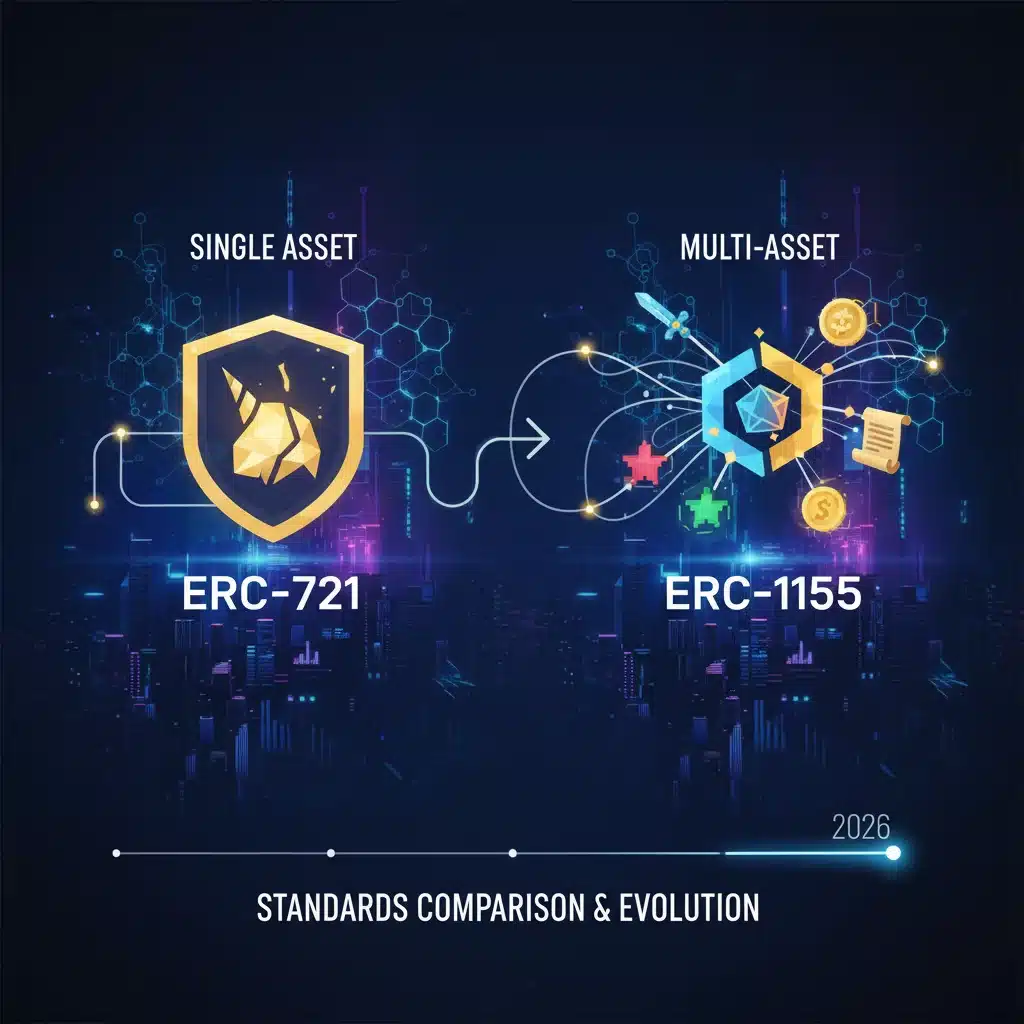
The Evolution of Smart Contract Standards: ERC-721 vs. ERC-1155 in 2026 Use Cases
The blockchain landscape is a constantly evolving ecosystem, driven by innovation in smart contract standards. Among the most pivotal developments are ERC-721 and ERC-1155, two Ethereum Improvement Proposals (EIPs) that have fundamentally shaped how digital assets are created, managed, and transferred. As we look towards 2026, understanding the nuances of these standards, their respective strengths, and their anticipated use cases becomes crucial for anyone involved in Web3, from developers and entrepreneurs to collectors and gamers.
This comprehensive analysis will delve deep into the core functionalities of ERC-721 and ERC-1155, providing a clear ERC-721 ERC-1155 Comparison. We will explore their historical context, technical specifications, and real-world applications, highlighting the scenarios where each standard excels. Furthermore, we will project their future trajectories, examining how they are likely to be adopted and innovated upon in the coming years, particularly in the burgeoning sectors of NFTs, gaming, and decentralized finance (DeFi).
The initial explosion of NFTs brought ERC-721 into the mainstream, enabling the verifiable ownership of unique digital items. However, the subsequent demand for more complex and efficient asset management led to the emergence of ERC-1155, a multi-token standard that promised greater flexibility and reduced transaction costs. Both standards have their distinct advantages and disadvantages, and their continued co-existence and evolution are testaments to the dynamic nature of blockchain technology. By 2026, the lines between these standards might become even more blurred, or perhaps, their specialized roles will become even more defined. Let’s embark on this journey to understand the future of digital asset standards.
Understanding ERC-721: The Genesis of Non-Fungible Tokens
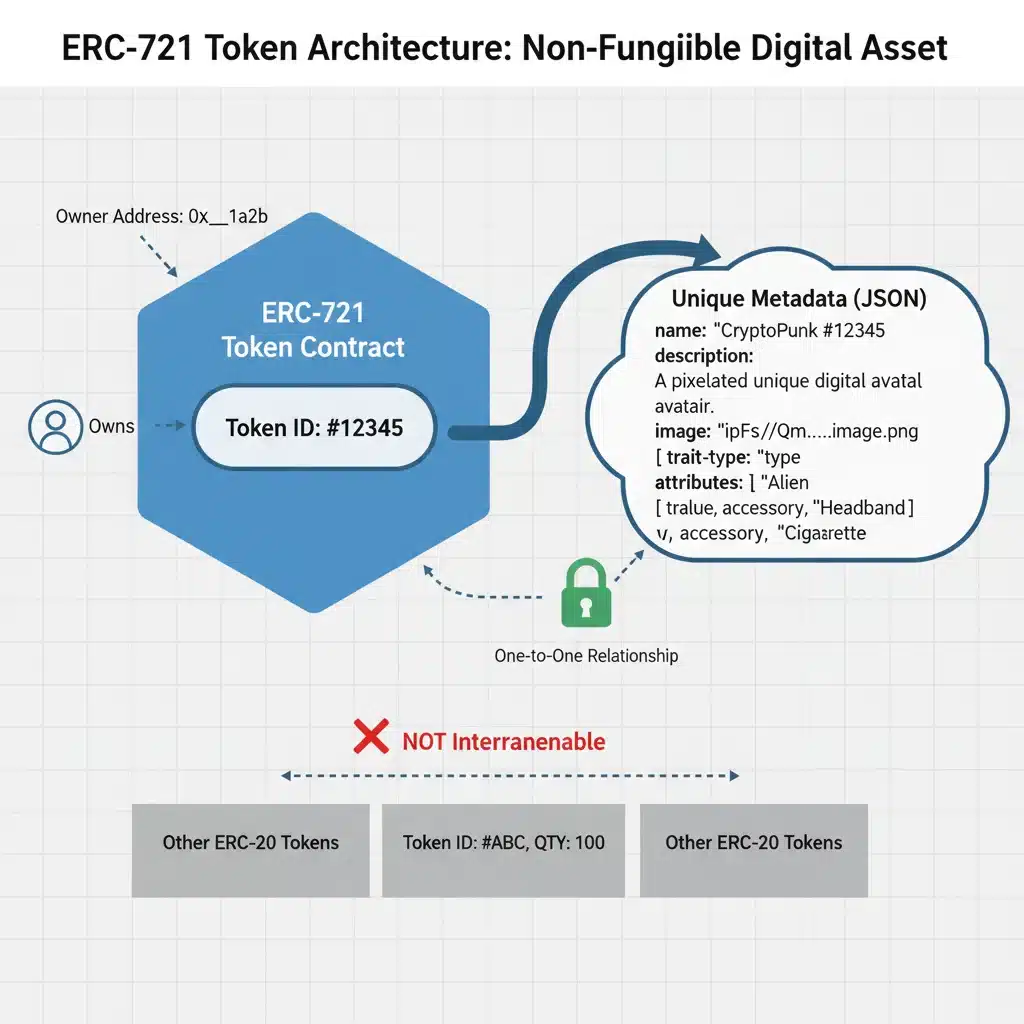
To fully appreciate the innovations of ERC-1155, it’s essential to first grasp the foundational principles of ERC-721. Introduced in January 2018, ERC-721 rapidly became the standard for creating non-fungible tokens (NFTs). The core concept of non-fungibility is that each token is unique and cannot be replaced by another identical token. Think of it like a unique piece of art or a specific deed to a house; there’s only one of it, and its value is intrinsic to its individuality.
Key Characteristics of ERC-721
- Uniqueness: Every ERC-721 token has a unique
tokenId. This is its distinguishing feature, ensuring that no two tokens are exactly alike. - Scarcity: The creator of an ERC-721 contract can define the total supply of tokens, often limiting it to a very small number or even just one, contributing to its perceived value.
- Indivisibility: ERC-721 tokens cannot be broken down into smaller units. You either own the whole token or you don’t.
- Global Uniqueness: The combination of the contract address and the
tokenIdguarantees global uniqueness across the entire Ethereum blockchain. - Ownership Tracking: The standard includes functions to easily track the ownership of each unique token, making transparent transfers and verification possible.
How ERC-721 Works
An ERC-721 contract typically maps each unique token ID to an owner’s address. When a token is minted, a new unique ID is created, and its ownership is assigned. Transfers involve updating this mapping on the blockchain. The metadata associated with an ERC-721 token, which describes its characteristics (e.g., image URL, properties, name), is usually stored off-chain and referenced by a URI within the token contract. This design was revolutionary, paving the way for digital collectibles, art, and virtual land ownership.
Prominent Use Cases and Their Impact
The initial success of ERC-721 was largely driven by projects like CryptoKitties, which demonstrated the potential of digital collectibles. Since then, its applications have expanded exponentially:
- Digital Art and Collectibles: Platforms like OpenSea and Rarible are built upon ERC-721, allowing artists to tokenize their work and collectors to prove ownership.
- Gaming Items: Unique in-game assets, characters, and skins are often represented as ERC-721 NFTs, giving players true ownership and the ability to trade them on secondary markets.
- Virtual Real Estate: Projects like Decentraland and The Sandbox use ERC-721 to represent plots of virtual land, enabling users to buy, sell, and develop digital property.
- Identity and Credentials: While still nascent, ERC-721 has potential for representing unique digital identities, certifications, or diplomas.
The simplicity and clear definition of uniqueness in ERC-721 made it the go-to standard for the early NFT boom. However, as the ecosystem matured, certain limitations began to emerge, particularly concerning efficiency and the management of diverse asset types.
Introducing ERC-1155: The Multi-Token Standard
Building upon the lessons learned from ERC-721 and other token standards like ERC-20 (for fungible tokens), ERC-1155 was proposed by Enjin in June 2018 and finalized in 2019. Its primary goal was to create a more efficient and flexible standard that could manage both fungible and non-fungible tokens within a single smart contract. This innovative approach addressed several pain points associated with managing multiple contract types, leading to significant improvements in gas efficiency and development complexity.
Key Characteristics of ERC-1155
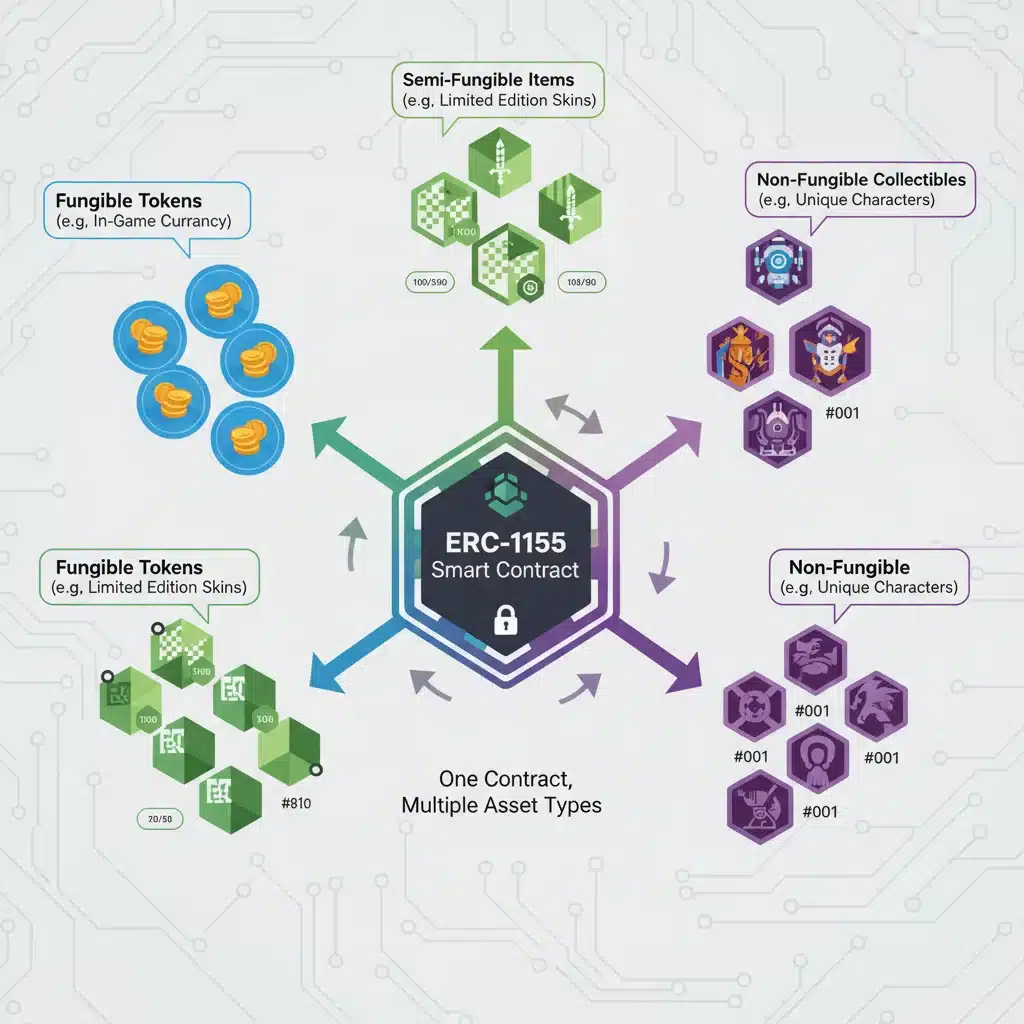
- Multi-Token Management: The most significant feature of ERC-1155 is its ability to define and manage any number of fungible, non-fungible, or semi-fungible token types within a single contract.
- Batch Operations: ERC-1155 allows for batch transfers, batch balances, and batch approvals. This means you can send multiple different token types to multiple recipients in a single transaction, drastically reducing gas costs and network congestion compared to individual ERC-721 or ERC-20 transactions.
- Semi-Fungibility: This standard introduces the concept of semi-fungible tokens. These are tokens that are fungible up to a certain point (e.g., a stack of 10 identical potions in a game) but can become non-fungible once used or imbued with unique properties.
- Efficiency: By consolidating multiple token types into one contract and enabling batch operations, ERC-1155 significantly improves gas efficiency and reduces deployment costs.
- Standardized Interface: It provides a standardized interface for interacting with various token types, simplifying development and integration for marketplaces and decentralized applications (dApps).
How ERC-1155 Works
Unlike ERC-721, where each token has a unique ID and its own contract instance, ERC-1155 uses a single contract to manage multiple token IDs, each representing a different type of asset. Each token ID can then have a supply, which can be 1 (for non-fungible) or greater than 1 (for fungible/semi-fungible). When a transfer occurs, the contract specifies which token ID and how many units of that token ID are being moved. This batching capability is a game-changer for applications dealing with a high volume of diverse digital assets.
Enhanced Use Cases and Advantages
- Blockchain Gaming: This is arguably where ERC-1155 shines brightest. A single game can use one ERC-1155 contract to manage all its assets: unique characters (NFTs), fungible in-game currency (ERC-20 equivalent), and semi-fungible items like weapons, armor, or consumables. This streamlines development, reduces transaction fees for players, and simplifies inventory management.
- Supply Chain Management: Representing various stages of a product (raw materials, components, finished goods) as different token types within one contract can improve traceability and efficiency.
- Ticketing Systems: A single ERC-1155 contract could manage different types of tickets (VIP, general admission, early bird) for an event, simplifying issuance and transfer.
- Financial Instruments: Complex financial products involving multiple asset classes can be more efficiently managed using ERC-1155.
- Marketplaces: Marketplaces can integrate more easily with projects using ERC-1155, as they only need to interact with a single contract to handle all asset types from a given project.
The efficiency gains and architectural flexibility offered by ERC-1155 address many of the scalability challenges faced by early blockchain projects, making it a powerful tool for future development.
ERC-721 ERC-1155 Comparison: A Head-to-Head Analysis
Now that we’ve explored each standard individually, let’s conduct a direct ERC-721 ERC-1155 Comparison to highlight their fundamental differences and respective strengths.
Core Differences
| Feature | ERC-721 | ERC-1155 |
|---|---|---|
| Token Type | Strictly Non-Fungible | Multi-Token (Fungible, Non-Fungible, Semi-Fungible) |
| Uniqueness | Each token has a unique ID and is distinct. | Each token ID represents a type of asset; individual units of that type share the same ID. |
| Contract Design | One contract per token collection/type. | One contract can manage multiple token collections/types. |
| Batch Operations | Not natively supported; requires multiple transactions for multiple tokens. | Natively supports batch transfers, balances, and approvals. |
| Gas Efficiency | Higher per token transfer due to individual transactions. | Significantly lower for multiple tokens due to batching. |
| Maturity/Adoption | More mature, widely adopted for unique NFTs. | Newer, growing adoption, particularly in gaming and complex systems. |
| Complexity | Simpler for basic non-fungible asset creation. | More complex contract logic but simplifies overall project architecture for diverse assets. |
When to Choose Which Standard
- Choose ERC-721 when:
- You need to represent truly unique, one-of-a-kind digital assets where each item has distinct value and provenance.
- Simplicity and clear individual ownership are paramount.
- The collection size is relatively small, or the frequency of transfers for individual tokens is not extremely high.
- Examples: High-value digital art, unique collectibles, deeds to virtual land, unique identity tokens.
- Choose ERC-1155 when:
- You need to manage a diverse range of digital assets (fungible, non-fungible, semi-fungible) within a single project or ecosystem.
- Gas efficiency and batch operations are critical, especially for applications with high transaction volumes (e.g., blockchain games).
- You anticipate creating many different types of assets that might share some common properties but differ in others.
- You want to simplify contract deployment and management by having one contract for all assets.
- Examples: In-game items (currency, skins, weapons), ticketing systems, complex supply chain tokens, metaverses with varied asset types.
The choice between ERC-721 and ERC-1155 is not about one being inherently superior to the other; rather, it’s about selecting the most appropriate tool for the specific use case. Both standards play vital roles in the broader blockchain ecosystem.
Anticipated Use Cases and Evolution in 2026
Looking ahead to 2026, the adoption and evolution of ERC-721 and ERC-1155 will continue to shape the digital economy. While ERC-721 will likely retain its stronghold in specific niches, ERC-1155 is poised for broader expansion, particularly as blockchain applications become more sophisticated and demand greater efficiency.
ERC-721 in 2026: Niche Specialization and Enhanced Utility
By 2026, ERC-721 will likely solidify its position as the premier standard for truly unique, high-value digital assets. Its simplicity and clear representation of individual ownership make it ideal for:
- Premium Digital Art and Collectibles: For high-profile artists and exclusive collections, the singular identity of an ERC-721 token will remain a key selling point, emphasizing scarcity and provenance.
- Digital Identity and Credentials: As decentralized identity solutions mature, ERC-721 could be used for non-transferable digital passports, academic degrees, professional certifications, or unique medical records, where each credential is a distinct, verifiable item.
- Real-World Asset Tokenization: Tokenizing real-world assets like real estate deeds, luxury goods, or intellectual property rights could increasingly leverage ERC-721, providing clear, immutable proof of ownership for unique physical items.
- Domain Names and Unique Identifiers: Web3 domain names (e.g., ENS) are already ERC-721 tokens, and this use case will likely expand to other forms of unique digital identifiers.
We might also see advancements in ERC-721 metadata standards, allowing for more dynamic and interactive NFTs without compromising their core non-fungible nature. Integration with layer-2 solutions will further enhance their scalability and reduce transaction costs, making them more accessible.
ERC-1155 in 2026: The Backbone of Dynamic Digital Economies
ERC-1155’s flexibility and efficiency make it incredibly well-suited for the complex digital economies emerging in 2026. Its adoption is expected to accelerate significantly in several key areas:
- Metaverse and Gaming Ecosystems: This will be a primary domain for ERC-1155. Entire metaverses will operate on ERC-1155 contracts, managing everything from virtual land (non-fungible), to in-game currency (fungible), to limited edition wearables and consumables (semi-fungible). Its batching capabilities will be essential for smooth in-game transactions and inventory management, ensuring a seamless user experience.
- Decentralized Finance (DeFi) Innovation: ERC-1155 could enable the creation of more sophisticated financial instruments. For example, a single contract could manage different tranches of a tokenized debt, various types of insurance policies, or complex derivatives, optimizing liquidity and reducing overhead.
- Creator Economies and Fan Engagement: Artists, musicians, and content creators could use ERC-1155 to issue diverse digital goods to their fans – unique collectible NFTs, limited edition access passes, fungible fan tokens for voting, and semi-fungible merchandise, all from one contract. This fosters deeper engagement and creates new revenue streams.
- Supply Chain and Logistics: Beyond basic traceability, ERC-1155 could represent complex bundles of goods, specific batches with varying characteristics, or different stages of a manufacturing process, enabling granular control and verifiable data across the supply chain.
- Dynamic NFTs (dNFTs) and Adaptive Assets: ERC-1155 is particularly well-suited for dNFTs, where an asset’s properties change based on external conditions or user interaction. A single token ID could represent a base item, with its changing states (e.g., an evolving character in a game) managed efficiently within the contract.
The continuous development of blockchain infrastructure, including more robust layer-2 solutions and cross-chain compatibility, will further amplify the advantages of ERC-1155, allowing it to handle even larger scales and more intricate interactions.
Challenges and Future Outlook for Both Standards
While both ERC-721 and ERC-1155 offer significant advancements, they also face ongoing challenges and areas for future development.
Challenges
- Scalability: Although ERC-1155 offers better gas efficiency for batch operations, the underlying blockchain’s scalability limits still impact overall transaction throughput for both standards. Layer-2 solutions are crucial here.
- Interoperability: Ensuring seamless transfer and recognition of these tokens across different blockchains (cross-chain compatibility) remains a significant hurdle. Bridges and standardized cross-chain protocols are under active development.
- User Experience (UX): The complexity of managing private keys, understanding gas fees, and navigating decentralized marketplaces can still be daunting for mainstream users. Simplified interfaces and custodial solutions will be vital.
- Security: Smart contract vulnerabilities remain a concern. Continuous auditing and best practices in development are essential to prevent exploits.
- Regulatory Clarity: The evolving regulatory landscape for digital assets will impact how both fungible and non-fungible tokens are classified and used, potentially affecting their adoption rates.
Future Outlook
By 2026, we can anticipate several key trends:
- Hybrid Models: Projects might increasingly employ hybrid approaches, using ERC-721 for core, unique assets and ERC-1155 for supporting, more dynamic items within the same ecosystem.
- Standard Refinements: Both standards may see further refinements or extensions (e.g., EIP-5006 for Nested NFTs, which could impact how complex digital items are structured).
- Enhanced Tooling and Infrastructure: Development tools, SDKs, and platforms will become more sophisticated, making it easier for creators and developers to leverage the full capabilities of both ERC-721 and ERC-1155.
- Mass Adoption: As the Web3 space matures, and the UX improves, both standards will underpin a vast array of digital experiences, moving beyond niche crypto communities into mainstream consciousness.
The ongoing innovation in blockchain technology, coupled with the increasing demand for verifiable digital ownership and efficient asset management, ensures that both ERC-721 and ERC-1155 will remain central to the digital economy’s evolution. Their continued development and specialized application will be key drivers of the next wave of Web3 adoption.
Conclusion
The journey from ERC-721 to ERC-1155 represents a significant leap in the capabilities of smart contract standards. Where ERC-721 pioneered the concept of unique digital ownership, laying the groundwork for the NFT revolution, ERC-1155 emerged as a more versatile and efficient solution for managing diverse digital assets within a single framework. The ERC-721 ERC-1155 Comparison reveals that neither standard is a universal panacea; instead, they serve distinct yet complementary roles in the blockchain ecosystem.
As we approach 2026, ERC-721 is set to remain the standard for high-value, truly unique collectibles and verifiable digital identities, emphasizing scarcity and individual provenance. Its clear-cut definition of non-fungibility will continue to be invaluable for specific use cases requiring absolute uniqueness.
Conversely, ERC-1155 is positioned to become the workhorse for dynamic digital economies, particularly in the burgeoning metaverse, gaming, and complex DeFi sectors. Its ability to handle fungible, non-fungible, and semi-fungible tokens with superior gas efficiency and batch operations makes it indispensable for applications that require managing a multitude of interconnected assets.
The future of digital assets will likely see a harmonious co-existence and strategic deployment of both ERC-721 and ERC-1155, often within the same overarching projects. Understanding their strengths and weaknesses is paramount for developers building the next generation of decentralized applications, for businesses exploring blockchain integration, and for users navigating the expanding world of digital ownership. The evolution of these smart contract standards is not just a technical detail; it’s a fundamental driver of how we will interact with and define value in the digital realm for years to come.