DeFi Altcoins: Spotting 10x Opportunities in the US Market for 2025
Decentralized Finance (DeFi) altcoins offer substantial growth potential in the US market for 2025, demanding astute analysis of project fundamentals and market dynamics to uncover 10x opportunities.
The landscape of cryptocurrency is constantly evolving, presenting both challenges and unprecedented opportunities. For those looking to navigate the exciting world of decentralized finance, understanding how to spot promising projects is key. This article delves into the strategies for identifying Decentralized Finance (DeFi) Altcoins: How to Spot the 10x Opportunities in the US Market for 2025, offering insights into what makes a project stand out and how to approach this dynamic sector.
Understanding the DeFi landscape in the US for 2025
The US market for decentralized finance (DeFi) is poised for significant transformation and growth in 2025, driven by evolving regulatory clarity, increasing institutional adoption, and a burgeoning retail investor base. As the technology matures, DeFi projects are moving beyond niche applications to offer more robust and user-friendly financial services. This shift is critical for identifying altcoins with 10x potential, as projects that align with regulatory frameworks and cater to a broader audience are likely to see substantial uptake.
Investors must recognize that the US regulatory environment, while often perceived as complex, is also a catalyst for innovation. Projects that proactively engage with compliance and demonstrate a commitment to security and transparency are better positioned for long-term success. This proactive approach not only mitigates legal risks but also builds trust among users and institutional partners, which is invaluable for scaling in a competitive market.
Regulatory trends and their impact
The regulatory landscape in the US is a critical factor influencing the growth and viability of DeFi altcoins. Understanding the direction of potential legislation and enforcement actions is paramount for investors. Future regulations are likely to focus on consumer protection, anti-money laundering (AML), and know-your-customer (KYC) requirements, which could shape the types of DeFi projects that thrive.
- Clarity on stablecoins: Expect more definitive rules regarding stablecoin issuance and reserves, which could impact a significant segment of the DeFi market.
- Taxation of DeFi activities: Enhanced guidance on how various DeFi activities, such as yield farming and staking, are taxed will provide much-needed certainty for investors.
- Exchange and platform licensing: Stricter licensing requirements for DeFi platforms operating within the US may lead to consolidation and favor compliant projects.
The evolving regulatory framework, while potentially challenging in the short term, ultimately provides a more stable foundation for DeFi innovation. Projects that can adapt and integrate these requirements will gain a significant competitive advantage. This adaptability is a key indicator of a project’s potential for sustained growth and market dominance in 2025.
In conclusion, the US DeFi market in 2025 will be characterized by both opportunity and regulatory evolution. Investors who stay informed about these trends and prioritize projects demonstrating strong fundamentals and a commitment to compliance will be best equipped to identify altcoins with substantial growth potential.
Key metrics for evaluating DeFi altcoins
Identifying 10x opportunities in DeFi altcoins requires a meticulous approach to evaluating project fundamentals beyond mere hype. While market sentiment plays a role, sustainable growth is rooted in solid technical foundations, strong community support, and clear utility. Investors must look past superficial metrics and delve into the core aspects that define a project’s long-term viability and potential for widespread adoption.
A comprehensive evaluation involves analyzing a project’s tokenomics, its total value locked (TVL), developer activity, and the strength of its community. These metrics collectively paint a picture of a project’s health, its potential for innovation, and its ability to withstand market fluctuations. Ignoring any of these aspects can lead to misinformed decisions and missed opportunities in the dynamic DeFi space.
Tokenomics and value accrual
Tokenomics, the economic model governing a cryptocurrency, is arguably one of the most crucial factors. A well-designed tokenomics model ensures that the token’s value is intrinsically linked to the platform’s success and that there are clear mechanisms for value accrual for holders. This includes aspects like supply schedule, distribution, utility within the ecosystem, and staking rewards.
Projects with inflationary token models without sufficient demand drivers are inherently risky. Conversely, projects with deflationary mechanisms, strong utility, and incentives for long-term holding tend to perform better. Look for tokens that are essential for governance, paying fees, or acting as collateral within their respective protocols, as these use cases drive demand.
Total value locked (TVL) and market capitalization
Total Value Locked (TVL) represents the total amount of assets currently staked or locked in a DeFi protocol. While a high TVL indicates user trust and liquidity, it’s crucial to compare it against the project’s market capitalization. A low market cap relative to a high TVL can suggest an undervalued asset, indicating potential for growth. However, a high TVL alone doesn’t guarantee success; it must be sustainable and ideally growing steadily.
- TVL growth trends: Analyze whether TVL is consistently growing or subject to wild fluctuations, which might indicate instability.
- Market cap to TVL ratio: A lower ratio might suggest higher upside potential, but also scrutinize the reasons behind it.
- Underlying assets: Understand the types of assets comprising the TVL and their inherent risks.
Developer activity is another vital sign. A project with consistent code updates, bug fixes, and new feature implementations demonstrates a healthy and active development team. Tools like GitHub activity trackers can provide insights into the frequency and quality of code commits. A vibrant developer community is often a precursor to innovation and adaptability, crucial for long-term survival in the fast-paced DeFi world.
In summary, evaluating DeFi altcoins goes beyond surface-level analysis. A deep dive into tokenomics, TVL relative to market cap, and sustained developer activity provides a robust framework for identifying projects with genuine 10x potential. These metrics, when considered together, offer a more holistic view of a project’s fundamental strength and future prospects.
Identifying innovative use cases and technological advantage
The DeFi space is a hotbed of innovation, and projects that offer genuinely novel solutions or significantly improve existing ones are often the ones that achieve exponential growth. Simply replicating an existing protocol with minor tweaks rarely leads to 10x opportunities. Instead, investors should seek out altcoins that address unmet needs, solve critical pain points, or introduce entirely new paradigms within decentralized finance. This requires a keen eye for emerging trends and a deep understanding of blockchain technology’s capabilities.
Technological advantage isn’t just about being first; it’s about being better, more secure, more scalable, or more user-friendly. Projects that can demonstrate a clear edge in these areas are more likely to attract users, developers, and capital. This advantage might stem from a unique consensus mechanism, a novel smart contract design, or a superior user experience that lowers the barrier to entry for mainstream adoption.
Novel protocol designs and problem-solving
Look for projects that are pushing the boundaries of what’s possible in DeFi. This could involve new approaches to lending, borrowing, derivatives, insurance, or even entirely new financial primitives. For instance, protocols introducing dynamic interest rates based on real-time market conditions, or decentralized insurance products that cover smart contract exploits, represent significant innovations.
Consider whether the project solves a tangible problem that existing DeFi protocols or traditional finance systems fail to address adequately. The more acute the problem, the larger the potential market for the solution. Projects that simplify complex DeFi processes or make them accessible to a wider audience also fall into this category.
Scalability, security, and user experience
A project’s technological advantage is often tied to its ability to scale, its security posture, and the overall user experience it provides. Blockchain scalability remains a major hurdle for widespread adoption, so altcoins built on or leveraging scalable layer-2 solutions, or those with inherently scalable architectures, are highly attractive.
- Scalability solutions: Projects utilizing sharding, optimistic rollups, ZK-rollups, or other layer-2 technologies to handle high transaction volumes.
- Security audits and bug bounties: A strong emphasis on security, evidenced by regular audits from reputable firms and active bug bounty programs.
- Intuitive user interfaces: Protocols that offer clean, easy-to-understand interfaces, reducing the friction typically associated with DeFi.
A superior user experience (UX) can be a significant differentiator. While early DeFi was often clunky, newer protocols are focusing on making decentralized finance as seamless as possible, mimicking the ease of use found in traditional financial apps. This focus on UX is crucial for attracting and retaining a broad user base, which is essential for network effects and sustained growth.
In conclusion, identifying innovative use cases and technological advantages is paramount for spotting 10x opportunities. Projects that offer unique solutions, demonstrate strong scalability and security, and prioritize user experience are well-positioned to disrupt the market and deliver significant returns in the US market for 2025.
Community strength and ecosystem development
Beyond technical prowess and innovative features, the strength of a DeFi project’s community and the robustness of its ecosystem are pivotal indicators of its potential for 10x growth. A vibrant and engaged community fuels adoption, provides valuable feedback, and contributes to the project’s long-term sustainability. Without a strong community, even the most technologically advanced project can struggle to gain traction and maintain relevance in the competitive DeFi landscape.
Ecosystem development refers to the growth and interconnectedness of applications, tools, and partnerships built around a core protocol. A thriving ecosystem creates network effects, where the value of the platform increases exponentially with each new participant and integration. This holistic view is essential for discerning projects that are merely speculative from those building lasting value.
Engaged community and governance
A truly decentralized finance project empowers its community through effective governance mechanisms. This means token holders have a real say in the project’s direction, including parameter changes, upgrades, and treasury management. Active participation in governance forums and voting on proposals are strong signs of a healthy and committed community.
Examine the project’s presence on social media platforms, forums, and developer communities. Look for genuine engagement, constructive discussions, and a willingness from the core team to interact with and listen to their community. Beware of projects with artificial engagement or a lack of transparency, as these can be red flags.
- Decentralized autonomous organizations (DAOs): Projects with active DAOs indicate a commitment to decentralized governance and community-led development.
- Developer ecosystem: The presence of external developers building on the protocol signifies a robust and extensible platform.
- Educational resources: Projects that invest in educating their community and potential users about their technology and its benefits often foster stronger adoption.
The quality of partnerships and integrations also speaks volumes about a project’s ecosystem. Collaborations with other reputable DeFi protocols, traditional financial institutions, or Web2 companies can significantly expand a project’s reach and utility. These partnerships often signal confidence from external entities and can unlock new user bases and liquidity sources.
In conclusion, the health of a DeFi altcoin’s community and the strategic development of its ecosystem are non-negotiable factors for identifying 10x opportunities. Projects that foster genuine engagement, empower their users through governance, and strategically expand their network through partnerships are building a foundation for sustainable and exponential growth.
Risk management and diversification strategies
Investing in DeFi altcoins, especially those with 10x potential, inherently carries significant risks. The volatility of the cryptocurrency market, coupled with the nascent nature of many DeFi protocols, necessitates a robust risk management strategy. Without careful planning and diversification, even a few missteps can lead to substantial losses. Therefore, a prudent investor must prioritize capital preservation while strategically positioning themselves for high growth.
Diversification is not just about spreading investments across different altcoins; it also involves diversifying across different sectors within DeFi, different blockchain ecosystems, and even different investment strategies. This approach helps to mitigate the impact of individual project failures or sector-specific downturns, offering a more resilient portfolio in the face of market uncertainty.
Understanding inherent DeFi risks
DeFi protocols are susceptible to various risks, including smart contract vulnerabilities, impermanent loss in liquidity pools, oracle manipulation, and regulatory crackdowns. Before investing, it’s crucial to understand the specific risks associated with each project and assess how the team is addressing them. Always assume that smart contracts can have bugs, and protocols can be exploited.
Furthermore, the regulatory landscape in the US is still evolving. Changes in legislation or enforcement actions could negatively impact certain DeFi protocols. Staying informed about these developments and their potential implications is part of effective risk management. Never invest more than you can afford to lose, and consider the worst-case scenarios for each investment.
Portfolio diversification and position sizing
A well-diversified portfolio is your best defense against the inherent volatility of the DeFi market. Instead of putting all your capital into one or two altcoins, spread your investments across a range of promising projects with different use cases and risk profiles. This includes diversifying across lending platforms, decentralized exchanges (DEXs), insurance protocols, and emerging sectors like real-world asset (RWA) tokenization.
Position sizing is equally important. Allocate smaller percentages of your portfolio to higher-risk, higher-reward altcoins with 10x potential, and larger percentages to more established, lower-risk DeFi assets. This allows you to capture significant upside while limiting your exposure to potential losses from any single speculative bet.
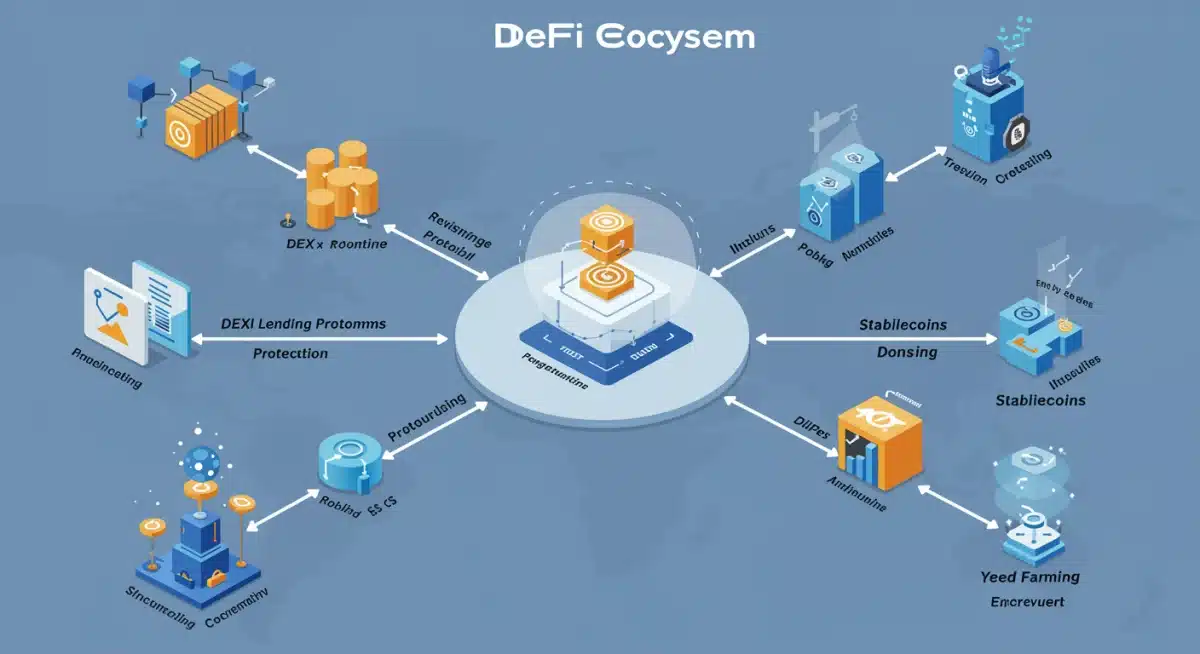
Consider also diversifying across different blockchain networks. While Ethereum remains dominant, layer-2 solutions and alternative layer-1 blockchains like Solana, Avalanche, or Polygon offer distinct advantages in terms of speed, cost, and specific ecosystem strengths. Investing in projects across multiple chains can further spread risk and capture growth from different corners of the DeFi space.
In conclusion, effective risk management and strategic diversification are paramount for navigating the high-stakes world of DeFi altcoins. By understanding inherent risks, diversifying intelligently, and sizing positions appropriately, investors can protect their capital while maximizing their chances of capturing those elusive 10x opportunities in the US market for 2025.
The role of institutional adoption and partnerships
The mainstream success and 10x growth potential of DeFi altcoins in the US market for 2025 will heavily depend on increasing institutional adoption and strategic partnerships. While retail investors have historically driven much of the crypto market, institutional capital brings unprecedented liquidity, legitimacy, and a broader user base. Projects that successfully attract institutional interest and forge meaningful collaborations are far more likely to achieve significant scale and sustained value appreciation.
Institutional involvement isn’t just about large investments; it also encompasses the integration of DeFi solutions into traditional financial systems, the development of enterprise-grade tools, and the endorsement from established players. These factors collectively signal maturity and reliability, which are crucial for overcoming the skepticism that sometimes surrounds decentralized technologies.
Integrating DeFi with traditional finance
Look for DeFi altcoins that are actively working to bridge the gap between decentralized and traditional finance (TradFi). This could involve protocols facilitating institutional access to DeFi yields, tokenizing real-world assets (RWAs) for on-chain use, or providing compliant infrastructure for financial institutions to engage with blockchain technology. Such integrations expand the total addressable market for DeFi significantly.
Projects that offer solutions for institutional custody, regulatory compliance, and robust risk management are particularly attractive. These are the critical pain points for traditional firms looking to enter the DeFi space, and projects that effectively solve them will likely become indispensable.
Strategic partnerships and enterprise solutions
Partnerships with established companies, both within and outside the crypto space, can be a powerful catalyst for growth. These collaborations can provide access to new technologies, distribution channels, and user bases. Evaluate the quality and relevance of a project’s partnerships; superficial alliances often yield little value, whereas deep, synergistic collaborations can be transformative.
- Enterprise integrations: Look for projects whose technology is being adopted by corporations for supply chain management, data verification, or other business processes.
- Cross-chain interoperability: Partnerships that enable seamless interaction between different blockchain networks enhance liquidity and utility.
- Regulatory guidance partnerships: Collaborations with legal and compliance firms to navigate the complex US regulatory environment.
Furthermore, projects developing robust enterprise-grade solutions, such as permissioned DeFi protocols or specialized blockchain infrastructure for businesses, are positioning themselves for long-term institutional engagement. These solutions often prioritize security, scalability, and compliance, making them appealing to larger entities.
In conclusion, institutional adoption and strategic partnerships are indispensable for DeFi altcoins aiming for 10x growth in the US market for 2025. Projects that successfully integrate with traditional finance, forge meaningful collaborations, and offer enterprise-ready solutions are building the necessary bridges for mainstream acceptance and sustained value creation.
Navigating market cycles and long-term vision
The cryptocurrency market, and DeFi within it, is notoriously cyclical, experiencing periods of explosive growth followed by significant corrections. Successfully identifying 10x opportunities in DeFi altcoins for the US market in 2025 requires not just spotting promising projects but also understanding how to navigate these market cycles with a long-term vision. Short-term speculation, while tempting, rarely yields sustainable returns and often leads to emotional decision-making.
A long-term perspective involves holding through market downturns, continuously researching and re-evaluating investments, and understanding that true innovation takes time to mature. This approach contrasts sharply with chasing ephemeral trends, which often results in buying at the peak and selling at the bottom.
Understanding bull and bear markets
Recognize that even the most promising DeFi altcoins will experience significant price fluctuations. Bull markets are characterized by widespread optimism and rising prices, while bear markets involve pessimism and declining values. Successful investors understand that bear markets are often the best time to accumulate high-quality assets at discounted prices, positioning themselves for the next bull run.
Avoid making impulsive decisions based on daily price movements. Instead, focus on the underlying technology, adoption rates, and the project’s ability to execute its roadmap, regardless of short-term market sentiment. Patience is a virtue in crypto investing, especially when aiming for exponential returns.
Focus on innovation and sustained development
Projects with a clear long-term vision and a consistent track record of innovation are more likely to weather market cycles and emerge stronger. Look for teams that continue to build and develop their protocols even during bear markets, as this demonstrates commitment and resilience. A project that goes quiet during a downturn is a significant red flag.
- Roadmap execution: Evaluate whether the team consistently delivers on its stated roadmap and adapts to changing market needs.
- Research and development: Projects investing in continuous R&D to improve their technology and expand their offerings.
- Adaptability: The ability of a project to pivot and innovate in response to technological advancements or regulatory shifts.
Furthermore, a project’s ability to attract and retain talent, even during challenging times, is a strong indicator of its long-term viability. Talented developers, marketers, and community managers are crucial for sustained growth and the successful implementation of a project’s vision.
In conclusion, navigating market cycles and maintaining a long-term vision are critical for realizing 10x opportunities in DeFi altcoins. By understanding market dynamics, focusing on sustained innovation, and exercising patience, investors can position themselves to benefit from the transformative potential of decentralized finance in the US market for 2025 and beyond.
| Key Aspect | Brief Description |
|---|---|
| Regulatory Compliance | Prioritize projects actively seeking US regulatory clarity and compliance for long-term viability. |
| Fundamental Analysis | Evaluate tokenomics, TVL, and developer activity for sustained growth potential. |
| Innovation & Use Cases | Focus on unique solutions, scalability, security, and superior user experience. |
| Risk & Diversification | Implement robust risk management and diversify across projects and sectors. |
Frequently asked questions about DeFi altcoins
DeFi altcoins are cryptocurrencies powering decentralized finance applications built on various blockchains. These applications aim to recreate traditional financial services like lending, borrowing, and trading without intermediaries, offering new investment opportunities beyond Bitcoin and Ethereum.
Identifying 10x opportunities involves deep research into project fundamentals, including strong tokenomics, innovative use cases, high and growing Total Value Locked (TVL), active developer communities, and clear regulatory compliance strategies. Look for projects solving real-world problems with scalable and secure solutions.
US regulation is crucial. Projects that proactively address compliance, security, and transparency are more likely to thrive. Evolving rules around stablecoins, taxation, and platform licensing will shape market dynamics, favoring compliant and well-structured DeFi protocols for long-term growth.
A strong, engaged community is vital for a DeFi project’s adoption and sustainability. It provides feedback, drives governance, and contributes to network effects. Projects with active DAOs, robust developer ecosystems, and transparent communication often demonstrate greater resilience and potential for sustained growth.
Risks include smart contract vulnerabilities, impermanent loss, oracle manipulation, and regulatory uncertainty. Diversification across projects and sectors, understanding inherent risks, and never investing more than you can afford to lose are essential risk management strategies in this volatile market.
Conclusion
The pursuit of 10x opportunities within Decentralized Finance (DeFi) Altcoins: How to Spot the 10x Opportunities in the US Market for 2025 is a venture that demands both keen insight and strategic patience. As the DeFi landscape continues to mature, especially within the US market, success hinges on a meticulous evaluation of regulatory compliance, fundamental project strengths, technological innovation, and the vitality of community engagement. By adopting a long-term perspective, practicing diligent risk management, and staying attuned to institutional trends, investors can strategically position themselves to capitalize on the transformative potential of decentralized finance. The future of finance is being built today, and informed participation is key to unlocking its most lucrative prospects.