Oracle Solutions for DeFi: A 4-Step Implementation Guide (2026)

The decentralized finance (DeFi) landscape in the United States is rapidly evolving, driven by innovation, increasing institutional adoption, and a dynamic regulatory environment. At the heart of every robust DeFi application lies the critical need for accurate, reliable, and secure external data. This is precisely where blockchain oracles come into play, serving as the essential bridge between the deterministic world of smart contracts and the unpredictable, real-world data landscape. Implementing effective DeFi Oracle Implementation is not just a technical challenge; it’s a strategic imperative for any project aiming for longevity, security, and compliance in the U.S. market.
As we look towards 2026, the demands on DeFi protocols are only set to intensify. From interest rate feeds for lending platforms to real-time asset prices for decentralized exchanges, and even complex insurance triggers, the integrity of these data streams is paramount. A single point of failure or a compromised data feed can lead to catastrophic losses, erode user trust, and invite regulatory scrutiny. Therefore, understanding and executing a meticulous implementation strategy for oracle solutions is non-negotiable.
This comprehensive guide delves into a structured, four-step process for implementing robust Oracle solutions within the U.S. DeFi ecosystem. We will explore the nuances of each stage, providing insights and best practices updated for the challenges and opportunities anticipated in 2026. Our focus will be on ensuring not only technical functionality but also adherence to emerging compliance standards and maximizing the security posture of your DeFi applications.
The Indispensable Role of Oracles in U.S. DeFi
Before diving into the implementation steps, it’s crucial to fully grasp why oracles are not merely an add-on but a foundational component of any serious DeFi project. Smart contracts, by their very nature, are isolated from the outside world. They can only execute logic based on data stored directly on their native blockchain. However, most real-world financial applications, from collateralized loans to synthetic assets, require information that originates off-chain: price feeds, event outcomes, identity verification, and more.
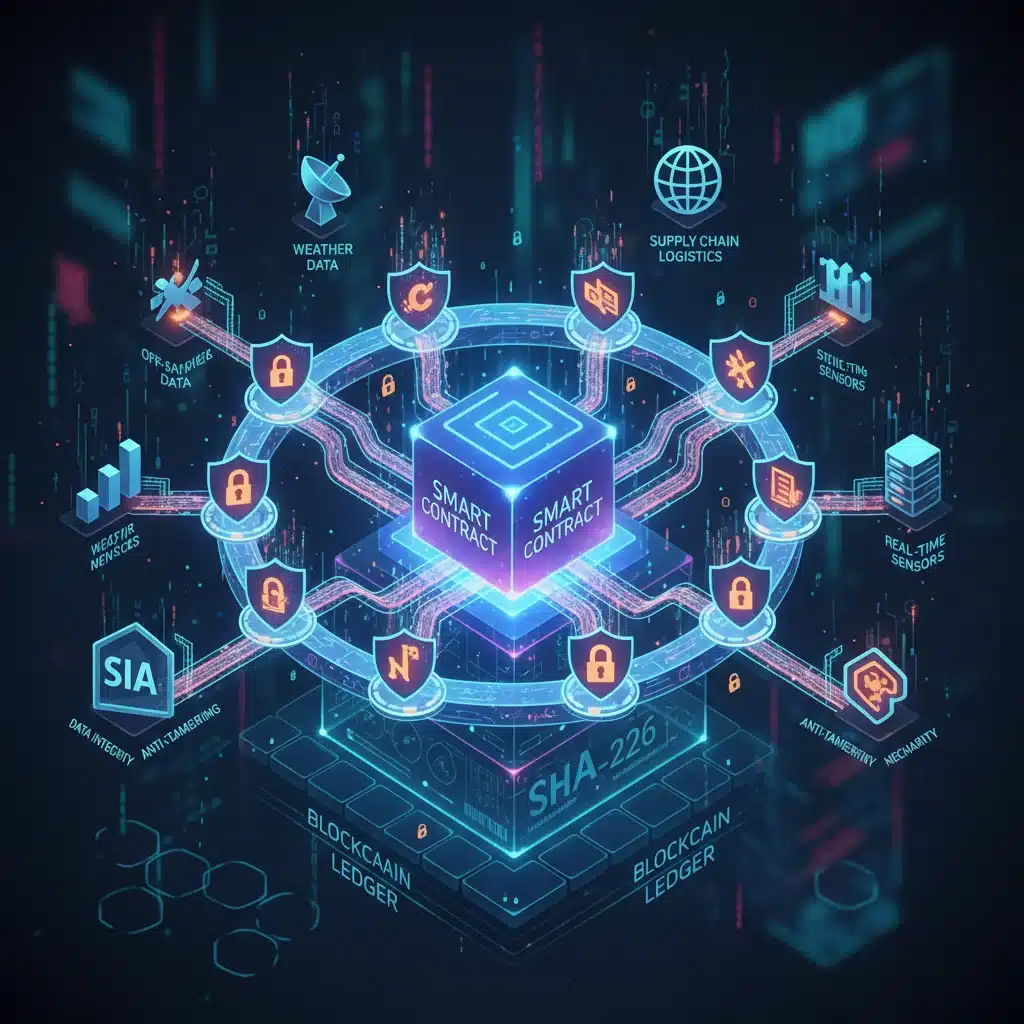
Oracles act as these vital intermediaries, fetching off-chain data and delivering it to smart contracts in a secure, verifiable, and tamper-proof manner. Without reliable oracle solutions, DeFi protocols would be severely limited in their functionality, confined to operations that only involve on-chain data. This would effectively cripple their ability to interact with traditional finance (TradFi) or reflect real-world economic conditions.
In the U.S. regulatory landscape, the integrity of data feeds is under increasing scrutiny. Regulators are keen to ensure market manipulation risks are mitigated and that data used in financial products is accurate and auditable. Robust DeFi Oracle Implementation directly addresses these concerns by providing transparency, redundancy, and cryptographic assurances around the data consumed by smart contracts. This not only builds trust with users but also demonstrates a commitment to responsible financial innovation.
Step 1: Thorough Assessment and Requirements Definition
The first and arguably most critical step in successful DeFi Oracle Implementation is a comprehensive assessment of your project’s specific needs and the precise definition of your data requirements. Rushing this stage can lead to suboptimal oracle choices, security vulnerabilities, and costly reworks down the line. This phase requires a deep dive into both the technical architecture of your DeFi protocol and its intended business logic.
Defining Data Needs and Characteristics
- Data Type: What kind of data do your smart contracts need? (e.g., cryptocurrency prices, stock prices, interest rates, exchange rates, weather data, sports scores, identity verification).
- Data Frequency: How often does this data need to be updated? (e.g., every block, every minute, hourly, daily, on-demand). High-frequency data requires more performant and potentially more expensive oracle solutions.
- Data Source Reliability: Where will the data originate from? Are these sources reputable, resilient to manipulation, and legally compliant? For example, using multiple, independent data aggregators for price feeds is often preferable to a single exchange API.
- Data Precision and Granularity: What level of accuracy and detail is required? For instance, a lending protocol might need price data to several decimal places, while an insurance product might only need a boolean outcome (e.g., ‘event occurred’ or ‘event did not occur’).
- Historical Data Requirements: Do your smart contracts need access to historical data? Some oracle solutions offer historical data feeds, which can be crucial for analytics, backtesting, or specific financial calculations.
Evaluating Security and Trust Assumptions
- Attack Vectors: What are the potential ways an attacker could compromise the data feed? (e.g., data manipulation, Sybil attacks on oracle networks, oracle downtime, front-running).
- Trust Minimization: How can you minimize the need to trust any single entity in the data delivery process? Decentralized oracle networks (DONs) are designed precisely for this purpose.
- Cryptographic Security: What cryptographic guarantees are provided by the oracle solution regarding data authenticity and integrity?
- Reputation and Auditability: Does the oracle solution have a strong track record? Has it undergone independent security audits?
Compliance and Regulatory Considerations (U.S. Specific)
- Data Provenance: Can you trace the origin of the data used by your smart contracts? This is increasingly important for audit trails and regulatory reporting.
- Sanctions Screening: If your DApp interacts with real-world identities or assets, how will the oracle solution assist in complying with OFAC (Office of Foreign Assets Control) sanctions lists?
- Data Privacy: For sensitive data, how does the oracle solution handle privacy, especially concerning U.S. data protection laws?
- Legal Entity and Jurisdiction: If using a centralized oracle, understand the legal entity behind it and its jurisdiction, as this impacts liability and dispute resolution.
This initial assessment forms the bedrock for subsequent decisions. By clearly defining these parameters, you establish the criteria against which potential oracle solutions will be evaluated.
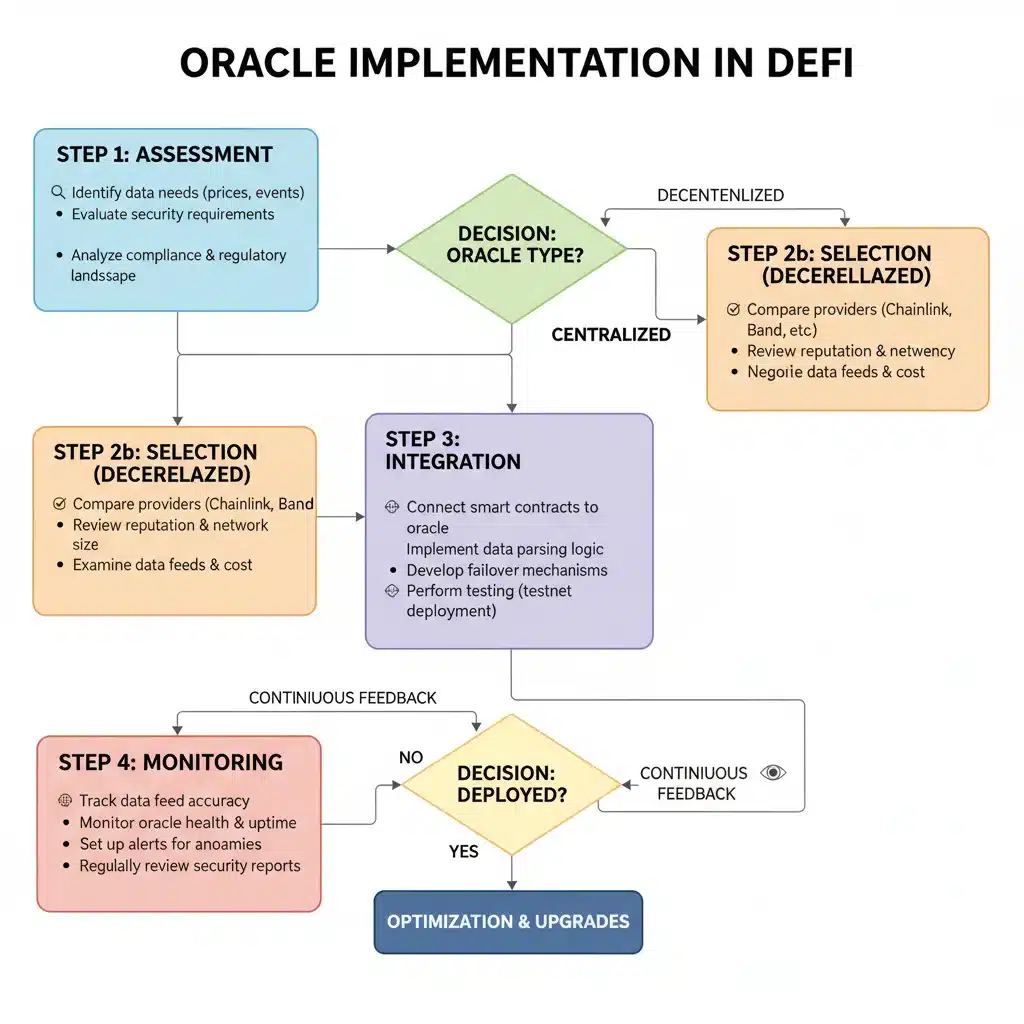
Step 2: Oracle Solution Selection and Due Diligence
Once your requirements are meticulously defined, the next step is to select the most suitable oracle solution. The market offers a variety of options, each with its own strengths, weaknesses, and architectural paradigms. This selection process is critical for successful DeFi Oracle Implementation.
Types of Oracle Solutions
- Centralized Oracles: Managed by a single entity responsible for fetching and delivering data. While simpler to implement, they introduce a single point of failure and require a high degree of trust in the central party. Suitable for less critical data or where trust in a specific provider is established.
- Decentralized Oracle Networks (DONs): These networks comprise multiple independent nodes that collectively fetch, validate, and deliver data. They offer enhanced security, censorship resistance, and resilience against single points of failure. Chainlink is the preeminent example in this category.
- Computation Oracles: Extend beyond simple data feeds to perform off-chain computations and deliver the results to smart contracts. This can be crucial for complex financial models or privacy-preserving computations.
- Human Oracles (Reality.eth, Kleros): Rely on human consensus to report on subjective or event-based outcomes. Often used for insurance, prediction markets, or dispute resolution.
- API Oracles: Directly connect to traditional web APIs to pull data. While efficient, the security of the API itself and the trust in the provider are paramount.
Key Evaluation Criteria for Selection
- Decentralization & Security: How decentralized is the network? What mechanisms are in place to prevent data tampering, collusion, and Sybil attacks? Look for strong cryptographic proofs, reputation systems, and economic incentives for honest behavior.
- Data Quality & Reliability: Does the oracle source data from multiple reputable providers? Are there aggregation mechanisms to ensure accuracy and resilience against outlier data points? What is the uptime guarantee?
- Cost & Efficiency: What are the costs associated with using the oracle (e.g., gas fees, subscription fees)? Is it economically viable for your protocol’s transaction volume and value?
- Speed & Latency: How quickly can data be delivered to your smart contracts? This is crucial for applications requiring real-time updates.
- Flexibility & Customization: Can the oracle be configured to meet your specific data formats, update frequencies, and aggregation logic?
- Developer Experience & Documentation: Is the oracle well-documented with clear APIs and SDKs? Is there a supportive developer community?
- Audits & Reputation: Has the oracle solution undergone independent security audits? What is its track record in the industry? Are there any known vulnerabilities or incidents?
- U.S. Regulatory Alignment: Does the chosen oracle solution offer features or compliance pathways that align with U.S. regulatory expectations, especially regarding data provenance and anti-manipulation?
Due Diligence Checklist
Perform thorough due diligence on your top candidates:
- Review their whitepapers, technical documentation, and security audit reports.
- Examine their on-chain activity and network statistics (e.g., number of active nodes, data requests served).
- Engage with their developer community and support channels.
- If possible, test their services in a sandbox environment.
- Consider legal counsel to review their terms of service, especially for U.S.-based projects.
The selection of the right oracle solution is a long-term commitment that significantly impacts the security, functionality, and regulatory standing of your DeFi protocol. Choose wisely, prioritizing resilience and trustworthiness over mere convenience or cost.
Step 3: Integration and Smart Contract Implementation
With the oracle solution selected, the next phase focuses on the technical integration into your DeFi protocol’s smart contracts. This step requires careful coding, testing, and a deep understanding of how your smart contracts will consume and react to the oracle data. Proper DeFi Oracle Implementation at this stage is crucial for preventing critical vulnerabilities.
Designing Smart Contract Interaction
- Request Patterns: How will your smart contracts request data from the oracle? Common patterns include:
- Pull Model: Smart contracts actively request data when needed. This gives more control but incurs gas costs for each request.
- Push Model: The oracle pushes data to the smart contract at predefined intervals or upon specific events. This can be more gas-efficient for frequently updated data but requires the smart contract to be designed to receive and process external calls.
- Data Consumption Logic: How will your smart contract parse and utilize the data received from the oracle? Ensure the data types and formats match expectations.
- Fallback Mechanisms: What happens if the oracle data feed becomes unavailable or returns erroneous data? Implement robust fallback mechanisms, such as using older data, pausing contract functionality, or relying on a secondary oracle.
- Access Control: Restrict which addresses can trigger oracle updates or receive data. Only trusted contracts or authorized roles should interact directly with the oracle.
Secure Coding Practices for Oracle Integration
- Input Validation: Always validate the data received from the oracle. Even trusted oracles can occasionally experience issues. Ensure data falls within expected ranges and formats.
- Reentrancy Guards: While not directly related to oracle data, reentrancy vulnerabilities can be exacerbated by external calls. Use reentrancy guards where appropriate.
- Time-Based Dependencies: Be cautious with time-dependent logic that relies on oracle updates. Network congestion or oracle latency can lead to unexpected behavior. Consider using time-weighted averages (TWAPs) for price feeds to mitigate flash loan attacks.
- Oracle Address Verification: Ensure your smart contract is interacting with the correct, verified oracle contract address to prevent spoofing.
- Upgradability: Design your smart contracts with upgradability in mind for oracle addresses or logic, as oracle solutions may evolve or require updates.
- Gas Optimization: Oracle calls can be expensive. Optimize your smart contract logic to minimize gas consumption, especially for frequent data requests.
Testing and Auditing
- Unit Testing: Thoroughly unit test all smart contract functions that interact with the oracle, simulating various data inputs (valid, invalid, edge cases).
- Integration Testing: Test the end-to-end flow of data from the oracle to your smart contract within a testnet environment.
- Security Audits: Engage reputable blockchain security firms to conduct comprehensive audits of your smart contract code, paying particular attention to oracle integration points. This is an absolute necessity for U.S. DeFi projects.
- Bug Bounty Programs: Consider launching a bug bounty program to incentivize ethical hackers to find vulnerabilities before deployment.
The integration phase is where theoretical designs become practical code. Precision, security considerations, and rigorous testing are paramount to ensure the oracle functions as intended and does not introduce new vulnerabilities into your DeFi protocol.
Step 4: Continuous Monitoring, Maintenance, and Adaptation
Deploying your DeFi protocol with an integrated oracle is not the end of the journey; it’s the beginning of continuous operational responsibility. The dynamic nature of blockchain, DeFi, and regulatory environments necessitates constant vigilance. Effective DeFi Oracle Implementation extends far beyond initial deployment.
Real-Time Monitoring of Oracle Feeds
- Data Feed Health: Implement monitoring tools to track the health and uptime of your chosen oracle feeds. This includes checking for data freshness, consistency, and any deviations from expected values.
- Deviation Alerts: Set up alerts for significant deviations in data, such as sudden price drops or spikes, which could indicate a data anomaly or an attack.
- Gas Price Monitoring: Track gas prices on the underlying blockchain. High gas prices can affect the cost and timeliness of oracle updates.
- On-Chain Events: Monitor on-chain events related to your oracle, such as updates to oracle addresses, changes in node operators, or governance votes.
- External Tools: Leverage external monitoring services and dashboards provided by oracle providers or third-party analytics platforms.
Maintenance and Upgrades
- Oracle Updates: Oracle providers regularly release updates, improvements, or new data feeds. Stay informed and plan for timely upgrades to leverage new features and security enhancements.
- Smart Contract Upgrades: If your smart contracts are upgradable, ensure that any changes are thoroughly tested and audited, especially those interacting with the oracle.
- Node Operator Management (for DONs): If you are running your own oracle nodes or relying on a specific set of node operators within a DON, ensure their infrastructure is well-maintained, secure, and performant.
- Emergency Procedures: Have clear emergency procedures in place for oracle failures, including communication strategies, fallback activation, and potential pausing of protocol functionality.
Adaptation to Regulatory Changes (U.S. Focus)
The regulatory landscape for DeFi in the U.S. is still evolving. Staying ahead of potential changes is crucial:
- Legal Counsel: Regularly consult with legal experts specializing in blockchain and financial regulations to understand new guidance or laws that might impact your oracle strategy.
- Data Provenance & Audit Trails: Ensure your monitoring and logging systems can provide clear audit trails of oracle data consumption, which may be required for future compliance.
- KYC/AML Integration: If your oracle solution is involved in identity verification or sanction screening, stay updated on KYC/AML regulations and ensure your oracle integration remains compliant.
- Market Manipulation Prevention: Continuously review your oracle’s resilience against market manipulation, especially as new attack vectors emerge. Regulators are highly focused on market integrity.
Community Engagement and Feedback
Engage with the wider DeFi and oracle communities. Community feedback can provide early warnings about potential issues, highlight best practices, and inform future development. Participating in relevant forums and discussions can be invaluable for staying informed about the latest trends and challenges in DeFi Oracle Implementation.
Conclusion: Securing the Future of U.S. DeFi with Robust Oracles
The journey of DeFi Oracle Implementation is multifaceted, demanding technical prowess, strategic foresight, and a keen awareness of the evolving regulatory landscape, particularly within the United States. As DeFi continues its trajectory of innovation and adoption, the reliability and security of its data feeds will remain its Achilles’ heel if not properly addressed.
By meticulously following these four steps—thorough assessment, diligent selection, secure integration, and continuous monitoring—DeFi projects can build a strong foundation for their smart contracts. This not only enhances the robustness and trustworthiness of their applications but also positions them favorably within a regulatory environment that increasingly values transparency, security, and accountability.
Looking ahead to 2026, the projects that prioritize resilient, decentralized, and compliant oracle solutions will be the ones that thrive, attracting greater user participation, institutional capital, and ultimately, driving the mainstream adoption of decentralized finance in the U.S. and beyond. The future of finance is open, programmatic, and undeniably reliant on the integrity of its data—a truth that makes effective DeFi Oracle Implementation an art and a science essential for success.