Formal Verification Smart Contracts: U.S. Bug-Free Code 2026
The blockchain landscape is rapidly evolving, and with it, the complexity and criticality of smart contracts. These self-executing agreements, written directly into lines of code, govern billions of dollars in assets and underpin the entire decentralized finance (DeFi) ecosystem. However, their immutable nature means that even a single bug can lead to catastrophic losses, as evidenced by numerous high-profile hacks and exploits. In response to this existential threat, a powerful paradigm is gaining traction, particularly within U.S. projects: formal verification for smart contracts. This rigorous, mathematical approach to software correctness is not just an incremental improvement; it’s a fundamental shift promising to deliver 99% bug-free code by 2026, setting a new gold standard for blockchain security and reliability.
The stakes couldn’t be higher. From lending protocols to decentralized exchanges, the integrity of smart contracts is paramount. Traditional software testing, while valuable, often falls short in guaranteeing the absence of subtle, edge-case vulnerabilities that can be exploited by malicious actors. Formal verification, on the other hand, offers a level of assurance that, until recently, was largely confined to mission-critical systems in aerospace or defense. Its application to smart contracts represents a pivotal moment, transforming the way developers approach security and ushering in an era of unprecedented trust in decentralized applications.
This comprehensive guide will explore the intricacies of formal verification for smart contracts, delve into its growing adoption within U.S. projects, examine the methodologies and tools being employed, and analyze the challenges and future trajectory of this transformative technology. We will uncover how leading U.S. blockchain initiatives are not just aiming for, but actively achieving, a future where smart contract vulnerabilities are a rarity rather than a recurring nightmare.
Understanding the Imperative: Why Traditional Methods Fall Short for Smart Contracts
Before diving into the specifics of formal verification for smart contracts, it’s crucial to understand why conventional software development practices are often inadequate for the unique demands of blockchain. Smart contracts operate in an adversarial environment where every line of code is a potential target. Unlike traditional applications, which can often be patched or rolled back, smart contracts, once deployed, are immutable. This immutability, while a core tenet of blockchain, also means that any flaw becomes a permanent vulnerability, often with irreversible financial consequences.
The Limitations of Traditional Testing and Auditing
Traditional software testing relies heavily on executing code with a predefined set of inputs and verifying the outputs. This approach can uncover many bugs, but it’s inherently limited by the test cases designed. It proves the presence of bugs, but never their absence. For complex smart contracts, the number of possible execution paths and input combinations can be astronomical, making exhaustive testing practically impossible.
Manual security audits, while essential, also have their limitations. They depend on the expertise and diligence of human auditors, who can sometimes miss subtle logical flaws or intricate attack vectors. Furthermore, audits are a snapshot in time; they don’t guarantee correctness against future interactions or unforeseen circumstances. The human element introduces subjectivity and potential for error, which in the high-stakes world of DeFi, is a risk many projects are no longer willing to take.
Penetration testing and bug bounty programs are valuable for finding known vulnerabilities, but they are reactive rather than proactive. They identify weaknesses after the code is written, and sometimes even after it’s deployed, which can be too late for smart contracts. The goal for smart contracts isn’t just to find bugs, but to prevent them from existing in the first place.
What is Formal Verification for Smart Contracts?
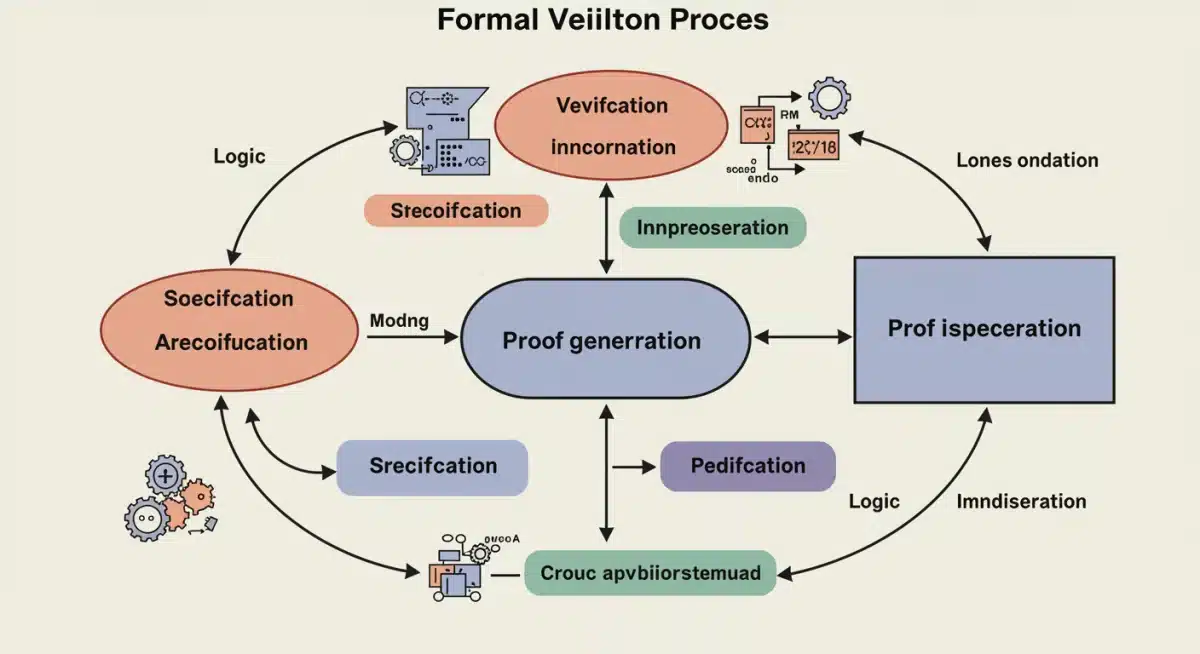
Formal verification for smart contracts is a mathematically rigorous process used to prove the correctness of software and hardware systems. Unlike testing, which shows that a system behaves as expected for a given set of inputs, formal verification aims to prove that a system will always behave as expected under all possible circumstances, according to a formal specification. It uses mathematical logic, formal methods, and automated reasoning tools to construct a mathematical proof of correctness.
The Core Principles
At its heart, formal verification involves two key components:
- Formal Specification: This is a precise, unambiguous mathematical description of what the smart contract is supposed to do. It defines the expected behavior, properties, and invariants of the system, often using formal languages like temporal logic or Hoare logic. This step is crucial, as any ambiguity in the specification will lead to an incorrect proof.
- Formal Proof: This is a mathematical demonstration that the smart contract code (or a formal model of it) satisfies its formal specification. This proof is typically generated using automated tools called theorem provers or model checkers, which systematically explore all possible states and transitions of the system.
The result is a high degree of assurance that the smart contract will behave exactly as intended, without any hidden vulnerabilities or unexpected outcomes. This deterministic guarantee is what makes formal verification for smart contracts so appealing for critical blockchain applications.
Formal Verification Techniques and Tools in Practice
Formal verification for smart contracts employs a variety of techniques, each with its strengths and areas of application. The choice of technique often depends on the complexity of the contract, the properties to be verified, and the available tooling.
Key Techniques
- Model Checking: This technique systematically explores all possible states of a system to determine if it satisfies a given property. It’s highly effective for finite-state systems and can automatically find counterexamples if a property is violated. Tools like Frama-C and Spin are widely used in traditional software, and specialized model checkers are emerging for smart contracts.
- Theorem Proving: This involves constructing a mathematical proof that a system satisfies its specification, often with human guidance. Theorem provers like Coq, Isabelle/HOL, and Lean allow for the verification of highly complex properties that might be beyond the scope of model checking, but they require significant expertise.
- Abstract Interpretation: This technique analyzes the behavior of a program without executing it, by approximating its semantics. It can identify properties like absence of runtime errors or overflow conditions. Tools like Infer (though primarily for traditional code) and specific static analyzers for Solidity leverage abstract interpretation principles.
- Symbolic Execution: This method executes a program with symbolic inputs instead of concrete values, collecting path conditions and generating constraints. It can explore multiple execution paths simultaneously and find inputs that lead to specific states or vulnerabilities. Popular tools include Mythril and Hegemon.
Leading Formal Verification Tools for Smart Contracts
The ecosystem of tools for formal verification for smart contracts is rapidly maturing, with several U.S.-based companies and research institutions leading the charge:
- Certora Prover: A leading solution that allows users to write formal specifications in a high-level language (CVL) and then automatically proves properties about Solidity and Vyper smart contracts. It’s widely adopted for its efficiency and ability to find subtle bugs.
- K Framework (Runtime Verification Inc.): Developed by Runtime Verification Inc., a U.S. company, the K Framework provides a rigorous, executable semantic framework for programming languages. It allows for the creation of formal semantics for EVM and Solidity, enabling highly precise formal verification.
- DappHub (Haskell-based tools): While not a single tool, DappHub’s suite of Haskell-based tools, including Dapp and Hevm, offers capabilities for formal modeling and testing of EVM bytecode, attracting projects seeking deep correctness guarantees.
- Solidity SMTChecker: Integrated directly into the Solidity compiler, this SMT (Satisfiability Modulo Theories) based checker can verify certain properties of Solidity code, such as assertions and invariants. It’s an accessible entry point for developers interested in formal verification.
- Foundry (Fuzzing and Invariant Testing): While primarily a testing framework, Foundry’s advanced fuzzing and invariant testing capabilities, particularly with its integration of Huff and property-based testing, bring it closer to formal methods by exploring a vast state space and verifying properties.
U.S. Projects Leading the Charge in 99% Bug-Free Code by 2026
The push for 99% bug-free code through formal verification for smart contracts is particularly strong within the U.S. blockchain ecosystem. Driven by institutional demand, regulatory pressures, and a commitment to robust infrastructure, several U.S.-based projects and companies are at the forefront of this revolution.
Case Studies and Adopters
- Compound Finance: A leading U.S.-based DeFi lending protocol, Compound has been an early and significant adopter of formal verification. They have openly discussed their use of tools like Certora Prover to verify critical invariants of their smart contracts, ensuring the integrity of their lending markets and preventing exploits. This commitment to formal verification is a key factor in their continued success and trust within the DeFi space.
- Uniswap: As one of the largest decentralized exchanges globally, Uniswap’s smart contracts handle immense liquidity. While their core V2/V3 contracts were rigorously audited, subsequent iterations and extensions have increasingly explored formal methods to guarantee their complex logic remains secure. The U.S.-based team understands the critical need for absolute correctness in such high-value, high-frequency systems.
- MakerDAO: The creator of the Dai stablecoin, MakerDAO’s complex system of collateralized debt positions (CDPs) and governance mechanisms requires extreme reliability. They have invested in formal analysis and verification techniques, often collaborating with academic institutions and specialized firms, to ensure the stability and security of their protocol, which is fundamental to the broader DeFi ecosystem.
- Aave (U.S. Operations): While Aave has a global presence, its significant U.S. operations and growing institutional interest mean a heightened focus on security. They have engaged with formal verification experts to analyze their V3 contracts and new features, aiming to proactively eliminate vulnerabilities before deployment.
- Research Institutions and Startups: U.S. universities like Stanford, UC Berkeley, and Carnegie Mellon are active in formal methods research applied to blockchain. Furthermore, numerous U.S. startups are specializing in providing formal verification services for smart contracts, developing proprietary tools, and integrating these practices into the development lifecycle of other blockchain companies.
These examples highlight a clear trend: projects handling significant value and aiming for long-term sustainability are increasingly integrating formal verification for smart contracts as a non-negotiable part of their development process. The goal of 99% bug-free code by 2026 is becoming a tangible reality for these pioneers.
Benefits of Formal Verification for Smart Contracts
The adoption of formal verification for smart contracts brings a multitude of benefits that extend far beyond simply finding bugs. It fundamentally elevates the security posture and trustworthiness of blockchain applications.
Unparalleled Security Guarantees
The primary benefit is the mathematical certainty it provides. By proving that a smart contract adheres to its specification under all possible conditions, formal verification virtually eliminates entire classes of bugs, such as reentrancy attacks, integer overflows, and logical flaws that are notoriously difficult to catch with traditional testing. This proactive approach prevents exploits before they can occur, safeguarding user funds and protocol integrity.
Increased Trust and Adoption
In an ecosystem plagued by hacks and rug pulls, trust is the most valuable commodity. Projects that can demonstrate their smart contracts have undergone rigorous formal verification instill significantly greater confidence in users, investors, and institutional partners. This increased trust is crucial for broader adoption of DeFi and other blockchain applications, especially from traditional financial institutions that demand the highest levels of security assurance.
Reduced Development Costs in the Long Run
While the initial investment in formal verification can be substantial, it often leads to significant cost savings in the long run. Preventing a single major exploit can save millions, if not billions, of dollars in lost funds, reputational damage, and recovery efforts. Furthermore, by catching design flaws early in the development cycle, formal verification reduces the need for expensive post-deployment audits, emergency patches, and potential legal liabilities.
Improved Code Quality and Design
The process of creating a formal specification forces developers to think deeply and precisely about the intended behavior of their smart contracts. This upfront rigor often leads to better-designed, more modular, and easier-to-understand code. The need to formally prove properties encourages simpler, more elegant solutions, reducing complexity and potential attack surface.
Compliance and Regulatory Readiness
As regulatory scrutiny around blockchain intensifies, projects that can demonstrate formal correctness will be better positioned to meet compliance requirements. The ability to mathematically prove adherence to specific safety and liveness properties could become a critical differentiator for regulated entities operating in the blockchain space, particularly in the U.S.
Challenges and Overcoming Them
Despite its immense promise, the widespread adoption of formal verification for smart contracts faces several challenges. However, the U.S. blockchain community is actively working to overcome these hurdles.
Complexity and Expertise
Formal verification requires specialized knowledge in mathematical logic, formal methods, and specific verification tools. This expertise is currently scarce, making it challenging for many development teams to integrate formal verification in-house. Solution: The emergence of specialized formal verification service providers, dedicated educational programs, and user-friendly tools are helping to lower the barrier to entry. Collaboration between academic researchers and industry practitioners is also crucial for knowledge transfer.
Cost and Time Investment
The upfront cost and time required for formal specification and proof generation can be significant, especially for highly complex contracts. This can be a deterrent for smaller projects or those with tight deadlines. Solution: As tools become more automated and efficient, and as the cost of exploits continues to rise, the ROI of formal verification becomes increasingly clear. Modular verification (verifying components independently) and incremental verification (verifying changes as they occur) can help manage costs and timelines.
Scalability for Large Systems
Verifying entire complex systems, especially those with numerous interconnected smart contracts, can be computationally intensive and challenging. Solution: Research into compositional verification (verifying components and then composing their proofs), abstraction techniques, and more powerful automated theorem provers is ongoing. Focusing on verifying critical components and interfaces first can provide significant security gains.
Evolving Language and EVM Semantics
The underlying blockchain platforms and smart contract languages (like Solidity and the EVM) are constantly evolving. This can make it difficult to keep formal models and verification tools up-to-date. Solution: Close collaboration between language developers, platform teams, and formal verification experts is essential. The K Framework, for instance, aims to provide a robust and adaptable semantic framework for EVM and Solidity, making it easier to verify against evolving standards.
The Road to 99% Bug-Free Code by 2026: A U.S. Perspective
The ambitious goal of achieving 99% bug-free code in smart contracts by 2026, particularly within U.S. projects, is not merely aspirational; it’s a strategic imperative driven by several factors:
Institutional Adoption and Regulatory Demands
As institutional players and traditional finance increasingly enter the blockchain space, they bring with them stringent demands for security and compliance. These entities are accustomed to the highest levels of assurance in their financial systems, and they will expect no less from decentralized alternatives. Formal verification provides the mathematical guarantees necessary to meet these demands, accelerating institutional adoption in the U.S.
Maturing Tooling and Methodologies
The formal verification ecosystem is maturing rapidly. Tools are becoming more powerful, user-friendly, and integrated into existing development workflows. U.S.-based companies and researchers are actively contributing to this advancement, making formal verification more accessible and efficient for a broader range of projects.
Increased Awareness and Education
There’s a growing awareness within the developer community and among project founders about the critical importance of deep security guarantees. Educational initiatives, conferences, and open-source contributions are helping to disseminate knowledge and best practices around formal verification, fostering a culture of security-first development.
Economic Incentives
The cost of smart contract exploits continues to climb, creating a strong economic incentive for prevention. The investment in formal verification, while significant, is increasingly seen as a necessary insurance policy against potentially catastrophic losses. This economic reality is driving U.S. projects, often backed by substantial capital, to prioritize formal methods.
Future Trends in Formal Verification for Smart Contracts
The field of formal verification for smart contracts is dynamic, with several exciting trends shaping its future:
- Increased Automation: Expect more sophisticated automated tools that require less human guidance and can verify increasingly complex contract properties with greater efficiency. AI and machine learning could play a role in generating specifications or proofs.
- Integration into Development Lifecycles: Formal verification will become a standard, integrated part of the smart contract development lifecycle, from design to deployment, rather than an afterthought. CI/CD pipelines will include formal verification checks.
- Domain-Specific Languages (DSLs) for Specification: The development of higher-level, domain-specific languages for writing formal specifications will make the process more accessible to smart contract developers who may not be formal methods experts.
- Cross-Chain Verification: As multi-chain and cross-chain interactions become more prevalent, formal verification will extend to verifying the correctness of inter-blockchain communication protocols and multi-contract systems.
- Hardware-Assisted Verification: For ultimate security, some critical blockchain components might eventually benefit from hardware-assisted formal verification, similar to its use in CPU design.
- Formal Verification as a Service (FVaaS): Specialized firms will continue to offer FVaaS, allowing projects to outsource their formal verification needs to experts, making the technology accessible without requiring in-house expertise.
The U.S. is poised to remain a leader in these advancements, leveraging its strong research institutions, vibrant startup ecosystem, and significant investment in blockchain technology.
Conclusion: The Dawn of Bug-Free Decentralized Applications
The journey towards 99% bug-free code in smart contracts by 2026, spearheaded by innovative U.S. projects, marks a transformative period for the blockchain industry. Formal verification for smart contracts is no longer a niche academic pursuit; it is rapidly becoming an indispensable pillar of secure and reliable decentralized applications.
By embracing mathematical rigor, advanced tooling, and a security-first mindset, U.S. blockchain initiatives are setting a new benchmark for trust and integrity in the digital economy. The challenges are real, but the commitment to overcoming them is stronger, driven by the profound realization that the future of decentralized finance and Web3 hinges on the absolute correctness of its foundational smart contracts.
As formal verification continues to evolve and integrate more deeply into development practices, we can anticipate a future where catastrophic smart contract exploits are rare anomalies, and users can interact with decentralized applications with unprecedented confidence. This will not only unlock new levels of innovation and adoption but also solidify blockchain’s position as a truly robust and trustworthy technological revolution.
The vision of a decentralized world powered by nearly bug-free smart contracts is within reach, and U.S. projects are leading the way in making that vision a reality, one formally verified line of code at a time.