Maximizing Altcoin Staking Rewards: Achieve 8-12% APY in 2026
Maximizing altcoin staking rewards to achieve 8-12% APY in 2026 involves navigating emerging protocols, understanding their unique mechanisms, and diligently managing associated risks for optimal passive income.
Maximizing altcoin staking rewards is no longer a niche strategy but a cornerstone for generating significant passive income in the evolving crypto landscape. As we look towards 2026, the potential to achieve annual percentage yields (APYs) between 8-12% through innovative and emerging protocols is becoming increasingly tangible. This guide will delve into the practicalities, strategies, and essential considerations for optimizing your staking endeavors in the dynamic world of altcoins.
Understanding the evolving landscape of altcoin staking
The cryptocurrency market is in constant flux, and staking mechanisms are no exception. What worked in 2023 might be obsolete by 2026, making continuous learning and adaptation crucial for those aiming to maximize their returns. Emerging protocols are introducing novel ways to secure networks and distribute rewards, often offering more attractive APYs than established giants.
These new protocols are frequently built on more efficient or specialized blockchain architectures, designed to address scalability, security, or decentralization specific to their use cases. This innovation often translates into higher initial staking rewards as they seek to incentivize network participation and liquidity. Understanding the underlying technology and economic model of these protocols is the first step toward identifying high-potential staking opportunities.
The shift towards flexible and liquid staking solutions
Traditional staking often involves locking up assets for extended periods, reducing liquidity. However, 2026 is seeing a greater emphasis on solutions that offer flexibility without compromising network security. Liquid staking, for instance, allows users to stake their tokens while receiving a liquid derivative token in return, which can then be used in other DeFi applications.
- Increased capital efficiency: Liquid staking tokens can be used as collateral or traded, preventing capital from being idle.
- Broader DeFi integration: These tokens open up new avenues for yield farming, lending, and borrowing, compounding returns.
- Reduced opportunity cost: Users can participate in staking rewards while still engaging with other market opportunities.
The evolving landscape of altcoin staking demands a proactive approach. Investors must move beyond simply holding assets and instead engage with the mechanisms that offer both security and profitability. Keeping abreast of technological advancements and protocol upgrades is paramount to securing competitive APY rates.
Identifying high-potential emerging protocols for 2026
To achieve the ambitious 8-12% APY target, focusing on emerging protocols is key. These projects are often in their growth phases, offering higher incentives to attract early stakers and establish network stability. However, this also comes with increased risk, necessitating thorough due diligence.
When evaluating emerging protocols, consider factors beyond just the advertised APY. A high APY might be unsustainable or indicative of significant underlying risks. Look for projects with robust technology, clear roadmaps, experienced development teams, and strong community support. Protocols addressing real-world problems or offering unique solutions in the Web3 space tend to have more long-term viability.
Key characteristics of promising staking protocols
Several indicators can help differentiate between fleeting high-APY schemes and sustainable opportunities. A protocol’s tokenomics, for example, plays a crucial role in the long-term sustainability of staking rewards. Inflationary models that excessively dilute token value can negate high APY.
- Sustainable tokenomics: A clear, transparent, and balanced token distribution and emission schedule.
- Strong use case: The protocol solves a genuine problem or offers a unique, in-demand service.
- Active development: Regular updates, bug fixes, and feature enhancements demonstrate commitment.
- Community engagement: A vibrant, supportive community is a strong indicator of a project’s health and future.
Furthermore, consider the security audits performed on the protocol’s smart contracts. Unaudited or poorly audited contracts are a significant vulnerability. Look for projects that prioritize security and have undergone rigorous third-party assessments. Ultimately, identifying high-potential protocols requires a blend of technical understanding, market analysis, and a keen eye for sustainable innovation.
Strategic allocation and diversification for optimal returns
Even with promising protocols identified, a haphazard approach to staking will likely fall short of the 8-12% APY goal. Strategic allocation and diversification are critical components of a successful altcoin staking strategy. Just as in traditional finance, spreading your investments across multiple assets and platforms reduces risk and increases the likelihood of consistent returns.
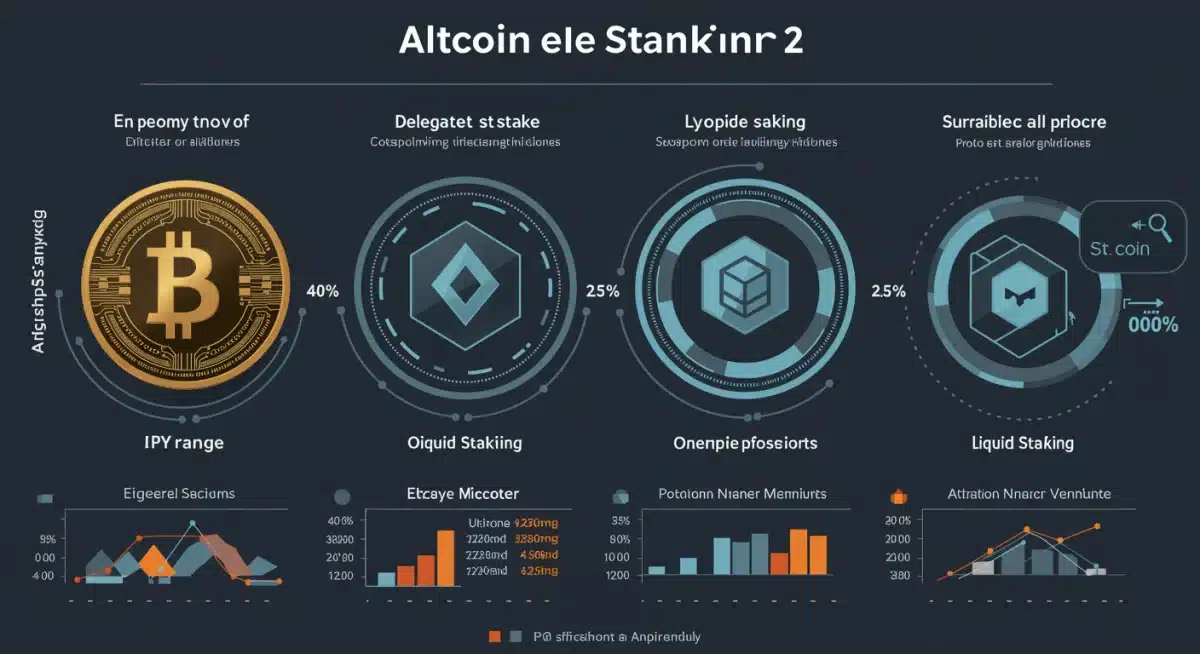
Diversification in staking means not putting all your capital into a single altcoin, regardless of its attractive APY. Instead, allocate funds across several carefully vetted protocols. This approach mitigates the impact of any single project failing or underperforming. Moreover, consider diversifying across different types of staking mechanisms, such as delegated proof-of-stake (DPoS), liquid staking, and even some forms of decentralized autonomous organization (DAO) governance staking.
Balancing risk and reward in your staking portfolio
The pursuit of high APY often correlates with higher risk. Therefore, a balanced approach is essential. A portion of your staking portfolio might be allocated to more established, lower-APY altcoins for stability, while another portion targets higher-APY emerging protocols for growth. This creates a blended APY that is both attractive and relatively secure.
- Risk assessment: Understand the specific risks associated with each protocol, including smart contract vulnerabilities, impermanent loss, and regulatory changes.
- Portfolio rebalancing: Regularly review and adjust your staking allocations based on market conditions, protocol performance, and your risk tolerance.
- Geographic diversification: Consider protocols based in different regulatory environments to mitigate country-specific risks.
Strategic allocation also involves understanding the lock-up periods and unbonding times associated with each staking option. High APY might come with long lock-up periods, limiting your ability to react to market changes. A well-diversified portfolio balances these factors, ensuring both profitability and flexibility.
Mitigating risks in altcoin staking for sustained profitability
While the allure of 8-12% APY is strong, ignoring the inherent risks in altcoin staking can lead to significant losses. The volatile nature of cryptocurrencies, coupled with the complexities of new protocols, demands a robust risk mitigation strategy. Understanding and addressing potential pitfalls is as important as identifying high-reward opportunities.
One primary risk is smart contract vulnerability. Many emerging protocols are built on new or experimental code, which can contain bugs or security flaws that attackers can exploit. Always prioritize protocols that have undergone multiple, independent security audits by reputable firms. Decentralized insurance protocols are also emerging to cover these risks, offering another layer of protection for stakers.
Common risks and how to address them
Beyond technical vulnerabilities, market volatility poses a significant threat. The value of staked altcoins can fluctuate wildly, potentially eroding the gains from staking rewards. Impermanent loss, especially in liquidity provision for decentralized exchanges, is another consideration.
- Smart contract audits: Only stake with protocols that have verifiable, comprehensive security audits.
- Market research: Stay informed about market trends, project news, and potential regulatory changes that could impact your staked assets.
- Use reputable platforms: When using staking-as-a-service providers or exchanges, choose those with a strong track record and robust security measures.
- Understand tokenomics: Be aware of inflation rates and vesting schedules that might dilute your staking rewards.
Furthermore, regulatory uncertainty remains a constant factor in the crypto space. Governments globally are still developing frameworks for digital assets, and new regulations could impact the legality or profitability of certain staking activities. Staying informed about the regulatory landscape in your region and where the protocols operate is crucial for long-term profitability.
Leveraging advanced staking techniques and tools
As the staking ecosystem matures, so do the tools and techniques available to maximize rewards. Beyond simple staking, advanced strategies can further enhance APY, pushing towards the higher end of the 8-12% target. These often involve integrating staking with other DeFi primitives, such as yield farming, lending, and borrowing.
Liquid staking, as mentioned earlier, is a foundational advanced technique. Once you have liquid staking tokens (LSTs), you can deploy them in various DeFi protocols. For example, you might use LSTs as collateral to borrow stablecoins, which can then be used to provide liquidity in a high-APY farm. This process, often called ‘leveraged staking’ or ‘re-staking’, significantly amplifies potential returns but also escalates risk.
Emerging tools and platforms for enhanced staking
The development of sophisticated analytical tools and aggregators is also playing a crucial role. These platforms help stakers identify the most profitable opportunities, compare APYs across different protocols, and even automate certain staking processes. Data-driven decision-making is becoming indispensable for competitive returns.
- Yield aggregators: Platforms that automatically move your funds to the highest-yielding staking or farming opportunities.
- Staking derivatives: Advanced financial instruments built on staked assets, offering new ways to manage risk and generate income.
- Automated portfolio managers: Tools that help manage and rebalance your staking portfolio based on predefined strategies or market conditions.
Participating in decentralized autonomous organizations (DAOs) using your staked tokens can also provide additional rewards through governance incentives or airdrops. By actively engaging with the protocols you stake in, you can gain insights and potentially influence decisions that directly impact your holdings. Leveraging these advanced techniques and tools requires a deeper understanding of DeFi mechanics and a willingness to explore innovative strategies.
The future of altcoin staking: trends and projections for 2026
Looking ahead to 2026, several key trends are poised to shape the future of altcoin staking. The drive for greater capital efficiency, enhanced security, and broader institutional adoption will undoubtedly influence how staking rewards are generated and distributed. Staying ahead of these trends is vital for maintaining a competitive edge and consistently hitting those 8-12% APY targets.
One significant trend is the continued convergence of staking with other DeFi sectors. The lines between staking, lending, and liquidity provision will become increasingly blurred, leading to more complex yet potentially more lucrative yield-generating strategies. We can expect more integrated platforms that offer seamless transitions between these activities, simplifying advanced strategies for users.
Key trends shaping altcoin staking
Regulatory clarity, while still evolving, is expected to improve, bringing more institutional investors into the staking space. This influx of capital could stabilize market volatility but might also lead to a decrease in exceptionally high APYs as competition increases and protocols mature.
- Institutional adoption: More traditional financial institutions entering the staking market.
- Cross-chain staking: Protocols enabling staking across multiple blockchains, increasing flexibility and reach.
- Enhanced security standards: Industry-wide adoption of stricter security audits and insurance mechanisms.
- Personalized staking products: Tailored staking solutions for different risk appetites and investment goals.
Furthermore, the focus on environmental sustainability in blockchain technology will likely drive innovation in proof-of-stake mechanisms, favoring energy-efficient protocols. Protocols that can demonstrate a commitment to sustainability might attract more stakers and potentially higher rewards. The future of altcoin staking in 2026 promises a dynamic environment rich with opportunities for informed and adaptable participants.
| Key Aspect | Brief Description |
|---|---|
| Emerging Protocols | Focus on new, innovative altcoin projects for higher APY potential, requiring thorough due diligence. |
| Liquid Staking | Stake tokens while maintaining liquidity via derivative tokens for use in other DeFi protocols. |
| Risk Mitigation | Implement strategies like diversification, smart contract audits, and market research to protect investments. |
| Strategic Diversification | Spread investments across various protocols and staking types to balance risk and optimize returns. |
Frequently asked questions about altcoin staking
Altcoin staking involves locking up your cryptocurrency holdings to support the operations of a proof-of-stake blockchain network. By doing so, you help validate transactions and secure the network. In return for your participation, the protocol distributes newly minted tokens or transaction fees as rewards, similar to earning interest in a traditional savings account.
Key risks include market volatility, where the value of your staked altcoin might drop significantly, impermanent loss in liquidity pools, and smart contract vulnerabilities that could lead to loss of funds. Additionally, some protocols have ‘slashing’ penalties for validator misbehavior, and long lock-up periods can limit liquidity.
Achieving this APY requires a strategic approach: focus on emerging protocols with sustainable tokenomics, utilize liquid staking solutions for compounding returns, diversify your portfolio across various altcoins and staking types, and actively mitigate risks through thorough research and security practices. Continuous adaptation to market trends is also crucial.
Liquid staking allows users to stake their altcoins while receiving a ‘liquid staking token’ (LST) representing their staked assets. This LST can then be used in other DeFi applications (e.g., lending, borrowing, yield farming) without unstaking the original assets. This increases capital efficiency and enables users to earn multiple layers of rewards simultaneously, maximizing overall APY.
Look for protocols with a strong use case, transparent and sustainable tokenomics, active development teams, and a supportive community. Crucially, ensure the protocol has undergone multiple, independent security audits of its smart contracts. Researching their roadmap and long-term vision can also indicate reliability and growth potential.
Conclusion
The journey to maximizing altcoin staking rewards, particularly aiming for an 8-12% APY by 2026, is a strategic endeavor requiring continuous learning and adaptation. By understanding the nuances of emerging protocols, implementing robust diversification and risk mitigation strategies, and leveraging advanced staking techniques, investors can significantly enhance their passive income streams. The future of altcoin staking promises innovation and opportunity for those willing to engage thoughtfully with this dynamic sector of the crypto economy.