Decoding Solidity Updates: 3 Critical Changes Impacting Smart Contract Security in 2026

Decoding Solidity Updates: 3 Critical Changes Impacting Smart Contract Security in 2026
The decentralized world, powered by blockchain technology, is in a perpetual state of flux. At the heart of this innovation lies Solidity, the primary programming language for writing smart contracts on the Ethereum blockchain and other compatible networks. As the ecosystem matures, so too does the need for more robust, secure, and efficient smart contracts. This constant evolution necessitates regular updates to the Solidity language, each designed to address emerging challenges, enhance functionality, and, crucially, bolster security. For developers, auditors, and anyone involved in the Web3 space, understanding these changes is not merely advantageous; it’s absolutely essential for building resilient and trustworthy decentralized applications (dApps).
In this comprehensive guide, we will delve into the projected Solidity Updates 2026, focusing specifically on three critical changes that are poised to significantly impact smart contract security. We’ll explore the “why” behind these updates, their technical implications, and practical strategies for integrating them into your development workflow. The goal is to equip you with the knowledge needed to navigate the future of smart contract development confidently, ensuring your projects remain at the forefront of security and innovation.
The Ever-Evolving Landscape of Smart Contract Security
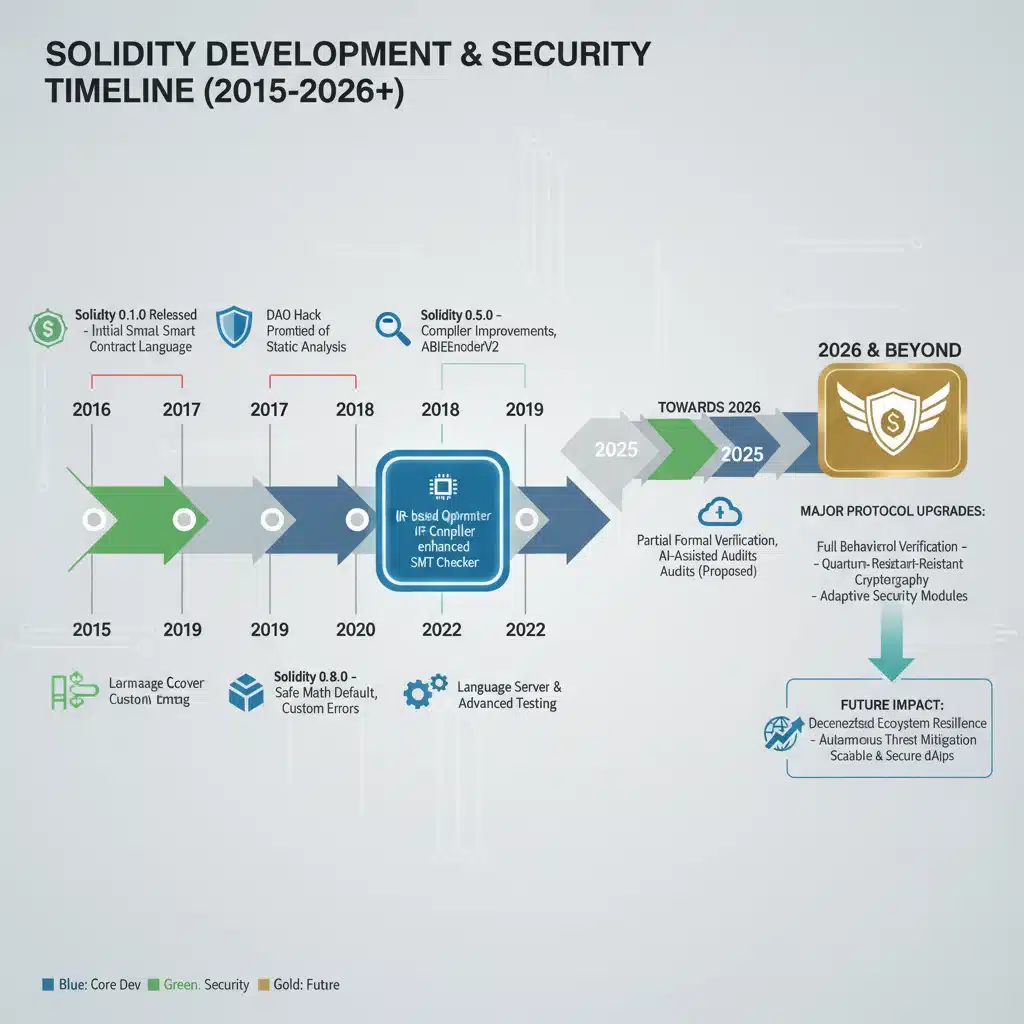
Before we dissect the specific Solidity Updates 2026, it’s important to contextualize the dynamic nature of smart contract security. The history of blockchain is replete with incidents – from the infamous DAO hack to reentrancy attacks and flash loan exploits – that underscore the critical importance of robust security measures. Each vulnerability discovered and exploited serves as a harsh lesson, driving the community to develop more sophisticated tools, better practices, and, fundamentally, a more secure programming language.
Solidity, as the backbone of countless dApps, bears a significant responsibility in this regard. Its development team, alongside the broader Ethereum community, is continuously working to identify potential attack vectors, improve language constructs, and introduce features that empower developers to write more secure code by default. These efforts are not just about patching holes; they are about building a more resilient foundation for the entire decentralized ecosystem. The projected Solidity Updates 2026 are a testament to this ongoing commitment, promising a future where smart contracts are not only more functional but also inherently safer against a growing array of threats.
Critical Solidity Update 1: Enhanced State Variable Immutability and Access Control
The Problem: Unintended State Modifications and Access Vulnerabilities
One of the persistent challenges in smart contract security revolves around the management of state variables. In Solidity, state variables store crucial information on the blockchain, and their integrity is paramount. However, current Solidity versions, while offering some immutability features (like immutable and constant keywords), still leave room for complex scenarios where unintended state modifications or unauthorized access can occur. This often stems from intricate inheritance patterns, poorly designed access control mechanisms, or overlooking edge cases in contract logic. Such vulnerabilities can lead to devastating consequences, from financial losses to complete compromise of contract functionality.
The Solution: “Immutable State Zones” and Granular Access Modifiers
The first critical update within the Solidity Updates 2026 framework is expected to introduce “Immutable State Zones” (ISZs) and significantly enhance granular access control modifiers. Imagine ISZs as designated sections within a smart contract where specific state variables, once initialized, can never be altered again, even by the contract owner, under any circumstances. This goes beyond the current immutable keyword by applying to a broader scope and potentially offering compile-time guarantees against accidental or malicious modifications.
Alongside ISZs, we anticipate the introduction of more sophisticated, built-in granular access modifiers. While Solidity currently offers public, private, internal, and external, the 2026 updates might introduce modifiers that allow for more fine-grained control based on roles, time-locked conditions, or even multi-signature confirmations embedded directly into the language syntax. For example, a new modifier like onlyAdmin(roleId) or timeLocked(timestamp) could be native, reducing reliance on custom, often error-prone, implementation patterns.
Impact on Security and Development Practices
This update has profound implications for smart contract security. By enforcing stricter immutability and providing more robust access control mechanisms at the language level, it significantly reduces the attack surface for a wide range of vulnerabilities, including:
- Unauthorized State Changes: ISZs make it impossible to alter critical parameters (e.g., token supply, contract owner address for certain functions) after deployment, eliminating a common vector for malicious actors.
- Privilege Escalation: Granular access modifiers will make it harder for attackers to gain unauthorized control over sensitive functions by exploiting flaws in custom access control logic.
- Reentrancy Attacks (Indirectly): While not a direct reentrancy fix, clearer state management and access patterns can make contracts less susceptible to complex reentrancy scenarios where state changes are unexpectedly manipulated.
For developers, this means a shift towards a more “secure by default” paradigm. Instead of meticulously coding and auditing custom access control, developers can leverage built-in language features with greater confidence. However, it also requires a deeper understanding of these new constructs and careful design during the initial contract setup, as an immutable state, once set, cannot be undone. Developers will need to plan their contract’s lifecycle and state management with even greater foresight.
Critical Solidity Update 2: Formal Verification Integration and Enhanced Static Analysis
The Problem: Limitations of Manual Audits and Runtime Bugs
The current gold standard for smart contract security often involves extensive manual audits by expert teams, supplemented by various static analysis tools. While invaluable, manual audits are time-consuming, expensive, and still susceptible to human error. Static analysis tools, while helpful, often provide false positives or miss complex logical flaws that only manifest under specific runtime conditions. The core issue is the inherent difficulty in proving the absolute correctness and security of a smart contract – especially for complex systems – before it goes live on an immutable blockchain.
The Solution: Native Formal Verification Primitives and Advanced Static Analyzers
The second critical update within Solidity Updates 2026 is anticipated to integrate native formal verification primitives and significantly enhance static analysis capabilities directly within the Solidity compiler and associated tooling. Formal verification involves mathematically proving the correctness of algorithms and systems, ensuring they behave exactly as intended under all possible conditions. Currently, this requires specialized tools and expertise, often separate from the core development workflow.

The 2026 updates could introduce new Solidity keywords or annotations that allow developers to specify invariants, pre-conditions, and post-conditions directly within their code. These annotations would then be processed by an integrated formal verification engine, enabling developers to mathematically prove certain security properties (e.g., “the total supply of tokens will never exceed X” or “only the owner can call this function”). This could involve leveraging technologies like ‘Scribble’ or ‘Certora Prover’ more deeply within the development ecosystem.
Furthermore, the built-in static analysis tools are expected to become far more sophisticated, moving beyond basic syntax checks to understand complex control flows, potential reentrancy patterns, integer overflows, and gas limit vulnerabilities with greater accuracy and fewer false positives. This could include AI-powered analysis that learns from historical exploits and common anti-patterns.
Impact on Security and Development Practices
This update represents a paradigm shift in how smart contract security is approached. The ability to formally verify critical properties directly within the development environment – or at least with significantly streamlined integration – will elevate the baseline security of smart contracts dramatically. It moves security from a reactive “find-and-fix” model to a proactive “prove-and-build” approach. Key benefits include:
- Reduced Vulnerabilities: Mathematical proof provides a level of certainty that manual audits alone cannot achieve, drastically reducing the likelihood of critical bugs.
- Faster Development Cycles: By catching deep logical flaws earlier in the development process, developers can save significant time and resources that would otherwise be spent on lengthy audit cycles and bug fixes post-deployment.
- Increased Trust: Contracts that can demonstrate formal verification of their core security properties will naturally inspire greater confidence among users and investors.
Developers will need to acquire new skills related to formal specification and assertion writing. While the tooling will aim for ease of use, understanding how to effectively articulate desired contract properties for verification will become a crucial part of the Solidity development skillset. This also means a greater emphasis on “design for verifiability” from the outset of a project.
Critical Solidity Update 3: Native Gas Cost Optimization and Predictability Features
The Problem: Unpredictable Gas Costs and Denial-of-Service Risks
While not strictly a “security” vulnerability in the traditional sense, unpredictable or excessively high gas costs can lead to significant problems, effectively acting as a denial-of-service (DoS) vector or making dApps economically unviable. Attackers can sometimes exploit contract logic to inflate gas consumption, making transactions prohibitively expensive or even impossible. Furthermore, inefficient code – even without malicious intent – can lead to unexpected gas consumption spikes, impacting user experience and contract reliability. Current Solidity offers some tools for gas optimization, but it often requires deep EVM knowledge and manual optimization efforts.
The Solution: “Gas Budget Annotations” and Compile-Time Gas Analysis
The third critical update under Solidity Updates 2026 is expected to introduce native features for gas cost optimization and predictability. This could manifest as “Gas Budget Annotations” and significantly enhanced compile-time gas analysis. Developers might be able to add annotations (e.g., @maxGas(100000)) to functions, specifying an expected maximum gas usage. The compiler would then perform sophisticated analysis to either confirm this budget or flag potential overruns, even for complex loops and data structures.
Beyond annotations, the compiler itself could integrate more advanced heuristics and static analysis specifically tailored to gas consumption. This might include identifying patterns that lead to unbounded loops, excessive storage writes, or inefficient data structures that contribute to high gas fees. The goal is to provide developers with clearer, more accurate gas cost estimates and warnings *before* deployment, rather than relying solely on testing on testnets, which can sometimes miss edge cases.
Impact on Security and Development Practices
Improved gas cost predictability and optimization have several indirect but significant security benefits:
- Reduced DoS Attack Vectors: By making it harder for attackers to “gas-grief” a contract through unexpected cost inflation, the system becomes more resilient against certain DoS attacks.
- Enhanced Economic Security: Predictable gas costs ensure that dApps remain economically viable and accessible, preventing situations where high transaction fees render a contract unusable.
- Improved Code Quality: The focus on gas efficiency inherently encourages developers to write cleaner, more optimized code, which often correlates with fewer bugs and better overall security.
For developers, this means a more streamlined process for optimizing gas consumption. Instead of extensive manual profiling and low-level EVM opcode analysis, developers will have higher-level language constructs and compiler assistance to guide them. It will still require an understanding of how different operations consume gas, but the tooling will provide much-needed support for proactive optimization. This will allow developers to build more efficient and robust smart contracts, ensuring the longevity and usability of their decentralized applications in a competitive and cost-sensitive environment.
Preparing for the Solidity Updates 2026: A Developer’s Roadmap
The projected Solidity Updates 2026 represent a significant leap forward in smart contract security and development. To ensure your projects are ready and your skills remain cutting-edge, consider the following roadmap:
- Stay Informed: Regularly follow official Solidity documentation, Ethereum Improvement Proposals (EIPs), and community discussions (e.g., Ethereum Magicians, Solidity Gitter/Discord channels). The exact specifications of these updates will evolve, and staying current is paramount.
- Experiment with Alpha/Beta Releases: As these features move from proposal to implementation, engage with alpha or beta versions of the Solidity compiler. Early experimentation will give you a head start in understanding the new syntax, semantics, and tooling.
- Deepen Your Understanding of Formal Methods: Even if you don’t become a formal verification expert, a foundational understanding of invariants, pre-conditions, and post-conditions will be invaluable. Explore tools like ‘Scribble’ or ‘Slither’ that bridge the gap between code and formal properties.
- Refine Access Control Patterns: Review your current smart contract access control implementations. As new native granular modifiers emerge, consider how you can simplify and secure your existing patterns, reducing custom logic that can be error-prone.
- Practice Gas-Conscious Coding: Start thinking about gas efficiency more explicitly in your current projects. While 2026 brings new tools, the fundamental principles of efficient EVM operations remain relevant. This will make adapting to new gas optimization features much smoother.
- Engage with the Community: Participate in forums, contribute to discussions, and share your insights. The collective wisdom of the blockchain development community is a powerful resource for navigating these changes.
- Invest in Continuous Learning: The Web3 space is defined by its rapid evolution. Treat learning as an ongoing process, regularly dedicating time to new concepts, tools, and best practices in smart contract development and security.
Conclusion: A More Secure Future for Smart Contracts
The Solidity Updates 2026, particularly the three critical changes discussed – enhanced state variable immutability and access control, formal verification integration, and native gas cost optimization – are set to usher in a new era of smart contract security. These advancements reflect the blockchain community’s unwavering commitment to building a more robust, trustworthy, and efficient decentralized ecosystem.
For developers, these updates present both challenges and immense opportunities. Challenges lie in adapting to new language features and paradigms, while opportunities abound in building more secure, resilient, and economically viable dApps. By proactively engaging with these changes, understanding their implications, and integrating them into your development practices, you will not only future-proof your skills but also contribute to the overall integrity and success of the decentralized web. The future of smart contracts is more secure, and the journey there begins with understanding and embracing these pivotal Solidity Updates 2026.