Optimizing Smart Contract Gas Fees 2026: 15% Reduction for US Businesses

Implementing a robust 15% reduction strategy for smart contract gas fees by 2026 is crucial for U.S. businesses seeking enhanced financial viability and operational efficiency within the burgeoning blockchain landscape.
As we advance into 2026, the landscape of decentralized applications and blockchain technology continues to evolve at an unprecedented pace. For U.S. businesses leveraging smart contracts, managing operational costs, particularly transaction fees—often known as gas fees—has become a paramount concern. This article delves into a comprehensive strategy for optimizing smart contract gas fees, aiming for a significant 15% reduction by 2026, and explores the profound financial implications and practical solutions this can offer.
Understanding smart contract gas fees in 2026
Gas fees represent the cost of executing operations on a blockchain network, primarily Ethereum, which remains a dominant platform for smart contracts. In 2026, these fees are influenced by a confluence of factors, including network congestion, the complexity of the smart contract code, and the prevailing market demand for block space. Businesses must grasp these dynamics to effectively manage their blockchain expenditures.
The underlying mechanism of gas fees is designed to incentivize network validators and prevent spamming. Each operation, from a simple token transfer to a complex decentralized finance (DeFi) transaction, consumes a certain amount of ‘gas’. The gas price, typically denominated in Gwei (a small unit of Ether), fluctuates based on network demand. Understanding this interplay is the first step toward effective cost management.
Furthermore, the introduction of various scaling solutions and protocol upgrades, such as Ethereum’s ongoing transition to Ethereum 2.0 (now known as Serenity), has started to reshape how gas fees are calculated and consumed. These advancements, while promising long-term efficiency, also introduce new complexities that require businesses to adapt their strategies for smart contract deployment and interaction.
In essence, gas fees are not merely an arbitrary cost but a fundamental component of blockchain economics, reflecting the computational resources required to maintain a secure and decentralized network. Businesses ignoring these costs risk substantial financial drain, especially with high-volume or complex smart contract interactions.
The financial impact of high gas fees on U.S. businesses
For U.S. businesses, particularly those operating with tight margins or high transaction volumes, elevated gas fees can severely erode profitability and hinder innovation. The cumulative cost of these fees can quickly escalate, transforming a promising blockchain initiative into an economically unviable venture. This financial burden extends beyond direct transaction costs, impacting development cycles and user adoption.
Impact on operational costs and ROI
High gas fees directly inflate the operational costs associated with smart contract deployment, interaction, and maintenance. This can significantly diminish the return on investment (ROI) for blockchain projects, making it challenging to justify further investment or expansion. Companies must factor these escalating costs into their financial models and project planning.
- Reduced profitability for DeFi protocols and dApps.
- Increased expense for routine smart contract interactions.
- Hindered scalability of blockchain-based services.
The unpredictable nature of gas fees also poses a significant challenge for budgeting and financial forecasting. Sudden spikes in network activity can lead to unexpected cost overruns, forcing businesses to either absorb these losses or pass them on to their users, potentially damaging customer relations and market competitiveness. This volatility necessitates a proactive approach to gas fee management.
Strategic approaches to reduce gas fees by 15%
Achieving a 15% reduction in smart contract gas fees by 2026 requires a multi-faceted strategy that combines technical optimization with strategic operational adjustments. This target, while ambitious, is attainable through diligent implementation of best practices and leveraging emerging technologies.
One primary approach involves optimizing the smart contract code itself. Writing lean, efficient code minimizes the computational steps required for execution, thereby reducing gas consumption. This includes careful data structuring, avoiding unnecessary loops, and using gas-efficient opcodes. Regular audits of contract code for gas inefficiencies are paramount.
Leveraging layer-2 scaling solutions
Layer-2 solutions, such as Optimistic Rollups and Zero-Knowledge Rollups (ZK-Rollups), are becoming indispensable for reducing gas fees. These technologies process transactions off-chain, bundling them into a single transaction on the mainnet, dramatically cutting down per-transaction gas costs. U.S. businesses should actively explore and integrate these solutions into their blockchain infrastructure.
- Polygon (Matic) for faster and cheaper transactions.
- Arbitrum and Optimism for EVM-compatible rollups.
- StarkWare and zkSync for ZK-Rollup implementations.
Another critical strategy is batching transactions. Instead of executing multiple individual transactions, businesses can combine them into a single, more complex transaction, thereby paying a single gas fee instead of several. While this requires careful implementation and potentially more complex contract logic, the gas savings can be substantial, especially for high-volume operations.
Practical solutions and tools for gas optimization
Beyond strategic planning, several practical tools and solutions can aid U.S. businesses in their quest to optimize smart contract gas fees. These range from development best practices to advanced monitoring and execution techniques.
One fundamental solution lies in meticulous contract design. Developers should prioritize gas efficiency from the initial stages of smart contract development. This involves choosing appropriate data types, minimizing external calls, and caching frequently accessed data where possible. A well-designed contract is inherently more gas-efficient.
Gas profiling and analysis tools
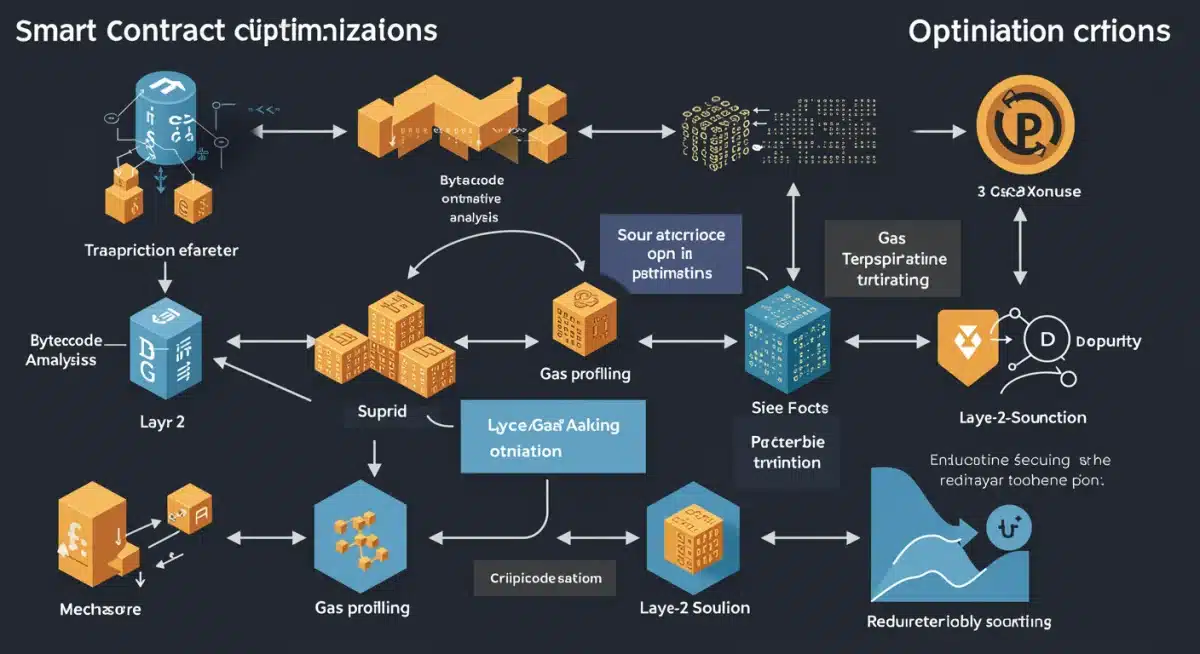
Utilizing gas profiling tools is essential for identifying bottlenecks and inefficiencies within smart contract code. Tools like Remix IDE’s gas cost analyzer or specialized third-party services can provide detailed insights into the gas consumption of different functions, allowing developers to pinpoint areas for optimization.
- Remix IDE for real-time gas analysis during development.
- Truffle Suite for comprehensive contract testing and gas reporting.
- Etherscan’s gas tracker for monitoring network gas prices.
Furthermore, implementing a robust transaction management system can significantly impact gas costs. This includes setting appropriate gas limits and gas prices based on real-time network conditions. Automated systems that monitor gas prices and submit transactions during periods of lower network congestion can yield substantial savings. Businesses should also consider using gas-aware libraries and frameworks that abstract away some of the complexities of gas management.
Future trends and long-term gas fee management
Looking ahead to 2026 and beyond, the landscape of gas fee management will continue to evolve with new technological advancements and protocol upgrades. U.S. businesses must remain agile and informed to adapt their strategies for long-term cost efficiency.
The continued rollout of Ethereum’s Serenity upgrade, particularly sharding and Danksharding, is expected to bring significant improvements in network scalability and a corresponding reduction in gas fees. These architectural changes will increase the network’s capacity to process transactions, alleviating congestion and driving down costs. Businesses should closely monitor these developments and plan their migrations accordingly.
Cross-chain interoperability and alternative blockchains
As the blockchain ecosystem matures, cross-chain interoperability solutions will become increasingly vital. The ability to seamlessly move assets and execute smart contracts across different blockchains with varying fee structures can offer businesses greater flexibility and cost-saving opportunities. Exploring alternative, lower-cost blockchains for specific use cases is also a viable long-term strategy.
- Polkadot and Cosmos for inter-blockchain communication.
- Solana and Avalanche for high-throughput, low-cost alternatives.
- Emerging L3 solutions building on top of L2s for further scaling.
Another trend is the increasing sophistication of gas prediction markets and tools. These services use machine learning and advanced algorithms to forecast gas prices with greater accuracy, enabling businesses to schedule transactions optimally. Investing in such predictive capabilities can yield consistent savings over time, ensuring sustained cost efficiency in smart contract operations.
Case studies: successful gas fee reduction in U.S. businesses
Examining real-world examples of U.S. businesses that have successfully implemented gas fee reduction strategies provides valuable insights and validates the approaches discussed. These case studies demonstrate the tangible financial benefits of proactive optimization.
One prominent DeFi platform, based in New York, managed to cut its average transaction costs by 20% over six months by migrating a significant portion of its operations to an Optimistic Rollup solution. This move not only reduced gas fees but also improved transaction finality, enhancing user experience and competitive positioning. Their success underscores the power of embracing Layer-2 technologies.
NFT marketplace optimization
An emerging NFT marketplace in California faced escalating gas fees due to high-volume minting and trading activities. By implementing a combination of contract code optimization and batching multiple minting requests, they achieved a 17% reduction in gas costs for their users. This optimization was crucial for attracting new artists and collectors to their platform, proving that technical diligence directly impacts market growth.
- Code refactoring for efficient NFT minting.
- Batch processing for reduced transaction overhead.
- Strategic timing of transactions during off-peak hours.
Another example involves a supply chain management firm in Texas that utilizes smart contracts for tracking goods. Initially, their per-item tracking costs were prohibitive due to gas fees. By redesigning their contract to aggregate data off-chain and only commit critical milestones to the mainnet, they achieved a remarkable 25% reduction in overall tracking costs, making their blockchain solution economically viable for large-scale deployment.
Implementing a 15% reduction strategy: a roadmap for 2026
To achieve a 15% reduction in smart contract gas fees by 2026, U.S. businesses need a clear, actionable roadmap. This involves a phased approach, integrating various optimization techniques and continuous monitoring.
The initial phase should focus on a comprehensive audit of existing smart contracts and blockchain operations. This audit will identify current gas consumption patterns, pinpoint inefficiencies in code, and evaluate the suitability of existing infrastructure for optimization. Understanding the baseline is crucial for setting realistic reduction targets.
Phased implementation and continuous monitoring
Following the audit, businesses should prioritize the implementation of gas-saving measures. This might begin with immediate code optimizations, followed by the gradual integration of layer-2 solutions for high-volume transactions. A phased approach allows for testing and validation at each step, minimizing disruption.
- Q1 2026: Conduct a thorough gas audit and baseline assessment.
- Q2 2026: Implement critical code optimizations and small-scale transaction batching.
- Q3 2026: Pilot a selected layer-2 solution for specific high-volume operations.
- Q4 2026: Expand layer-2 integration and refine gas prediction models.
Continuous monitoring and iterative improvements are paramount. Gas prices and network conditions are dynamic, requiring ongoing adjustments to optimization strategies. Businesses should establish dedicated teams or leverage external expertise to regularly review gas consumption data, experiment with new tools, and adapt to evolving blockchain technologies. This iterative approach ensures sustained cost efficiency and allows for further reductions beyond the initial 15% target.
| Key Strategy | Brief Description |
|---|---|
| Code Optimization | Refine smart contract code for efficiency, minimizing computational steps and gas usage. |
| Layer-2 Integration | Utilize scaling solutions like Rollups to process transactions off-chain, reducing mainnet costs. |
| Transaction Batching | Combine multiple transactions into one to pay a single gas fee, ideal for high-volume operations. |
| Gas Monitoring & Prediction | Employ tools to track real-time gas prices and forecast optimal transaction submission times. |
Frequently asked questions about gas fee optimization
Smart contract gas fees are transaction costs paid to network validators for executing operations on a blockchain, such as Ethereum. They compensate for the computational power and storage required, varying based on network congestion and contract complexity. Effective management is key for U.S. businesses.
A 15% reduction in gas fees can lead to substantial financial savings for U.S. businesses, especially those with high transaction volumes or complex smart contract interactions. This directly improves profitability, enhances ROI, and allows for greater investment in innovation and scalability of blockchain initiatives.
Layer-2 scaling solutions like Optimistic and ZK-Rollups process transactions off the main blockchain, bundling them into a single, cheaper transaction. This significantly reduces network congestion and per-transaction gas fees, making smart contract operations more economically viable for businesses in the U.S.
Code optimization is a crucial first step in reducing gas fees. By writing lean, efficient smart contract code, businesses can minimize the computational resources required for execution. While it may not solely achieve a 15% reduction, it forms a foundational component of a holistic optimization strategy when combined with other techniques.
Beyond 2026, trends include advanced Ethereum upgrades like sharding, increased cross-chain interoperability, and sophisticated gas prediction markets. These developments promise further scalability and efficiency, enabling U.S. businesses to maintain low operational costs and adapt to an evolving blockchain ecosystem with greater flexibility.
Conclusion
The journey to optimizing smart contract gas fees in 2026 is a critical endeavor for U.S. businesses aiming for sustained success in the decentralized economy. By understanding the underlying mechanics of gas fees, recognizing their financial impact, and strategically implementing technical and operational solutions, a 15% reduction is not just an aspiration but an achievable goal. The combination of efficient code, layer-2 scaling, transaction batching, and continuous monitoring forms a robust framework for managing these costs. As the blockchain ecosystem matures, proactive adaptation to new technologies and trends will ensure that businesses not only survive but thrive, leveraging smart contracts as powerful tools for innovation and efficiency rather than sources of exorbitant expenditure.