Quantum-Resistant Cryptography: Protecting Digital Assets by 2026
The digital world, as we know it, is built on a foundation of cryptography. From securing our online banking transactions to protecting sensitive government communications, encryption is the invisible guardian of our data. However, a seismic shift is on the horizon, one that promises to shatter the very ciphers that keep our information safe today: the advent of practical quantum computing. This isn’t a distant science fiction scenario; experts predict that by 2026, the threat posed by quantum computers to current cryptographic standards will be undeniable and potentially devastating. The race is on to develop and implement quantum-resistant cryptography, a new generation of encryption algorithms designed to withstand the immense computational power of quantum machines. Ignoring this impending revolution is not an option; proactive measures are essential to safeguard our digital future.
The Looming Quantum Threat: Why 2026 is a Critical Deadline for Digital Asset Protection
For decades, the security of our digital communications and data has relied heavily on public-key cryptography. Algorithms like RSA and Elliptic Curve Cryptography (ECC) form the backbone of secure internet protocols (HTTPS), digital signatures, and encrypted communications. Their strength lies in the computational difficulty of solving certain mathematical problems, such as factoring large numbers or computing discrete logarithms. Even the most powerful classical supercomputers would take an unfathomable amount of time – billions of years – to break these ciphers.
However, quantum computers operate on fundamentally different principles. Utilizing phenomena like superposition and entanglement, they possess the potential to perform calculations that are impossible for classical machines. Specifically, algorithms like Shor’s algorithm, discovered in 1994, can efficiently factor large numbers and solve discrete logarithm problems, directly undermining the security of RSA and ECC. Grover’s algorithm, another quantum breakthrough, can significantly speed up brute-force attacks on symmetric-key encryption (like AES) and hash functions, though its impact is less severe than Shor’s on public-key cryptosystems.
The timeline for a “cryptographically relevant quantum computer” (CRQC) – one powerful enough to break current encryption standards – has been a subject of debate. While a fully fault-tolerant quantum computer is still some years away, significant advancements in quantum hardware and error correction are occurring rapidly. Many experts, including those at the National Institute of Standards and Technology (NIST) and various intelligence agencies, project that such a machine could emerge within the next decade, with some estimates pointing to as early as 2026. This isn’t just about a single, sudden event; it’s a gradual increase in quantum capabilities that will eventually reach a critical threshold.
The implications of this breakthrough are staggering. Imagine a world where all past and present encrypted data, if intercepted and stored, could be decrypted. This includes financial records, national security secrets, intellectual property, personal health information, and more. The concept of “harvest now, decrypt later” (HNDL) is a terrifying reality: adversaries could be collecting encrypted data today, patiently waiting for the advent of CRQCs to unlock its secrets. This makes the 2026 deadline not just about future security, but about protecting data that is being transmitted and stored right now.
Understanding Quantum-Resistant Cryptography: A New Era of Security
Quantum-resistant cryptography, often referred to as post-quantum cryptography (PQC), refers to cryptographic algorithms that are secure against attacks by both classical and quantum computers. These algorithms are based on different mathematical problems than those used in current public-key cryptography, problems that are believed to be intractable even for quantum machines. The development of PQC has been a global collaborative effort, spearheaded by organizations like NIST.
NIST’s Pivotal Role in Standardizing Quantum-Resistant Cryptography
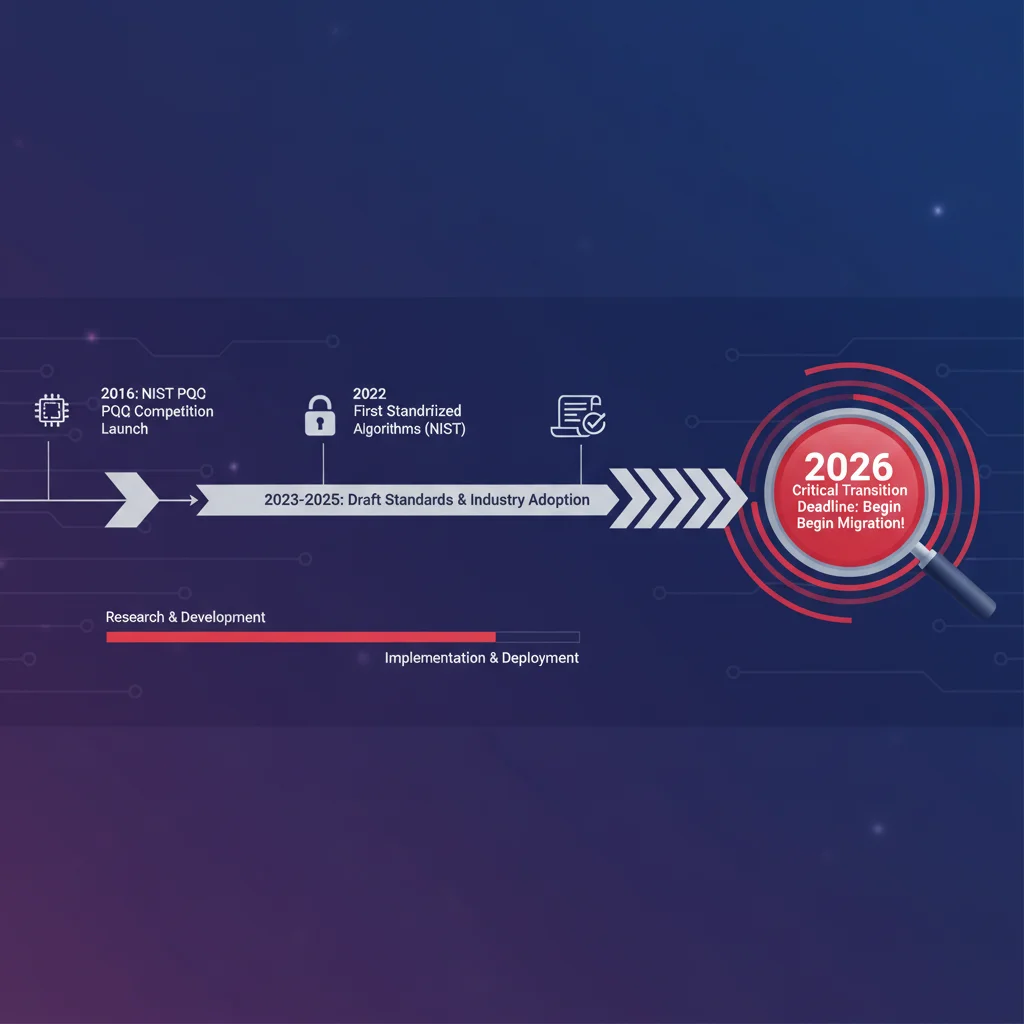
Recognizing the impending threat, NIST launched a multi-year standardization process for PQC algorithms in 2016. This rigorous, open competition invited cryptographic researchers from around the world to submit new algorithms, which were then subjected to extensive public scrutiny, analysis, and cryptanalysis. The goal was to identify and standardize a suite of algorithms that could replace current public-key cryptography and provide robust security in the quantum era.
The NIST PQC standardization process has progressed through several rounds, evaluating hundreds of submissions. In July 2022, NIST announced the first set of four algorithms chosen for standardization:
- CRYSTALS-Kyber: A key-encapsulation mechanism (KEM) based on lattice-based cryptography, designed for establishing shared secrets.
- CRYSTALS-Dilithium: A digital signature algorithm, also lattice-based, used for authenticating digital information.
- FALCON: Another lattice-based digital signature algorithm, offering a different performance profile.
- SPHINCS+: A hash-based digital signature algorithm, providing a more conservative security approach, though with larger key sizes and signature lengths.
NIST continues to evaluate additional algorithms for future standardization, particularly for general-purpose encryption and other applications. The selection of these initial algorithms marks a crucial step towards a quantum-safe digital infrastructure. These new algorithms are designed to be implemented on classical computers, meaning they can be deployed and used today to secure systems against future quantum threats.
Characteristics of Quantum-Resistant Cryptography
Unlike traditional cryptography, PQC algorithms often rely on different mathematical foundations, such as:
- Lattice-based cryptography: These algorithms derive their security from the computational difficulty of certain problems in high-dimensional lattices. CRYSTALS-Kyber and CRYSTALS-Dilithium are prime examples.
- Hash-based cryptography: These schemes use one-way hash functions to create digital signatures. SPHINCS+ falls into this category.
- Code-based cryptography: Based on error-correcting codes, these algorithms have a long history of study and offer robust security, though often with larger key sizes.
- Multivariate polynomial cryptography: These systems rely on the difficulty of solving systems of multivariate polynomial equations over finite fields.
Each of these categories presents unique trade-offs in terms of security, performance (key size, signature size, computational overhead), and maturity. The goal of NIST’s process is to provide a diverse set of algorithms suitable for various applications and security requirements.
The Urgency of Transition: Why Delay is Not an Option
The transition to quantum-resistant cryptography is not a simple software update; it’s a complex, multi-faceted undertaking that will require significant planning, resources, and coordination across industries and governments. The 2026 deadline is not arbitrary; it represents a critical window for action, driven by several factors:
- Cryptographic Agility: Many existing systems are not designed for easy cryptographic algorithm changes. Hard-coded algorithms and tightly coupled systems make upgrades challenging and time-consuming.
- Supply Chain Complexity: Modern digital infrastructure is a vast, interconnected web. Ensuring all components, from hardware to software, are quantum-safe requires extensive collaboration across the supply chain.
- Long Data Lifespans: Data that needs to remain confidential for decades (e.g., government secrets, medical records, intellectual property) is particularly vulnerable to the “harvest now, decrypt later” attack. The longer the required confidentiality period, the more urgent the need to protect it with PQC today.
- Resource Allocation: The scale of the transition demands significant investment in research, development, testing, and deployment. Organizations need to start budgeting and allocating resources now.
- Talent Gap: There is a growing need for cybersecurity professionals with expertise in quantum computing and PQC. Training and upskilling existing teams will be crucial.
The longer an organization waits to begin its PQC migration strategy, the greater the risk of being caught unprepared when CRQCs become a reality. A phased approach, starting with inventory and risk assessment, is essential.
Two Immediate Steps to Protect Your Digital Assets
Given the urgency, organizations and individuals cannot afford to wait for full PQC standardization and widespread adoption before taking action. Here are two immediate, actionable steps to begin protecting your digital assets:
Step 1: Inventory and Cryptographic Discovery
You can’t protect what you don’t know exists. The first and most critical step is to gain a comprehensive understanding of your current cryptographic landscape. This involves:
- Identify all cryptographic assets: This includes every instance where encryption, digital signatures, or hashing is used. Think about VPNs, secure boot mechanisms, code signing, encrypted databases, email encryption, cloud services, IoT devices, and internal communication systems.
- Map cryptographic algorithms: For each identified asset, determine which specific cryptographic algorithms are being used (e.g., RSA-2048, AES-256, SHA-256, ECC P-256).
- Assess data sensitivity and lifespan: Categorize the data protected by each cryptographic asset based on its sensitivity (e.g., public, internal, confidential, top secret) and how long it needs to remain confidential. Data with a long confidentiality requirement (e.g., 10+ years) is at the highest risk from HNDL attacks.
- Locate cryptographic dependencies: Understand which applications, services, or hardware components rely on specific cryptographic libraries or modules. This will help identify the scope of potential changes.
- Evaluate cryptographic agility: Determine how easy or difficult it would be to replace existing cryptographic algorithms with new ones. Are algorithms hard-coded, or can they be updated via software patches or configuration changes?
Tools for cryptographic discovery can range from manual audits to automated scanning solutions. The goal is to build a detailed inventory that provides a clear picture of your organization’s cryptographic posture and highlights areas of greatest vulnerability to quantum threats. This inventory will serve as the foundation for your entire PQC migration strategy.
Step 2: Develop a Quantum-Readiness Roadmap and Pilot Projects
Once you understand your cryptographic landscape, the next step is to develop a strategic plan for transitioning to quantum-resistant cryptography. This roadmap should be a multi-year plan, acknowledging the complexity and scale of the undertaking. Key elements of a quantum-readiness roadmap include:
- Prioritize assets: Based on your inventory, identify the most critical and vulnerable assets that require immediate attention. Focus on data with long confidentiality requirements and systems with low cryptographic agility.
- Research PQC algorithms: Stay informed about the latest developments in NIST’s standardization process and the selected algorithms. Understand their performance characteristics and suitability for different applications.
- Plan for cryptographic agility: For systems that lack cryptographic agility, begin planning for architectural changes or upgrades that will allow for easier algorithm swapping in the future. This might involve adopting new cryptographic module interfaces or integrating with Hardware Security Modules (HSMs) that can be updated.
- Conduct pilot projects: Don’t wait for a full-scale rollout. Start with small, contained pilot projects to gain practical experience with PQC algorithms. For example, implement a hybrid encryption scheme (combining current encryption with a PQC algorithm) for a non-critical application, or experiment with PQC digital signatures for internal code signing. These pilots will help you understand the performance impact, integration challenges, and necessary skill sets.
- Allocate resources and budget: Secure the necessary financial and human resources for the transition. This includes budgeting for new hardware, software licenses, training, and potentially external consulting.
- Educate and train staff: Begin educating your IT and security teams about quantum computing and PQC. Provide training on the new algorithms and tools that will be used in the migration.
- Engage with vendors: Start discussions with your software and hardware vendors to understand their PQC roadmaps and ensure their future products will support quantum-resistant standards.
The Hybrid Approach: A Bridge to the Quantum Future
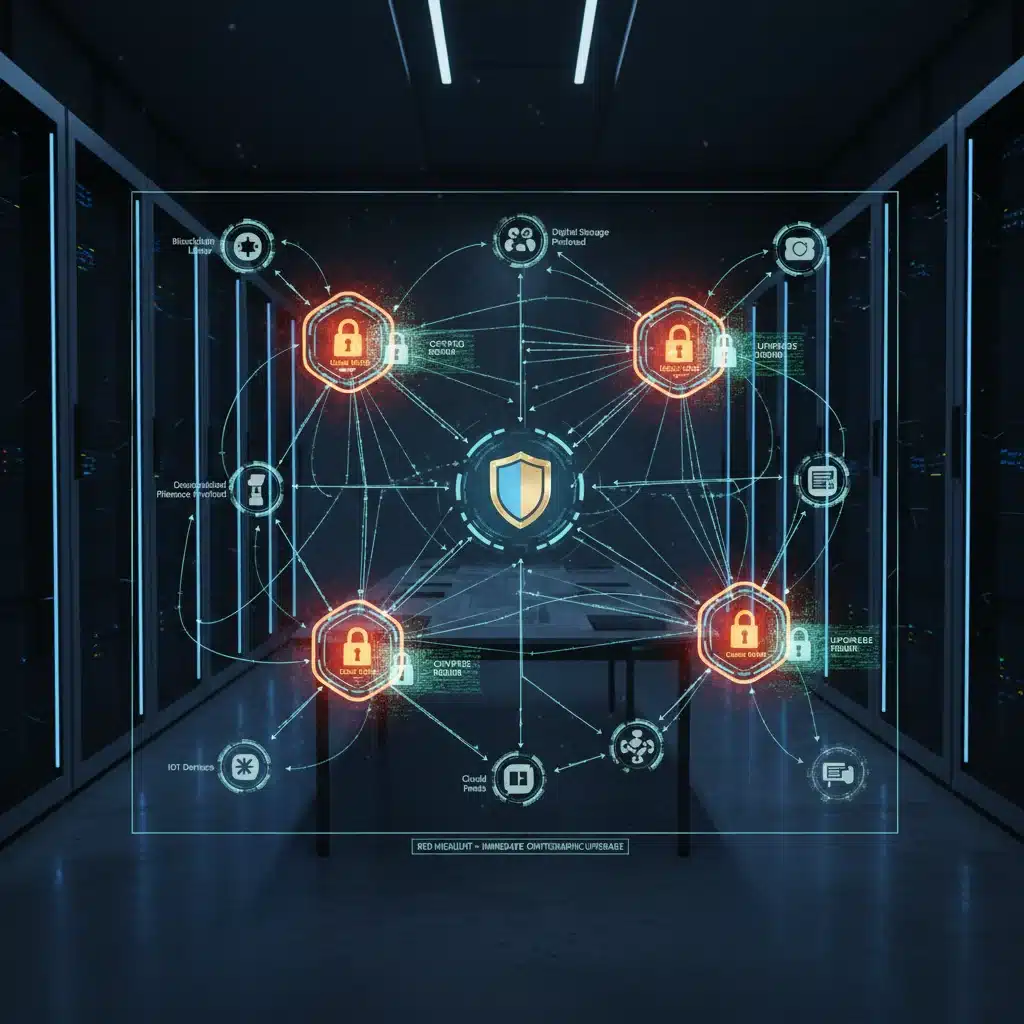
One practical strategy for immediate protection and a smooth transition is the “hybrid approach.” This involves using both a traditional (pre-quantum) cryptographic algorithm and a quantum-resistant cryptography algorithm simultaneously to protect the same data or establish a shared secret. For example, when establishing a secure communication channel, both an ECC key exchange and a CRYSTALS-Kyber key encapsulation could be used to derive the session key.
The advantage of the hybrid approach is that the security of the communication relies on the stronger of the two algorithms. If either the classical algorithm or the PQC algorithm remains unbroken, the communication remains secure. This provides a robust fallback mechanism, mitigating the risk that a chosen PQC algorithm might later be found vulnerable (a possibility in any new cryptographic development) or that a CRQC arrives sooner than expected. It also allows organizations to begin deploying PQC today without fully committing to a single, potentially unproven, quantum-resistant standard.
Government and Industry Initiatives
Governments worldwide, recognizing the strategic importance of this transition, are actively promoting and mandating the adoption of quantum-resistant cryptography. In the United States, Executive Order 14028, “Improving the Nation’s Cybersecurity,” and the National Security Memorandum (NSM-10) on “Promoting United States Leadership in Quantum Computing While Mitigating Risks to National Security” both emphasize the need for federal agencies to prepare for the quantum threat and migrate to PQC. Similar initiatives are underway in the European Union, the UK, and other nations.
Industry consortiums and working groups are also forming to address the challenges of PQC migration. These collaborations are essential for sharing best practices, developing interoperable solutions, and ensuring a coordinated global transition. Software and hardware vendors are beginning to integrate PQC capabilities into their products, but organizations must actively engage with their suppliers to ensure their specific needs are met.
Challenges and Considerations in PQC Adoption
While the path to quantum-resistant cryptography is clear, several challenges must be addressed:
- Performance Overhead: Some PQC algorithms have larger key sizes, signature sizes, or require more computational resources than their classical counterparts. This can impact bandwidth, storage, and processing power, especially for resource-constrained devices or high-volume applications.
- Standardization Evolution: While NIST has announced initial selections, the PQC landscape is still evolving. Organizations need to remain flexible and be prepared for potential updates or additional algorithm selections.
- Interoperability: Ensuring that different systems and platforms can communicate securely using PQC algorithms will require careful attention to standards and implementation details.
- Legacy Systems: Many organizations rely on older, legacy systems that are difficult to update or replace. Migrating these systems to PQC will be a significant challenge.
- Cryptographic Randomness: Quantum-safe cryptography also relies on strong random number generation. Ensuring the availability of robust, quantum-resistant random number generators is crucial.
Addressing these challenges requires a strategic, phased approach, beginning with the immediate steps outlined above. Organizations that start planning and experimenting now will be in a much stronger position to adapt to the quantum era.
Conclusion: Securing Our Digital Future with Quantum-Resistant Cryptography
The countdown to a cryptographically relevant quantum computer is underway, and 2026 stands as a significant marker for organizations to have initiated their transition to quantum-resistant cryptography. The risks associated with inaction – potential data breaches, compromise of long-term secrets, and erosion of public trust – are too great to ignore. While the task ahead is complex, the path forward is clear.
By taking immediate steps such as conducting a thorough cryptographic inventory and developing a comprehensive quantum-readiness roadmap that includes pilot projects, organizations can proactively safeguard their digital assets. The hybrid approach offers a pragmatic solution for immediate protection, allowing for a gradual and secure migration. The future of digital security depends on our collective ability to embrace and implement these next-generation cryptographic solutions. The time to act is now, ensuring that our digital world remains secure, resilient, and ready for the quantum age.