Cross-Chain Smart Contracts: Unlocking Interoperability in Web3

The blockchain landscape, once a collection of isolated islands, is rapidly evolving into a vast, interconnected archipelago. At the heart of this transformation lies the concept of cross-chain smart contracts – a groundbreaking innovation poised to redefine how we interact with decentralized applications and assets. As the Web3 ecosystem matures, the demand for seamless communication and functionality across different blockchain networks has become paramount. This article delves deep into the world of cross-chain smart contracts, exploring their fundamental principles, the immense possibilities they unlock, the formidable challenges they face, and the cutting-edge solutions paving the way for true cross-chain interoperability.
The Genesis of Interoperability: Why Cross-Chain Matters
In the early days of blockchain, each network operated in its own silo. Bitcoin had its own ledger, Ethereum its own, and so on. While this isolation provided a degree of security and autonomy, it also severely limited the potential for broader adoption and innovation. Imagine a world where you could only use specific applications on a single operating system, or transfer money only within a single bank. This was, in essence, the early blockchain paradigm.
The problem of interoperability arises from the inherent design differences between various blockchains. Each chain might have unique consensus mechanisms, programming languages, virtual machines, and data structures. This heterogeneity, while fostering diversity, creates significant barriers to the free flow of assets and information, hindering the creation of truly decentralized and composable applications.
The limitations of a siloed blockchain environment are multifaceted:
- Limited Liquidity: Assets are fragmented across different chains, leading to inefficient markets and reduced liquidity.
- Fragmented User Experience: Users often need to navigate multiple wallets, bridges, and interfaces to interact with different dApps, creating a cumbersome experience.
- Reduced Developer Creativity: Developers are restricted to the capabilities of a single chain, limiting the scope and ambition of their projects.
- Scalability Bottlenecks: While some chains offer high throughput, the inability to leverage resources from other chains can lead to overall network congestion.
Cross-chain interoperability directly addresses these issues by enabling different blockchains to communicate, exchange data, and transfer assets in a secure and trust-minimized manner. It’s the key to unlocking the full potential of a multi-chain future, allowing for a more cohesive, efficient, and user-friendly decentralized ecosystem.
Understanding Cross-Chain Smart Contracts: The Core Mechanism
At its core, a cross-chain smart contract is a piece of code deployed on one or more blockchain networks that can execute predefined actions based on events or data originating from a different blockchain. This is a significant leap from traditional smart contracts, which are confined to their native chain.
The magic of cross-chain smart contracts lies in their ability to overcome the inherent isolation of blockchains. They achieve this through various mechanisms, each with its own trade-offs in terms of security, decentralization, and efficiency.
How Do They Work? Bridging the Gap
Several architectural approaches facilitate cross-chain interoperability:
-
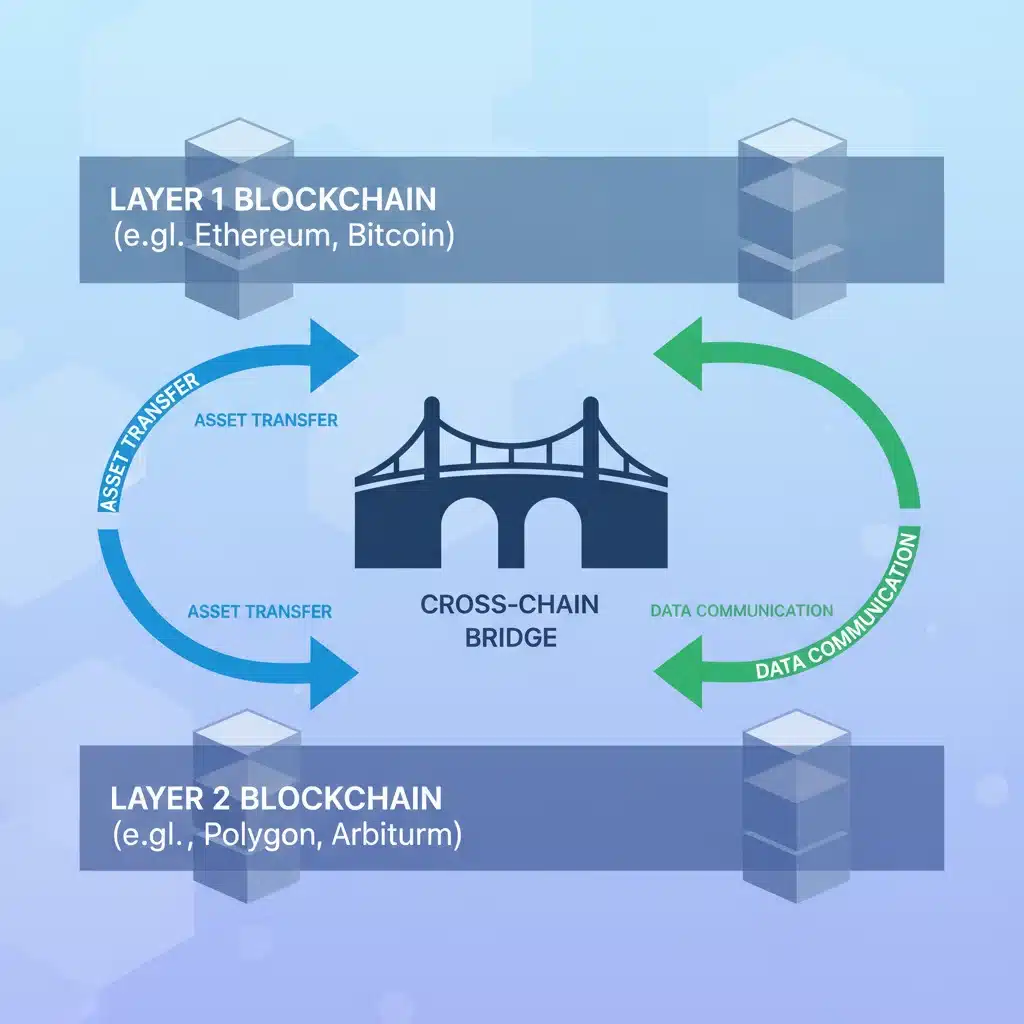
Blockchain Bridges: These are arguably the most common and straightforward method. A bridge essentially locks assets on one chain and mints an equivalent wrapped asset on another chain. When the wrapped asset is burned, the original asset is unlocked. Bridges can be categorized into:
- Centralized Bridges: Rely on a trusted third party to custody assets and facilitate transfers. While simpler to implement, they introduce a single point of failure and censorship risk.
- Decentralized Bridges: Utilize smart contracts and a network of validators or multi-signature schemes to secure assets and verify transactions. Examples include LayerZero, Wormhole, and Connext.
-
Relays and Light Clients: A relay is a smart contract on one chain that monitors and verifies events on another chain. Light clients, on the other hand, only download block headers and a small subset of transactional data, allowing them to verify transactions without syncing the entire blockchain. Together, they can enable secure, trust-minimized communication without full reliance on external validators.
-
Atomic Swaps: These allow for the direct exchange of cryptocurrencies between different blockchains without the need for an intermediary. They rely on Hash Time-Locked Contracts (HTLCs), which ensure that either both parties receive their funds or neither does, preventing loss of funds. While highly secure, atomic swaps are typically limited to direct asset exchanges and don’t facilitate complex smart contract interactions.
-
Sidechains and Parachains: These are separate blockchains that run parallel to a main chain (e.g., Ethereum sidechains like Polygon, or Polkadot parachains). They can communicate with the main chain and often offer higher scalability and lower transaction fees. While not strictly "cross-chain smart contracts" in the sense of two independent chains directly interacting, they enable smart contract execution on a more performant chain while relying on the security of the main chain.
-
Inter-Blockchain Communication (IBC) Protocol: Developed by Cosmos, IBC is a standardized protocol that allows independent blockchains to communicate and exchange data. It provides a robust, generalized framework for secure data packet relaying between heterogeneous chains, effectively enabling true cross-chain interoperability at a protocol level.
The Transformative Power of Cross-Chain Smart Contracts
The implications of robust cross-chain smart contracts are profound, promising to revolutionize various sectors of the decentralized world.
1. Enhanced DeFi Composability and Liquidity
Currently, DeFi liquidity is fragmented across numerous chains. A user might have assets on Ethereum, another set on Solana, and yet another on Avalanche. Cross-chain smart contracts enable:
- Unified Liquidity Pools: Imagine a single liquidity pool that draws capital from multiple blockchains, significantly deepening liquidity and reducing slippage.
- Cross-Chain Lending and Borrowing: Users could collateralize assets on one chain to borrow on another, optimizing capital efficiency.
- Arbitrage Opportunities: More efficient markets due to the ability to quickly move assets and capitalize on price differences across exchanges on different chains.
2. Seamless NFT Experiences
NFTs, once confined to their native blockchains, can now transcend these boundaries. Cross-chain interoperability allows:
- NFT Bridging: Moving an NFT from Ethereum to a more scalable chain like Polygon for lower gas fees or faster transactions, and then back.
- Cross-Chain NFT Marketplaces: A single marketplace could list NFTs from various blockchains, offering a broader selection to buyers.
- Gaming and Metaverse Integration: Digital assets and characters could be used across different blockchain-based games and metaverse platforms, regardless of their native chain.
3. Decentralized Autonomous Organizations (DAOs) with Broader Reach
DAOs often operate on a single blockchain, limiting their governance and operational scope. Cross-chain smart contracts can enable:
- Multi-Chain Governance: A DAO could manage assets and execute proposals across several chains, leveraging the strengths of each.
- Voting with Cross-Chain Assets: Token holders on different chains could participate in a unified governance process.
4. Improved User Experience and Accessibility
By abstracting away the underlying blockchain complexities, cross-chain solutions make Web3 more user-friendly:
- Single Interface for Multi-Chain dApps: Users could interact with applications that leverage resources from various chains, all through one intuitive interface.
- Reduced Transaction Costs: By enabling transactions on more efficient chains, users benefit from lower fees.
5. Enhanced Scalability and Throughput
Instead of relying on a single monolithic blockchain, cross-chain solutions allow for parallel processing and distribution of workload across multiple networks. This significantly enhances the overall scalability and throughput of the decentralized ecosystem.
Navigating the Labyrinth: Challenges of Cross-Chain Interoperability
Despite the immense potential, achieving robust and secure cross-chain interoperability is no trivial task. Several significant challenges must be addressed:
1. Security Risks and Attack Vectors
Bridges, in particular, are attractive targets for malicious actors. They often hold significant amounts of locked value, making them prime targets for hacks. Vulnerabilities can arise from:
- Smart Contract Bugs: Flaws in the code governing the bridge can be exploited to drain funds.
- Validator Collusion: If a decentralized bridge relies on a set of validators, a majority collusion could lead to fraudulent transactions.
- Front-Running and MEV: Malicious actors can exploit transaction ordering to gain an unfair advantage.
- Oracle Attacks: If a bridge relies on external data feeds (oracles) for price or state information, a compromised oracle can lead to incorrect or malicious actions.
The history of blockchain is unfortunately littered with examples of bridge hacks, underscoring the critical importance of rigorous security audits and innovative security designs.
2. Trust Assumptions and Decentralization
Many existing cross-chain solutions still rely on some degree of trust, whether in a centralized intermediary or a set of validators. The goal is to minimize these trust assumptions, moving towards truly trustless and decentralized interoperability.
3. Transaction Finality and Latency
Different blockchains have varying transaction finality times. When moving assets across chains, ensuring that the transaction is truly irreversible on both ends can introduce delays and complexities. This latency can impact real-time applications and user experience.
4. State Consistency and Data Integrity
Maintaining a consistent state across multiple, asynchronous blockchains is a complex problem. Ensuring that data transferred from one chain is accurately interpreted and acted upon by another, especially when dealing with complex smart contract logic, requires robust mechanisms for data integrity and verification.
5. Scalability of Interoperability Solutions
As the number of blockchains and cross-chain transactions grows, the interoperability solutions themselves must be scalable. The overhead of verifying and relaying information between numerous chains can become a bottleneck.
6. Complexity and Developer Experience
Developing cross-chain applications is significantly more complex than building on a single chain. Developers need to understand the nuances of multiple blockchain environments, bridge protocols, and security considerations. Simplifying this developer experience is crucial for wider adoption.
Pioneering Solutions and the Path Forward
Despite the challenges, significant progress is being made in developing more secure, decentralized, and efficient cross-chain interoperability solutions. Key innovations include:
1. Advanced Bridge Designs
- Optimistic Bridges: Rely on an "innocent until proven guilty" approach, allowing transactions to pass through unless challenged by a fraud proof. This can improve speed but requires a dispute resolution period.
- Zero-Knowledge (ZK) Bridges: Utilize ZK proofs to cryptographically verify the state of one blockchain on another without revealing underlying transaction details. This offers high security and privacy but is computationally intensive.
- Threshold Cryptography: Distributes trust among multiple parties, requiring a threshold number of signers to authorize a transaction, enhancing security against single points of failure.
2. General Message Passing Protocols
Protocols like LayerZero and Chainlink’s Cross-Chain Interoperability Protocol (CCIP) are moving beyond simple asset transfers to enable arbitrary message passing between blockchains. This allows for more complex smart contract interactions and the creation of truly composable multi-chain applications. These protocols often act as a "router" for cross-chain messages, abstracting away the underlying bridge mechanisms.
3. Modular Blockchain Architectures
Projects embracing modularity, such as Celestia and Fuel, are designing blockchains where execution, data availability, and settlement are handled by separate layers. This approach can inherently improve cross-chain communication by standardizing data availability and making it easier for different execution layers to interact.
4. Standardized Interoperability Protocols
The adoption of standardized protocols like Cosmos’s IBC is crucial. By providing a common language and framework for inter-blockchain communication, these protocols reduce complexity and foster a more integrated ecosystem.
5. Decentralized Identity and Reputation
As users interact across multiple chains, decentralized identity solutions can help establish a unified reputation and identity, streamlining interactions and improving security.

The Future of Cross-Chain Smart Contracts and Web3
The trajectory of Web3 is undeniably multi-chain. The future will not be dominated by a single blockchain but by an interconnected network of specialized and general-purpose chains, each contributing to a larger, more resilient ecosystem. Cross-chain interoperability is the connective tissue that will bind this future together.
We can expect to see:
- Ubiquitous Cross-Chain dApps: Applications that seamlessly draw resources and functionality from various blockchains, offering unparalleled flexibility and performance.
- Interconnected Financial Systems: A global decentralized financial system where assets and liquidity flow freely, creating more efficient and inclusive markets.
- True Digital Ownership: NFTs and other digital assets that are truly portable and usable across any compatible platform, empowering users with greater control over their digital identities and possessions.
- Enhanced Decentralized Governance: DAOs with the ability to manage and influence projects across the entire Web3 spectrum.
- Increased Developer Tooling: Simplified SDKs and frameworks that abstract away the complexities of cross-chain development, making it easier for developers to build the next generation of decentralized applications.
However, the journey towards this interconnected future is not without its perils. Continuous innovation in security, robust auditing practices, and a commitment to decentralization will be paramount. The community must remain vigilant against potential vulnerabilities and work collaboratively to build resilient and trustworthy cross-chain infrastructure.
Conclusion
Cross-chain smart contracts represent a monumental leap forward in the evolution of blockchain technology. They are the essential ingredient for realizing the vision of a truly interoperable and composable Web3, where assets and information flow freely, fostering innovation and empowering users. While the path is fraught with technical and security challenges, the relentless pursuit of solutions by developers and researchers is steadily paving the way for a more integrated, efficient, and user-friendly decentralized future.
The era of isolated blockchain islands is coming to an end. The rise of robust cross-chain interoperability is ushering in a new age of interconnected blockchain continents, where the full potential of distributed ledger technology can finally be unleashed. As users and developers, understanding these underlying mechanisms and their implications is crucial for navigating and contributing to the exciting future of Web3.