Crypto Security 2026: Advanced MFA for US Investors
US crypto investors in 2026 must implement sophisticated multi-factor authentication to secure digital assets against advanced threats, moving beyond simple passwords for robust protection.
Are you a US investor navigating the dynamic world of cryptocurrency, keenly aware of both its immense potential and inherent risks? In 2026, the landscape of digital asset security has evolved dramatically, making robust protection not just advisable, but absolutely essential. This article will delve into Protecting Your Crypto in 2026: 5 Advanced Multi-Factor Authentication Strategies for US Investors, equipping you with the knowledge to safeguard your investments against ever-more sophisticated threats.
The Evolving Threat Landscape for Crypto in 2026
The digital asset space in 2026 is a double-edged sword: offering unparalleled financial innovation while simultaneously attracting increasingly sophisticated cybercriminals. Traditional security measures, once considered adequate, are now often insufficient against determined attackers. Phishing scams are more convincing, malware is more insidious, and social engineering tactics are alarmingly effective. Investors, particularly in the US, face a constant barrage of threats designed to compromise their crypto holdings.
Understanding the current threat landscape is the first step toward effective defense. Attackers are no longer just after easy targets; they are employing advanced techniques that exploit vulnerabilities across various platforms, from centralized exchanges to personal wallets. This necessitates a proactive and multi-layered approach to security, with multi-factor authentication (MFA) at its core.
Sophisticated Phishing and Social Engineering
Phishing attacks in 2026 are highly personalized, often leveraging AI to craft messages that mimic legitimate communications from exchanges or wallet providers. These scams are designed to trick users into revealing their credentials or approving malicious transactions. Social engineering has also become more prevalent, with attackers building rapport over extended periods to gain trust before executing their schemes.
- AI-powered phishing emails and messages
- Deepfake voice and video calls for impersonation
- Exploitation of public personal information for targeted attacks
The sheer volume and convincing nature of these attacks make it crucial for investors to have multiple layers of verification beyond a simple password. MFA acts as a critical barrier, even if an attacker manages to obtain one factor of authentication.
Advanced Malware and Supply Chain Attacks
Malware continues to evolve, with new variants specifically targeting cryptocurrency users. Keyloggers, clipboard hijackers, and remote access trojans (RATs) are designed to steal private keys, seed phrases, or directly manipulate transactions. Furthermore, supply chain attacks, where legitimate software or hardware is compromised before reaching the user, pose a significant risk.
These threats highlight the need for not just strong authentication at the point of access, but also for ongoing vigilance and the adoption of secure practices across all digital interactions. The goal is to make it prohibitively difficult for an attacker to gain unauthorized access, even if they breach one security component.
In conclusion, the crypto threat landscape in 2026 demands a robust and adaptable security posture. US investors must recognize that basic password protection is a relic of the past and embrace advanced MFA strategies to effectively counter the sophisticated tactics employed by today’s cybercriminals.
Hardware Security Keys: The Gold Standard for Crypto MFA
When discussing advanced MFA for crypto, hardware security keys consistently emerge as the gold standard. These physical devices provide an unparalleled level of security by requiring a physical interaction to authorize transactions or logins. Unlike software-based authenticators that can be compromised by malware on your device, hardware keys operate independently, making them highly resistant to remote attacks.
For US investors, integrating a hardware security key into their crypto security strategy in 2026 is no longer optional; it is a fundamental requirement for serious asset protection. These keys utilize strong cryptographic protocols to verify identity, offering a robust defense against phishing and man-in-the-middle attacks.
Implementing FIDO2/WebAuthn Keys
The FIDO2 standard, often implemented through WebAuthn, represents the pinnacle of hardware key security. This open authentication standard allows for passwordless logins and strong second-factor authentication across a wide range of services, including many cryptocurrency exchanges and wallet interfaces. FIDO2 keys are designed to resist phishing by binding authentication to the specific origin of the website or application.
- Universal second factor (U2F) for strong authentication
- Resistant to phishing and man-in-the-middle attacks
- Physical presence required for authorization
The advantage of FIDO2 is its cryptographic proof that the user is interacting with the legitimate service, preventing attackers from tricking users into authenticating on a fake site. This makes it an incredibly powerful tool for protecting your crypto assets.
Choosing the Right Hardware Key
Several reputable brands offer high-quality hardware security keys, each with slightly different features. Investors should consider factors such as FIDO2 compliance, NFC capabilities for mobile devices, and USB-C or USB-A connectivity. It is also wise to purchase at least two keys: one for primary use and a backup stored securely in a separate location.
While the initial investment in a hardware key might seem like an extra step, the peace of mind and enhanced security it provides far outweigh the cost. It effectively creates a physical barrier that most digital attackers cannot overcome, making it an indispensable part of any advanced MFA strategy for US crypto investors in 2026.
In essence, hardware security keys offer a robust, unhackable second factor that significantly elevates the security posture of your digital assets. Their physical nature and cryptographic strength make them a cornerstone of modern crypto protection.
Biometric MFA with Liveness Detection: Beyond Fingerprints
Biometric authentication has evolved significantly beyond simple fingerprint or facial recognition. In 2026, advanced biometric MFA solutions incorporate sophisticated liveness detection to prevent spoofing attempts, offering a highly convenient yet secure method for accessing crypto accounts. This technology analyzes subtle biological cues to confirm that the user is a living, present individual, not a photograph, video, or mask.
For US investors, integrating biometric MFA with strong liveness detection adds another layer of sophisticated security, balancing ease of use with robust protection. This is particularly relevant for mobile access to crypto wallets and exchanges, where quick yet secure authentication is paramount.
Advanced Facial and Voice Recognition
Modern facial recognition systems for MFA utilize 3D mapping, infrared sensors, and even micro-expression analysis to ensure liveness. Similarly, voice recognition now incorporates pitch, cadence, and even subtle vocal tremors to differentiate between a live voice and a recording or AI-generated deepfake. These advancements make it exceedingly difficult for unauthorized individuals to bypass biometric checks.
- 3D facial mapping and infrared analysis
- Voice cadence and tremor detection
- Iris and retina scanning for enhanced precision
The integration of these advanced techniques means that even if an attacker obtains a high-quality image or recording of an investor, they are unlikely to fool the liveness detection mechanisms. This is crucial for protecting your crypto from advanced impersonation attempts.
Behavioral Biometrics as a Silent Factor
Beyond explicit biometric scans, behavioral biometrics offers a silent, continuous form of authentication. This involves analyzing unique patterns in how a user interacts with their device—typing rhythm, mouse movements, swipe gestures, and even gait if using a wearable. If these patterns deviate significantly from the norm, the system can flag it as suspicious activity and request additional verification.
Behavioral biometrics can act as a powerful, passive MFA factor, constantly assessing the legitimacy of an ongoing session without requiring explicit user input. This continuous monitoring adds an invisible layer of security, making it harder for unauthorized users to maintain access even if they initially bypass a strong explicit MFA challenge.
In summary, biometric MFA with liveness detection provides a convenient yet highly secure authentication method. Its ability to verify the presence of a living user, combined with passive behavioral analysis, makes it an invaluable strategy for US crypto investors in 2026 looking for advanced protection.
Quantum-Resistant Cryptography & Post-Quantum MFA
As quantum computing advances, the threat it poses to current cryptographic standards—including those underpinning blockchain and traditional MFA—becomes increasingly real. In 2026, forward-thinking US investors are beginning to explore quantum-resistant cryptography and post-quantum MFA strategies to future-proof their digital assets. This involves adopting authentication methods designed to withstand attacks from even the most powerful quantum computers.
While a full-scale quantum attack might still be years away, proactive adoption of these technologies is a prudent step for securing long-term crypto investments. The transition to post-quantum standards will be gradual, but early movers will gain significant security advantages.
Understanding Post-Quantum Cryptography (PQC)
PQC refers to cryptographic algorithms that are believed to be secure against attacks by quantum computers. These new algorithms are being developed to replace current standards like RSA and ECC, which are vulnerable to quantum algorithms like Shor’s algorithm. For MFA, this translates to new methods for generating and verifying authentication factors that are quantum-safe.
- Lattice-based cryptography for key exchange
- Hash-based signatures for digital authentication
- Code-based cryptography for data encryption
Integrating PQC into MFA means that the underlying cryptographic processes—how your identity is verified and protected—are designed to be impervious to quantum threats, ensuring the long-term integrity of your crypto access. This is a critical consideration for protecting your crypto in the decades to come.
Implementing Post-Quantum MFA Solutions
While still in their nascent stages, some platforms are beginning to experiment with or offer post-quantum MFA solutions. These might involve specialized hardware keys that incorporate PQC algorithms or software authenticators built on new cryptographic primitives. Investors should monitor developments in this area and prioritize platforms that commit to adopting quantum-resistant standards.
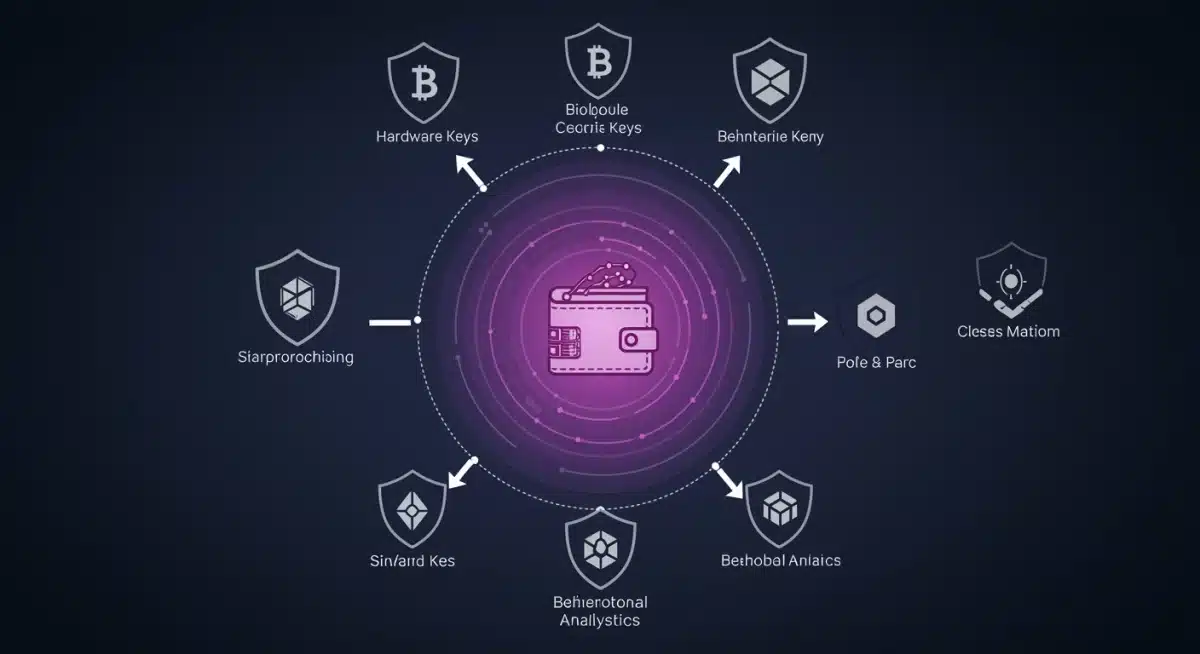
The shift to quantum-resistant MFA will likely involve a combination of new hardware and updated software protocols. Staying informed and choosing providers that are actively preparing for the post-quantum era is essential for US investors looking to secure their assets against future computational advancements.
In essence, quantum-resistant MFA is about future-proofing your crypto security. By embracing these cutting-edge strategies, US investors can ensure their digital assets remain protected even as quantum computing capabilities become a more tangible threat.
Decentralized Identity (DID) and Self-Sovereign MFA
Decentralized Identity (DID) represents a paradigm shift in how identity is managed and authenticated, offering a powerful new approach to MFA for crypto in 2026. Instead of relying on centralized authorities to store and verify identity, DIDs allow individuals to control their own digital identities, issuing verifiable credentials that can be selectively shared. This self-sovereign model introduces a highly secure and private form of multi-factor authentication.
For US investors, DID-based MFA means enhanced privacy, reduced reliance on third parties, and a more resilient security posture. It moves authentication away from vulnerable centralized databases towards a user-controlled, blockchain-anchored system.
Verifiable Credentials as MFA Factors
Under a DID framework, various aspects of your identity can be represented as “verifiable credentials” (VCs). These VCs are cryptographically signed by issuers (e.g., a bank, a government agency) and can be presented to verifiers (e.g., a crypto exchange) without revealing unnecessary personal information. For MFA, a VC could act as a strong authentication factor, proving your identity without exposing your full profile.
- Blockchain-anchored cryptographic proofs of identity
- Selective disclosure of personal attributes
- User-controlled identity management
This approach significantly reduces the attack surface, as there is no central honey pot of user data for hackers to target. Your MFA factors are self-attested and cryptographically verifiable, making it extremely difficult for unauthorized access when protecting your crypto.
DID Wallets and Integrated Authentication
DID wallets are emerging as central hubs for managing these verifiable credentials and facilitating self-sovereign MFA. These wallets allow users to store, manage, and present their VCs directly from their device, interacting seamlessly with dApps and crypto platforms that support DID authentication. This integration streamlines the authentication process while maintaining a high level of security.
The beauty of DID-based MFA lies in its decentralization and user empowerment. By giving investors direct control over their authentication factors, it fundamentally changes the security equation, making it much harder for external entities to compromise access to digital assets. As the Web3 ecosystem matures, DID-based MFA is poised to become a mainstream strategy for US crypto investors in 2026.
In conclusion, decentralized identity and self-sovereign MFA offer a privacy-enhancing and highly secure approach to protecting crypto. By leveraging verifiable credentials and DID wallets, US investors can achieve robust authentication while maintaining control over their digital identities.
Adaptive MFA with AI-Powered Risk Scoring
Adaptive Multi-Factor Authentication (AMFA) leverages artificial intelligence to dynamically assess risk factors in real-time and adjust the authentication requirements accordingly. In 2026, AMFA with AI-powered risk scoring has become a crucial component for US crypto investors, offering a flexible yet robust security layer. This system analyzes a multitude of contextual signals to determine the likelihood of a login attempt being legitimate or fraudulent.
Instead of a one-size-fits-all approach, AMFA intelligently applies the appropriate level of authentication, posing a significant hurdle for attackers while minimizing friction for legitimate users. This balance of security and usability is key for modern crypto protection.
Real-time Contextual Analysis
AI algorithms in AMFA systems analyze various data points during a login attempt, including:
- Geographic location: Is the login from an unusual country or region?
- Device recognition: Is the user logging in from a recognized device?
- Time of access: Is it outside typical usage patterns?
- IP address reputation: Is the IP associated with known malicious activity?
- Behavioral biometrics: Are the typing patterns or mouse movements consistent?
Based on this real-time analysis, the AI assigns a risk score to the login attempt. If the score is low, access might be granted with a single factor (e.g., password). If the score is high, additional MFA factors (e.g., hardware key, biometric scan) are dynamically requested. This ensures that protecting your crypto is always a priority, without unnecessary hurdles.
Dynamic Enforcement of MFA Policies
The power of AMFA lies in its ability to dynamically enforce MFA policies. For instance, if an investor attempts to log in from a new, unrecognized device in a different country, the system might automatically require a hardware key and a biometric scan, even if their usual login only requires an authenticator app. Conversely, a routine login from a trusted device and location might only require a password.
This intelligent layering of authentication factors makes it incredibly difficult for attackers to gain unauthorized access, as they would need to spoof not only credentials but also a convincing combination of contextual factors. AMFA adapts to the evolving threat landscape, providing a responsive and strong defense.
In summary, adaptive MFA with AI-powered risk scoring offers a smart and dynamic approach to crypto security. By continuously assessing risk and adjusting authentication requirements, it provides robust protection for US investors while maintaining a user-friendly experience.
Regular Security Audits and Best Practices Adoption
While advanced MFA strategies are critical, their effectiveness is amplified when combined with regular security audits and the consistent adoption of best practices. For US crypto investors in 2026, this holistic approach ensures that their entire digital footprint is secure, not just their login credentials. A chain is only as strong as its weakest link, and security audits help identify and fortify those weak points.
Beyond implementing MFA, investors must cultivate a mindset of continuous security improvement, regularly reviewing their practices and staying informed about new threats and protective measures.
Periodic Wallet and Exchange Audits
Regularly audit your cryptocurrency wallets and exchange accounts. This involves checking transaction histories for any unauthorized activity, reviewing authorized devices, and ensuring all security settings are optimally configured. For hardware wallets, verify the firmware is up to date and that the device itself remains untampered.
- Reviewing transaction history for anomalies
- Checking authorized devices and API keys
- Updating firmware on hardware wallets
These audits help catch potential compromises early and ensure that all your security measures, including your advanced MFA, are functioning as intended. This proactive step is vital for protecting your crypto assets effectively.
Adopting a Zero-Trust Security Model
A zero-trust security model, traditionally applied in corporate environments, is increasingly relevant for individual crypto investors. This model operates on the principle of “never trust, always verify.” It means that even if a device or user is inside a presumed secure perimeter, their identity and access are continuously verified before granting access to resources.
For investors, this translates to scrutinizing every link, every email, and every login request. Assume every interaction could be a threat until proven otherwise. Combine this with strong MFA, and you create an incredibly resilient security posture.
Furthermore, maintaining separate, strong, and unique passwords for every service, avoiding public Wi-Fi for crypto transactions, and using a dedicated, clean device for managing significant crypto holdings are all fundamental best practices that complement any MFA strategy.
In conclusion, advanced MFA strategies are foundational, but their true power is unlocked when integrated with a regimen of regular security audits and adherence to best practices. This comprehensive approach provides US crypto investors in 2026 with the most robust defense against the evolving threat landscape.
| MFA Strategy | Brief Description |
|---|---|
| Hardware Security Keys | Physical devices providing independent, phishing-resistant authentication, often FIDO2 compliant. |
| Biometric MFA with Liveness Detection | Advanced facial/voice recognition with anti-spoofing technology, plus behavioral biometrics. |
| Quantum-Resistant MFA | Authentication methods using post-quantum cryptography to secure against future quantum attacks. |
| Decentralized Identity (DID) MFA | User-controlled identity verification via verifiable credentials on blockchain, enhancing privacy and security. |
Frequently Asked Questions About Crypto Security in 2026
Traditional MFA, like SMS codes, are vulnerable to SIM-swapping and other social engineering attacks. Crypto’s high value makes it a prime target, requiring more robust, phishing-resistant methods to prevent unauthorized access and asset theft. Advanced threats in 2026 demand advanced defenses.
Hardware security keys, especially FIDO2 compliant ones, cryptographically bind authentication to the specific website or service. This means even if you’re tricked into visiting a fake site, the key won’t authenticate, effectively neutralizing phishing attempts by ensuring you’re interacting with the legitimate platform.
Advanced biometric MFA in 2026 incorporates sophisticated liveness detection using 3D mapping, infrared, and behavioral analysis. These technologies detect subtle biological cues, making it extremely difficult for deepfakes or recordings to bypass authentication by confirming a living, present individual.
DID allows users to control their own digital identity, using verifiable credentials as secure, privacy-preserving MFA factors. This reduces reliance on centralized identity providers, minimizing the risk of data breaches and enhancing overall security for crypto access by decentralizing authentication.
AI-powered adaptive MFA analyzes real-time contextual data (location, device, time) to assess login risk. It dynamically adjusts authentication requirements, demanding stronger factors for high-risk attempts and streamlining access for low-risk ones, providing flexible yet robust protection against evolving threats.
Conclusion: Fortifying Your Crypto Future
In 2026, the imperative for US investors to adopt advanced multi-factor authentication strategies for their cryptocurrency holdings has never been clearer. The digital asset landscape, while offering immense opportunities, is also a magnet for sophisticated cyber threats that continually evolve. Moving beyond basic security measures to embrace hardware security keys, biometric MFA with liveness detection, quantum-resistant cryptography, decentralized identity, and AI-powered adaptive MFA is not merely an upgrade; it is a fundamental necessity for robust protection. By integrating these cutting-edge strategies and maintaining a vigilant security posture, investors can significantly fortify their digital assets against future compromises, securing their financial future in the dynamic world of crypto.