Preventing Reentrancy Attacks: Smart Contract Security Best Practices 2026

Preventing Reentrancy Attacks: 4 Essential Smart Contract Coding Practices for U.S. Developers in 2026
In the rapidly evolving landscape of decentralized finance (DeFi) and Web3, smart contracts serve as the backbone of countless applications. These self-executing agreements, encoded on the blockchain, hold immense potential for innovation and trustless transactions. However, their immutable nature and direct handling of valuable assets make them prime targets for malicious actors. Among the most insidious and historically damaging vulnerabilities is the reentrancy attack. For U.S. developers operating in 2026, understanding and rigorously applying smart contract reentrancy prevention techniques is not merely a best practice; it is a fundamental requirement for building secure and reliable decentralized applications (dApps).
The infamous DAO hack in 2016, which resulted in the loss of millions of dollars and a hard fork of the Ethereum blockchain, stands as a stark reminder of the devastating impact a reentrancy vulnerability can have. While the ecosystem has matured significantly since then, new attack vectors and sophisticated methods continue to emerge. Therefore, staying ahead of these threats and implementing robust security measures from the outset is paramount. This comprehensive guide will delve into the intricacies of reentrancy attacks and, more importantly, equip U.S. developers with four essential smart contract coding practices to effectively mitigate this risk in their projects.
By the end of this article, you will have a deep understanding of why smart contract reentrancy prevention is crucial, and you will be armed with actionable strategies to fortify your smart contracts against these persistent threats. Let’s embark on this journey to build a more secure decentralized future.
Understanding the Reentrancy Attack: A Critical Threat to Smart Contracts
Before we dive into prevention strategies, it’s essential to grasp what a reentrancy attack entails and how it exploits vulnerabilities in smart contract design. At its core, a reentrancy attack occurs when an external call to an untrusted contract is made before the state variables of the calling contract have been updated. This allows the untrusted contract to "re-enter" the calling contract’s function multiple times before the initial call has completed, potentially draining funds or manipulating contract logic.
How a Reentrancy Attack Unfolds
Consider a simple withdrawal function in a smart contract. A typical, but vulnerable, sequence of operations might look like this:
- Check if the user has enough balance.
- Send the requested amount to the user’s address.
- Update the user’s balance to reflect the withdrawal.
The vulnerability lies in step 2. If the recipient’s address is a malicious smart contract, that contract can, upon receiving the funds, immediately call the original contract’s withdrawal function again. Because the balance update (step 3) hasn’t occurred yet, the malicious contract can repeatedly withdraw funds before the initial transaction is finalized and the balance is decremented. This loop continues until the contract’s funds are depleted or the transaction gas limit is reached.
The danger of reentrancy attacks is amplified by the composable nature of smart contracts. dApps often interact with multiple external contracts (e.g., lending protocols, decentralized exchanges, or oracle services). Each external call introduces a potential reentrancy vector if not handled with extreme care. For U.S. developers, this means a rigorous approach to smart contract reentrancy prevention is non-negotiable, especially as regulatory scrutiny and the value locked in DeFi continue to grow.
The financial implications of reentrancy attacks can be catastrophic, leading to significant financial losses for users and irreparable damage to the reputation of projects. Therefore, understanding this attack vector is the first step toward building truly secure and resilient decentralized systems.
1. Implement the Checks-Effects-Interactions Pattern
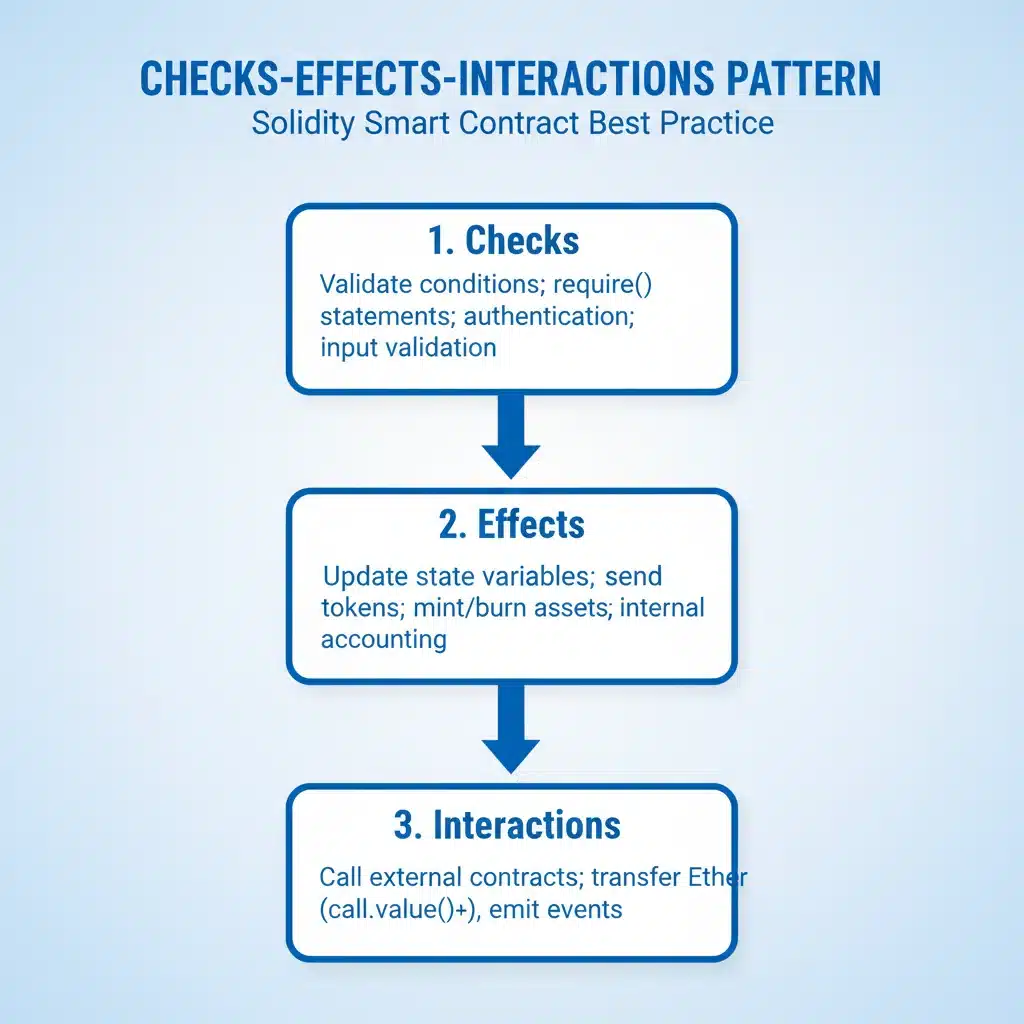
The Checks-Effects-Interactions (CEI) pattern is arguably the most fundamental and widely adopted best practice for smart contract reentrancy prevention. It dictates a specific order for operations within a smart contract function to ensure that state changes are finalized before any external calls are made.
The Three Pillars of CEI:
-
Checks: The initial phase involves verifying all preconditions and inputs. This includes checking user permissions, validating input parameters, ensuring sufficient balances, and confirming any other conditions necessary for the function to proceed. If any check fails, the function should revert.
Example:
require(balances[msg.sender] >= amount, "Insufficient balance"); require(amount > 0, "Amount must be positive"); -
Effects: After all checks have passed, the contract’s state variables are updated. This is the crucial step for reentrancy prevention. All internal state changes, such as decrementing balances, updating ownership records, or modifying internal accounting, must occur before any external calls. By updating the state first, even if a malicious contract re-enters, its subsequent calls will see the updated (decremented) state, preventing repeated withdrawals.
Example:
balances[msg.sender] -= amount; emit Withdrawal(msg.sender, amount); // Emit events after state change -
Interactions: Only after all internal state changes have been committed should the contract interact with external contracts or send Ether to external addresses. This ensures that the contract’s internal logic is consistent and finalized before any potential re-entry can occur.
Example:
(bool success, ) = msg.sender.call{value: amount}("");
require(success, "Transfer failed");
By strictly adhering to the CEI pattern, developers create a robust defense against reentrancy. Even if an external call attempts to re-enter the function, the state variables will have already been updated, rendering subsequent attempts to exploit the original state ineffective. This pattern is fundamental to secure smart contract development and should be a cornerstone of every U.S. developer’s toolkit when building for the blockchain in 2026.
2. Utilize Reentrancy Guards and Mutexes
While the CEI pattern is highly effective, sometimes complex contract interactions or specific design choices might make its strict application challenging in every scenario. This is where reentrancy guards, often implemented as mutexes (mutual exclusion locks), come into play as an additional layer of smart contract reentrancy prevention.
How Reentrancy Guards Work
A reentrancy guard is a mechanism that prevents a function from being called again by the same (or any) external contract while it is still executing. It typically involves a boolean state variable that acts as a lock. When a function protected by the guard is entered, the lock is set to true. If another call attempts to enter the function while the lock is true, it is immediately reverted. Once the function completes its execution, the lock is reset to false.
The OpenZeppelin Contracts library provides a widely used and battle-tested ReentrancyGuard contract that developers can inherit from. This contract offers a convenient nonReentrant modifier.
Example of a Reentrancy Guard:
// SPDX-License-Identifier: MIT
pragma solidity ^0.8.0;

import "@openzeppelin/contracts/security/ReentrancyGuard.sol";

contract MyContract is ReentrancyGuard {
    mapping(address => uint256) public balances;

    constructor() {
        balances[msg.sender] = 1000 ether;
    }

    function withdraw(uint256 amount) public nonReentrant {
        require(balances[msg.sender] >= amount, "Insufficient balance");

        balances[msg.sender] -= amount;

        (bool success, ) = msg.sender.call{value: amount}("");
        require(success, "Transfer failed");
    }
}
In this example, the nonReentrant modifier ensures that if a malicious contract tries to call withdraw again during the execution of the first withdraw call (e.g., from within the msg.sender.call), the second call will revert because the reentrancy guard is active. This effectively locks the function until the first execution is complete and the lock is released.
It’s important to note that while reentrancy guards are powerful, they should be used judiciously. Overuse can lead to unnecessary gas costs and potentially hinder legitimate contract interactions. They are best applied to functions that perform external calls and modify state, especially those involving token transfers or Ether withdrawals. For U.S. developers, integrating such proven security patterns, like those from OpenZeppelin, is a highly recommended practice for robust smart contract reentrancy prevention.

3. Prefer transfer() or send() for Ether Transfers (with caveats)
Historically, for sending Ether to external accounts, Solidity offered three primary methods: call(), transfer(), and send(). While call() is the most flexible, it also carries the highest risk of reentrancy if not used carefully. For simpler Ether transfers, transfer() and send() were often recommended as a measure of smart contract reentrancy prevention due to their gas limitations.
Understanding the Gas Limit:
transfer()andsend()forward a fixed stipend of 2300 gas to the recipient contract. This gas limit is typically insufficient for a malicious contract to perform complex logic, including re-entering the calling contract. This severely restricts the attacker’s ability to execute a reentrancy attack.call(), by default, forwards all available gas. This means a malicious contract can execute arbitrary code, including re-entering the original contract, if the gas limit is not explicitly set.
Why transfer()/send() are less recommended now (and what to do instead):
While the gas stipend provided by transfer() and send() was a good defense against reentrancy, the evolving Ethereum ecosystem has introduced complexities. Specifically, the introduction of gas costs for certain operations (like sending Ether to a contract that uses a fallback function to store data) and the potential for contracts to become non-upgradable or unable to receive Ether due to tight gas limits have made transfer() and send() less reliable. Furthermore, layer 2 solutions and different EVM implementations might have varying gas costs, making the 2300 gas stipend unpredictable.
The modern recommendation for robust smart contract reentrancy prevention is to use call() but explicitly limit the gas forwarded to external contracts, or even better, use it with a zero-value call if only sending Ether and no complex interaction is needed.
Secure Ether Transfer with call():
// Recommended way to send Ether securely
(bool success, ) = payable(msg.sender).call{value: amount, gas: 2300}("");
require(success, "Transfer failed");
This approach explicitly sets the gas limit for the external call, mimicking the safety feature of transfer()/send(), but gives developers more control and avoids the potential issues associated with the fixed stipend. For U.S. developers, this nuanced understanding of Ether transfer mechanisms is vital. While the intent behind transfer()/send() was good, the explicit gas limiting with call() is the more future-proof and flexible approach for ensuring smart contract reentrancy prevention in 2026 and beyond.
It’s crucial to always use call() with an empty calldata ("") when simply sending Ether, as this prevents the external contract from executing arbitrary code via a fallback function that might lead to unexpected behavior or reentrancy. Additionally, always check the return value of call() to ensure the transfer was successful.
4. Avoid Untrusted External Calls Where Possible (and Isolate Them)
The most effective way to prevent reentrancy attacks is to minimize the attack surface by reducing reliance on external calls to untrusted contracts. While complete isolation is often impractical in a highly interconnected DeFi ecosystem, strategic minimization and careful isolation are powerful smart contract reentrancy prevention techniques.
Minimize External Interactions:
Before making an external call, ask yourself if it’s truly necessary. Can the required functionality be achieved internally within your contract or through an already trusted and audited library? Every external call introduces a potential point of failure and a reentrancy vector. By reducing the number of external calls, you inherently reduce the chances of a reentrancy attack.
Isolate External Calls:
When external calls are unavoidable, they should be isolated as much as possible. This means:
-
Dedicated Functions: Create dedicated, simple functions solely for making external calls. These functions should do nothing else besides the external interaction and potentially logging the outcome. This makes it easier to audit and reason about the security implications.
-
Stateless Interactions: Ideally, the external call should not rely on any sensitive state variables that could be manipulated by a re-entrant call. If state changes are required, ensure they adhere strictly to the Checks-Effects-Interactions pattern discussed earlier.
-
Known and Audited Contracts: When interacting with external contracts, prioritize those that are well-known, widely used, and have undergone multiple security audits. While no contract is 100% immune to vulnerabilities, relying on established and vetted projects significantly reduces risk.
-
Pull vs. Push Payments: Instead of pushing funds to users (which involves an external call to their address), consider implementing a "pull" mechanism. In a pull payment system, users request and withdraw their funds themselves from the contract. This puts the burden of initiating the external call on the user and can shift some of the reentrancy risk, as the user’s contract is less likely to be designed to attack your specific contract via reentrancy. However, the contract still needs to protect its own withdrawal function with CEI and/or reentrancy guards.
// Example of a pull-based withdrawal (simplified)
function withdraw() public nonReentrant {
    uint256 amount = balances[msg.sender];
    require(amount > 0, "No balance to withdraw");

    balances[msg.sender] = 0; // Effect: Update state first

    (bool success, ) = payable(msg.sender).call{value: amount}(""); // Interaction
    require(success, "Transfer failed");
}
For U.S. developers, adopting a conservative approach to external calls is a hallmark of secure design. By minimizing and isolating these interactions, you significantly reduce the attack surface and enhance your smart contract reentrancy prevention posture. This practice aligns with the principle of least privilege, ensuring your contracts only interact externally when absolutely necessary and in a controlled manner.
Beyond Coding Practices: A Holistic Approach to Smart Contract Security
While the four coding practices outlined above are crucial for smart contract reentrancy prevention, true blockchain security requires a multi-faceted approach. For U.S. developers navigating the complex regulatory and technological landscape of 2026, integrating these practices within a broader security framework is essential.
Regular Security Audits:
Professional security audits by reputable firms are indispensable. Even the most experienced developers can overlook subtle vulnerabilities. Auditors bring fresh eyes, specialized tools, and extensive knowledge of past exploits to identify potential weaknesses, including reentrancy vectors, before deployment. For projects handling significant value, multiple audits are often recommended.
Automated Security Tools:
Leverage static analysis tools (e.g., Slither, Mythril) and dynamic analysis tools (e.g., fuzzing with Echidna) during development. These tools can automatically detect common vulnerabilities, including potential reentrancy issues, and provide immediate feedback, saving time and reducing human error. Integrating these into your CI/CD pipeline ensures continuous security checks.
Comprehensive Testing:
Write extensive unit tests, integration tests, and scenario-based tests that specifically target potential reentrancy conditions. Simulate various attack scenarios, including those where external contracts attempt to re-enter your functions. Tools like Hardhat and Foundry offer powerful testing frameworks that facilitate this.
Bug Bounty Programs:
Once your contract is deployed, consider launching a bug bounty program. Incentivizing ethical hackers to find vulnerabilities provides an additional layer of security review. Platforms like Immunefi and HackerOne specialize in connecting projects with security researchers. This demonstrates a commitment to security and can uncover issues missed by audits and internal testing.
Continuous Monitoring:
Even after deployment, active monitoring of your smart contracts and the blockchain for unusual activity is critical. Tools for on-chain monitoring can alert you to suspicious transactions or patterns that might indicate an ongoing attack, allowing for a rapid response. This includes monitoring for large, unexpected withdrawals or unusual call sequences.
Staying Updated with Security Research:
The blockchain security landscape is constantly evolving. New attack vectors and mitigation techniques emerge regularly. U.S. developers must actively follow security research, read post-mortems of hacks, and participate in security communities to stay informed and adapt their practices. Subscribing to security newsletters and attending industry conferences are excellent ways to keep abreast of the latest threats and solutions.
By combining these robust coding practices with a comprehensive security strategy, U.S. developers can significantly enhance the resilience of their smart contracts against reentrancy and other sophisticated attacks. This holistic approach is not just about preventing individual exploits; it’s about building a foundation of trust and reliability crucial for the widespread adoption of blockchain technology.
Conclusion: Fortifying Smart Contracts Against Reentrancy in 2026
Reentrancy attacks remain a persistent and potent threat in the smart contract ecosystem, capable of causing catastrophic financial losses and eroding trust in decentralized applications. For U.S. developers building the next generation of Web3 innovations in 2026, a deep understanding of smart contract reentrancy prevention is not optional, but absolutely essential.
We’ve explored four critical coding practices that form the bedrock of defense against these attacks:
- Implementing the Checks-Effects-Interactions (CEI) Pattern: Ensuring state changes are finalized before any external calls are made is the golden rule of reentrancy prevention.
- Utilizing Reentrancy Guards and Mutexes: Employing mechanisms like OpenZeppelin’s
nonReentrantmodifier provides an additional, robust layer of protection by locking functions during execution. - Preferring Secure Ether Transfers with Explicit Gas Limits: Moving beyond outdated methods to use
call()with carefully set gas stipends ensures external calls cannot execute complex re-entrant logic. - Avoiding Untrusted External Calls and Isolating Them: Minimizing the attack surface by reducing unnecessary external interactions and isolating critical calls to known, audited contracts significantly reduces risk.
Beyond these coding practices, we’ve emphasized the importance of a holistic security approach, encompassing regular audits, automated tooling, comprehensive testing, bug bounty programs, continuous monitoring, and staying updated with the latest security research. The decentralized future hinges on the security and reliability of its underlying smart contracts.
By diligently applying these principles, U.S. developers can build smart contracts that are not only innovative and functional but also resilient against the most sophisticated attacks. This commitment to security will foster greater trust, accelerate adoption, and solidify the position of the United States as a leader in the global blockchain space. Let’s build a more secure Web3, one robust smart contract at a time.