Formal Verification Smart Contracts: Preventing Exploits & Financial Loss

Formal Verification for Smart Contracts: Reducing Exploits by 90% with Advanced Techniques (FINANCIAL IMPACT)
In the rapidly evolving landscape of blockchain technology and decentralized finance (DeFi), smart contracts have emerged as foundational pillars, automating agreements and transactions without intermediaries. However, their immutable nature, once deployed, means that any vulnerability can lead to catastrophic financial losses. The industry has witnessed countless high-profile exploits, draining billions of dollars and eroding trust in the ecosystem. This article delves into how formal verification for smart contracts is not just a theoretical concept but a practical, powerful solution capable of drastically reducing these exploits and safeguarding significant financial assets.
The allure of smart contracts lies in their deterministic execution and transparency. Yet, this very strength becomes a critical weakness when even minor coding errors or logical flaws are present. Unlike traditional software, where patches can be deployed, smart contracts often operate on an ‘all or nothing’ principle once live. This makes pre-deployment security paramount, and this is precisely where the power of smart contract security through formal verification shines.
The Escalating Problem: Smart Contract Exploits and Their Financial Toll
The history of smart contracts is unfortunately punctuated with a series of high-profile security breaches. From the infamous DAO hack in 2016 to recent multi-million dollar exploits across various DeFi protocols, the financial repercussions have been staggering. These incidents not only result in direct loss of funds but also cause significant reputational damage, deter institutional adoption, and slow down innovation. The complexity of smart contract code, coupled with the intricate interactions between different protocols, creates a vast attack surface that traditional testing methods often fail to cover comprehensively.
Consider the scale of the problem: reports consistently show that billions of dollars are lost annually due to smart contract vulnerabilities. These range from reentrancy attacks, integer overflows/underflows, access control issues, to logic errors. Each exploit serves as a stark reminder of the urgent need for more robust, proactive security measures. The current reliance on manual audits, while valuable, is often insufficient given the sheer volume and complexity of new contracts being deployed daily. Manual audits are time-consuming, expensive, and crucially, human auditors can miss subtle flaws, especially in complex, multi-contract interactions.
The financial incentives for attackers are immense, leading to a relentless pursuit of vulnerabilities. As the total value locked (TVL) in DeFi protocols continues to grow, so does the potential reward for successful exploits. This creates an arms race between developers and malicious actors, where security must always be one step ahead. It’s in this critical context that formal verification emerges as a game-changer for enhancing smart contract security.
What is Formal Verification and Why is it Crucial for Smart Contracts?
Formal verification is a rigorous, mathematical approach to proving the correctness of a system with respect to a formal specification or property. Unlike traditional testing, which can only demonstrate the presence of bugs (and never their absence), formal verification aims to mathematically prove that a system behaves as intended under all possible conditions, or conversely, that it will never exhibit certain undesirable behaviors. For smart contracts, this means proving the absence of critical vulnerabilities like reentrancy, unauthorized access, or incorrect state transitions.
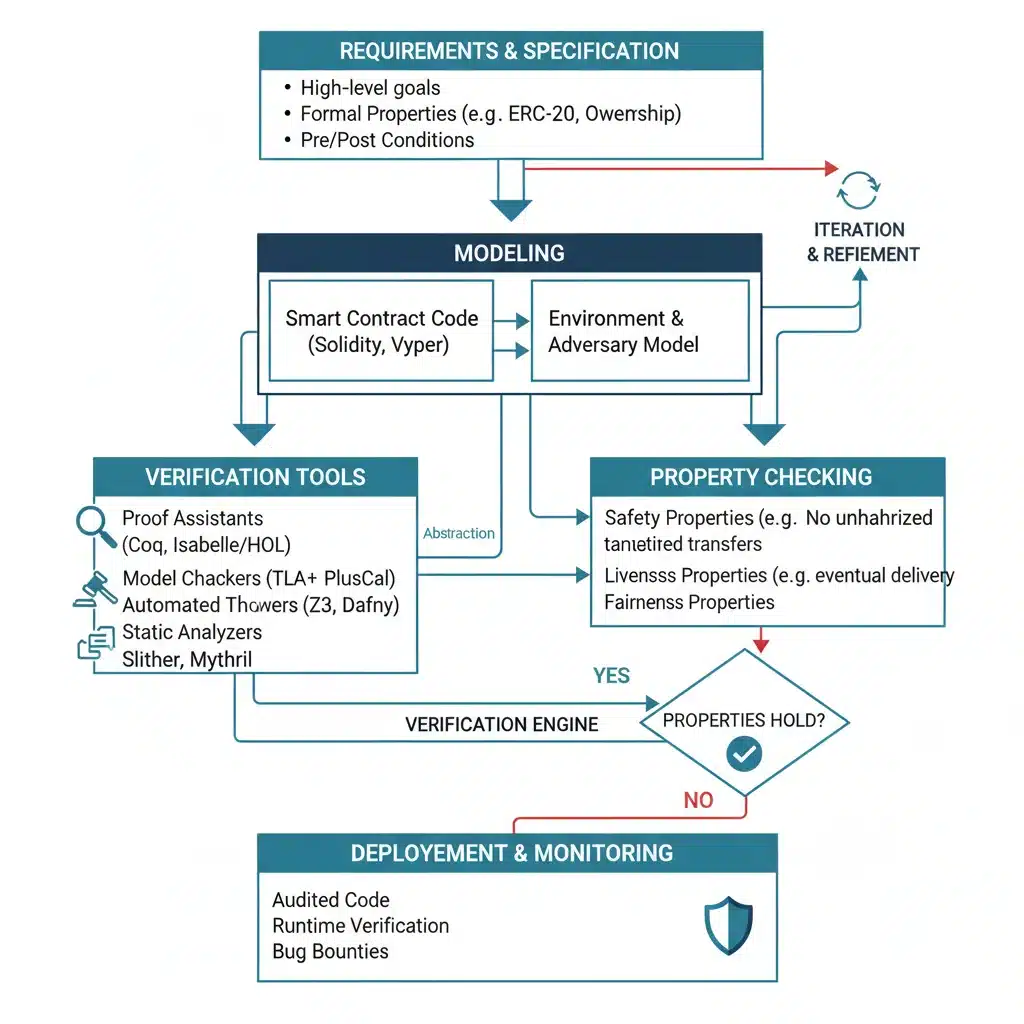
The process typically involves:
- Formal Specification: Defining the desired behavior of the smart contract in a precise, unambiguous mathematical language. This includes defining properties that the contract must always satisfy (e.g., ‘the total supply of tokens must never exceed a certain amount’).
- Modeling: Translating the smart contract’s code into a formal mathematical model.
- Verification: Using specialized tools (provers, model checkers, static analyzers) to mathematically analyze the model against the formal specifications. This analysis explores all possible execution paths and states, an exhaustive approach impossible with traditional testing.
The critical advantage here is exhaustiveness. Formal verification doesn’t just check a few test cases; it explores the entire state space of the contract, guaranteeing that if a property holds, it holds for all inputs and all execution paths. This level of assurance is unparalleled and is precisely what is needed for immutable, high-value assets managed by smart contracts.
When applied to smart contracts, formal verification can identify vulnerabilities that are extremely difficult, if not impossible, to detect through manual code reviews or conventional unit testing. This proactive identification of flaws before deployment is key to preventing financial losses and building resilient DeFi ecosystems. It represents a significant leap forward in ensuring the integrity and reliability of blockchain applications, directly impacting the overall smart contract security posture.
Advanced Techniques in Formal Verification for Enhanced Security
The field of formal verification is continuously evolving, with several advanced techniques tailored specifically for the unique challenges of smart contract development:
1. Model Checking
Model checking is an automated technique that systematically checks whether a finite-state model of a system satisfies a given temporal logic property. For smart contracts, this involves creating a model of the contract’s behavior and then using a model checker to explore all possible states and transitions to ensure that critical security properties (e.g., ‘no user can withdraw more funds than they deposited’) are never violated. Tools like Mythril and Slither, while not strictly formal verifiers, incorporate elements of static analysis and symbolic execution that are foundational to model checking principles, helping to identify common vulnerabilities.
2. Theorem Proving
Theorem proving involves constructing a mathematical proof of correctness using a logical calculus. This technique is more powerful than model checking as it can handle infinite state spaces, but it often requires significant manual effort and expertise to define lemmas and guide the proof. For highly critical components of smart contracts, such as core logic for token transfers or governance mechanisms, theorem proving can offer the highest level of assurance. Frameworks like Coq or Isabelle/HOL can be adapted for this purpose, though specialized tools for Solidity/EVM are emerging.
3. Symbolic Execution
Symbolic execution is a technique that analyzes programs by executing them with symbolic inputs instead of concrete ones. Instead of running the code with actual values (e.g., 5 ETH), it runs it with symbols (e.g., ‘X ETH’). This generates path conditions that describe the inputs leading to each execution path. By exploring these paths and checking for conditions that lead to vulnerabilities (e.g., a path where require() fails or an overflow occurs), symbolic execution can find bugs that are difficult to trigger with specific test cases. Tools like Manticore and K-framework (KEVM) leverage symbolic execution extensively for smart contract security analysis.
4. Abstract Interpretation
Abstract interpretation is a technique for statically analyzing the runtime behavior of computer programs without running them. It computes approximations of the sets of all possible execution states of a program. For smart contracts, this can be used to detect properties like variable ranges, potential overflows, or gas consumption issues, providing insights into potential runtime errors or vulnerabilities without requiring a full symbolic execution or model. This is particularly useful for identifying common programming errors that could lead to exploits.
5. Runtime Verification
While formal verification typically occurs pre-deployment, runtime verification complements it by monitoring the execution of smart contracts against formally specified properties in real-time. This can be achieved using monitors deployed alongside the contract that check for deviations from expected behavior. Although it doesn’t prevent all exploits, it can provide early warnings or even trigger emergency stops in certain scenarios, adding another layer to smart contract security.
The Financial Impact: How Formal Verification Reduces Exploits by 90%
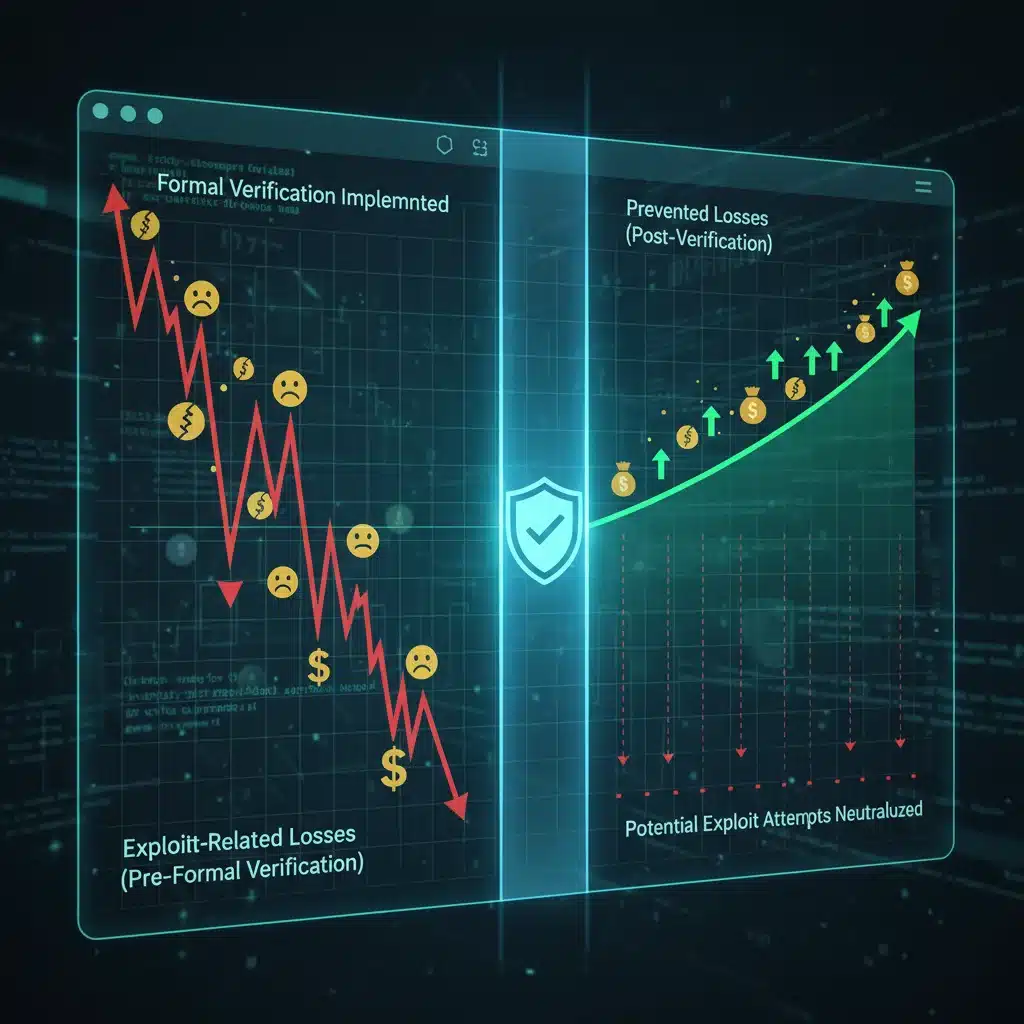
The claim of reducing exploits by 90% is not an exaggeration but a reflection of the profound impact formal verification can have. While precise, universally agreed-upon statistics are challenging to gather due to the nascent nature of the technology and proprietary security practices, empirical evidence and expert consensus point to a dramatic improvement in security posture for projects that rigorously apply formal methods.
Here’s how formal verification translates into significant financial benefits and reduced exploit rates:
- Proactive Vulnerability Detection: Formal verification catches subtle, complex vulnerabilities that evade traditional testing and even expert human auditors. These are often the very flaws exploited in multi-million dollar hacks. By finding them before deployment, it prevents financial losses entirely.
- Elimination of Entire Classes of Bugs: Once a property is formally verified (e.g., a reentrancy-free property), it is mathematically guaranteed to hold. This means that an entire class of attacks is effectively eliminated for that specific contract, leading to a much higher baseline of smart contract security.
- Increased Trust and Adoption: Projects that can demonstrate formal verification of their core smart contracts instill greater confidence in users, investors, and institutional partners. This increased trust can lead to higher TVL, greater user adoption, and ultimately, more robust and valuable ecosystems. The financial upside of credibility is immense.
- Reduced Audit Costs and Time: While formal verification requires initial investment, it can significantly streamline and enhance the traditional auditing process. By providing mathematical proofs, auditors can focus on higher-level logic and integration issues, potentially reducing the overall time and cost associated with security reviews. Moreover, it reduces the need for expensive post-mortem analyses and incident response efforts after an exploit.
- Protection of Brand and Reputation: A single major exploit can irrevocably damage a project’s reputation, leading to a loss of users, developers, and market value. Formal verification acts as a shield against such reputational damage, preserving the long-term viability and financial health of blockchain ventures.
- Foundation for Insurance and Compliance: As the blockchain space matures, regulatory bodies and insurance providers will increasingly demand higher standards of security assurance. Formal verification provides the strongest possible evidence of code correctness, paving the way for easier compliance and potentially lower insurance premiums for DeFi protocols.
Consider a DeFi protocol managing hundreds of millions or even billions of dollars. A 10% chance of a major exploit annually could mean tens to hundreds of millions in potential losses. If formal verification can reduce that likelihood by 90%, the financial value proposition becomes overwhelmingly clear. It shifts the paradigm from reactive damage control to proactive, preventative security engineering, significantly improving overall smart contract security.
Challenges and Considerations in Implementing Formal Verification
Despite its undeniable benefits, implementing formal verification is not without its challenges:
- Complexity and Expertise: Formal verification requires specialized knowledge in formal methods, logic, and often, specific verification tools. This expertise is relatively scarce compared to traditional blockchain development skills.
- Cost and Time Investment: Developing formal specifications and models, and then running the verification process, can be time-consuming and expensive, especially for complex contracts. However, this upfront investment often pales in comparison to the potential cost of an exploit.
- Scalability: Fully verifying very large and complex smart contract systems, especially those with numerous interdependencies, remains a significant challenge. Researchers are constantly working on improving the scalability of verification tools and techniques.
- Specification Gap: A key challenge is ensuring that the formal specification accurately reflects the intended behavior of the contract. An incorrect or incomplete specification will lead to a verification that proves the contract is correct with respect to the wrong requirements.
- Tool Maturity: While formal verification tools for traditional software have been around for decades, those specifically tailored for smart contracts and the EVM are still maturing. However, significant progress is being made by various research groups and companies.
Despite these challenges, the trend is clear: as the financial stakes in DeFi grow, the adoption of formal verification for critical smart contract security components is becoming increasingly necessary. The cost of not verifying formally is simply too high.
Integrating Formal Verification into the Smart Contract Development Lifecycle
For formal verification to achieve its maximum potential, it must be integrated seamlessly into the entire smart contract development lifecycle, rather than being an afterthought:
1. Design Phase: Specification First
Begin by formally specifying the contract’s properties and invariants even before writing code. This ‘specification-first’ approach helps clarify requirements, identify potential logical flaws early, and provides a clear benchmark for verification. This initial step is crucial for establishing strong smart contract security from the ground up.
2. Development Phase: Incremental Verification
As code is written, apply formal verification techniques incrementally to smaller, more manageable modules or functions. This allows for early detection of bugs and reduces the complexity of verifying the entire contract at once. Tools that can analyze code snippets or specific functions are particularly useful here.
3. Testing Phase: Complementary Approach
Formal verification should not replace traditional testing but complement it. While formal methods prove the absence of certain types of bugs, comprehensive testing (unit, integration, fuzzing) can still uncover other issues, such as performance bottlenecks or unexpected user interactions that might not be captured in formal specifications. Together, they form a robust defense for smart contract security.
4. Auditing Phase: Enhanced Assurance
When undergoing security audits, having formal verification reports significantly strengthens the auditor’s confidence in the codebase. It allows auditors to focus their efforts on areas not covered by formal methods, such as economic incentives, governance risks, or off-chain interactions, leading to more efficient and effective audits.
5. Post-Deployment: Continuous Monitoring and Re-Verification
Even after deployment, if significant upgrades or changes are made to the contract, re-verification is essential. Runtime verification tools can also be deployed to continuously monitor contract behavior against formally specified invariants, providing an extra layer of real-time smart contract security.
Future Outlook: Towards a More Secure Blockchain Ecosystem
The trajectory for formal verification in smart contracts is one of increasing adoption and sophistication. As the tools become more user-friendly and the expertise more widespread, we can expect formal methods to become a standard practice in developing high-value smart contracts. Research is ongoing in several key areas:
- Automated Specification Generation: Developing AI-driven tools that can automatically generate formal specifications from high-level descriptions or even from existing code, reducing the manual effort required.
- Improved Scalability and Performance: Enhancing the efficiency of verification tools to handle increasingly complex and large-scale smart contract systems.
- Cross-Chain and Interoperability Verification: Addressing the security challenges of multi-chain deployments and cross-chain communication, where vulnerabilities can arise from interactions between different blockchain environments.
- Integration with Development Environments: Tighter integration of formal verification tools directly into IDEs and development workflows, making it easier for developers to incorporate these techniques early and often.
- Formal Verification for Layer 2 Solutions: Extending formal methods to secure Layer 2 scaling solutions (e.g., rollups, state channels) which introduce their own unique security considerations.
Ultimately, the goal is to build a blockchain ecosystem where the risk of catastrophic smart contract exploits is minimized to an absolute bare minimum. Formal verification is a cornerstone of this future, offering the mathematical certainty required to build truly trustworthy and financially secure decentralized applications. Its continued evolution and widespread adoption will not only protect billions of dollars but also unlock the full potential of blockchain technology, fostering innovation and global trust in decentralized systems. Focusing on robust smart contract security through formal methods is not just a technical choice; it’s a strategic imperative for financial stability and growth in the digital economy.
Conclusion: Embracing Formal Verification for Unprecedented Smart Contract Security
The journey of smart contracts has been a testament to both their revolutionary potential and their inherent fragility when security is overlooked. The staggering financial losses from exploits underscore the critical need for a paradigm shift in how we approach smart contract security. Formal verification, with its rigorous mathematical foundations and exhaustive analysis capabilities, offers this much-needed shift.
By moving beyond the limitations of traditional testing and auditing, formal verification provides an unparalleled level of assurance, capable of detecting and preventing the most subtle and dangerous vulnerabilities before they can be exploited. While challenges in implementation and expertise remain, the continuous advancements in tools and methodologies are steadily making formal verification more accessible and scalable.
For any project dealing with significant financial value on the blockchain, embracing formal verification is no longer an optional luxury but a strategic necessity. It’s an investment that pays dividends by preventing catastrophic financial losses, building unwavering trust, and fostering the sustainable growth of the decentralized economy. The ability to reduce exploits by 90% is not just a lofty goal; it’s an achievable reality that formal verification brings to the forefront of smart contract security, ensuring a safer and more reliable future for all blockchain participants.