Securing DAOs: Robust Smart Contract Solutions for Decentralized Governance
In the rapidly evolving landscape of Web3, Decentralized Autonomous Organizations (DAOs) stand as a testament to the power of collective decision-making and transparent governance. These organizations, built on blockchain technology, are governed by immutable rules encoded in smart contracts. While this paradigm offers unprecedented levels of transparency and decentralization, it also introduces unique and significant security challenges. The very essence of a DAO – its reliance on code for operational logic – makes DAO smart contract security an absolutely critical concern. A single vulnerability in a smart contract can lead to catastrophic losses, as evidenced by numerous high-profile exploits in the past.
This comprehensive guide delves into the practical solutions and best practices for securing DAOs through robust smart contract logic. We will explore the multifaceted nature of these challenges and provide actionable insights for developers, auditors, and DAO members alike. Our focus will be on understanding the attack vectors, implementing preventative measures, and establishing resilient recovery protocols to safeguard the future of decentralized governance.
The Foundation: Understanding DAO Smart Contract Vulnerabilities
Before we can secure DAOs, we must first understand the common vulnerabilities that plague smart contracts. These vulnerabilities are often subtle and can be exploited by malicious actors, leading to loss of funds, unauthorized control, or disruption of operations. The immutable nature of smart contracts means that once deployed, fixing these vulnerabilities can be incredibly difficult, if not impossible, without complex and often risky upgrade mechanisms.
Reentrancy Attacks
Perhaps one of the most infamous smart contract vulnerabilities, reentrancy attacks occur when an external call to an untrusted contract is made before the current contract’s state has been updated. This allows the external contract to call back into the original contract multiple times, draining funds. The DAO hack in 2016, which resulted in the loss of millions of Ether, is a prime example of a reentrancy attack. To mitigate this, developers must follow the ‘checks-effects-interactions’ pattern, ensuring all state changes are made before external calls.
Integer Overflow and Underflow
Smart contracts often deal with numerical operations. If a variable is not properly constrained, an attacker can manipulate it to exceed its maximum value (overflow) or fall below its minimum value (underflow). This can lead to unexpected behavior, such as an attacker being able to mint an arbitrary amount of tokens or bypass spending limits. Modern Solidity versions have built-in checks, but careful handling of arithmetic operations, especially in older contracts or custom logic, remains crucial for robust DAO smart contract security.
Front-Running Attacks
Front-running occurs when an attacker observes a pending transaction and submits their own transaction with a higher gas fee to have it executed first. In the context of DAOs, this could involve proposals or voting mechanisms. For example, an attacker might front-run a large purchase order to buy the asset at a lower price before the official transaction executes, then sell it at a higher price. While not a direct smart contract vulnerability, it’s a significant concern for DAO operations and requires careful design of transaction ordering and execution.
Access Control Vulnerabilities
Improper access control can grant unauthorized users permissions they shouldn’t have, leading to malicious actions. This could range from allowing anyone to call a sensitive function to poorly designed role-based access control (RBAC) where privileged functions are not adequately protected. Robust access control mechanisms, often implemented using libraries like OpenZeppelin’s Ownable or AccessControl, are fundamental to securing DAO operations.
Denial-of-Service (DoS) Attacks
DoS attacks aim to make a smart contract or its functions unavailable to legitimate users. This can be achieved by exploiting gas limits, infinite loops, or by filling up data structures in a way that makes them too expensive to process. While complete DoS attacks are challenging on a decentralized network, targeted DoS against specific contract functions or governance mechanisms can still pose a significant threat to DAO smart contract security.
Pillars of Robust DAO Smart Contract Security
Building secure DAOs requires a multi-layered approach, addressing both technical vulnerabilities and governance risks. Here are the key pillars:
1. Rigorous Smart Contract Auditing
Auditing is paramount. It involves a systematic review of the smart contract code by security experts to identify vulnerabilities, logical flaws, and deviations from best practices. A comprehensive audit typically includes:
- Manual Code Review: Human auditors meticulously examine every line of code for potential exploits.
- Automated Tooling: Utilizing static analysis tools (e.g., Slither, Mythril) and dynamic analysis tools to automatically detect common vulnerabilities.
- Penetration Testing: Simulating real-world attacks to test the contract’s resilience.
- Economic Analysis: Assessing potential economic exploits, such as flash loan attacks or oracle manipulation.
It’s crucial to engage reputable auditing firms and to conduct audits at various stages of development, not just before deployment. Post-deployment audits, especially after significant upgrades, are also highly recommended to maintain strong DAO smart contract security.

2. Formal Verification
While auditing is essential, formal verification takes security to the next level. It involves using mathematical methods to prove that a smart contract behaves exactly as intended, under all possible conditions. Unlike testing, which can only show the presence of bugs, formal verification aims to prove their absence. This is particularly valuable for critical components of a DAO’s smart contract logic, such as voting mechanisms, treasury management, and upgradeability functions.
- Specification Writing: Clearly defining the desired behavior and properties of the contract in a formal language.
- Proof Generation: Using specialized tools and techniques (e.g., F*, Coq, K-framework) to generate mathematical proofs that the code adheres to its specification.
- Automated Provers: Utilizing automated theorem provers to verify complex properties.
Formal verification is resource-intensive but offers the highest degree of assurance for critical functionalities, making it an increasingly important aspect of advanced DAO smart contract security.
3. Secure Development Practices
Prevention is always better than cure. Adopting secure development practices from the outset significantly reduces the likelihood of vulnerabilities. Key practices include:
- Use of Battle-Tested Libraries: Relying on well-audited and widely used libraries like OpenZeppelin Contracts for common functionalities (e.g., ERC-20, ERC-721, access control).
- Modular Design: Breaking down complex contracts into smaller, manageable modules, making them easier to audit and reason about.
- Input Validation: Thoroughly validating all external inputs to prevent unexpected behavior and malicious data injection.
- Error Handling: Implementing robust error handling mechanisms to gracefully manage unexpected situations.
- State Management: Carefully managing contract state variables, ensuring atomic operations and preventing race conditions.
- Gas Optimization: While not directly a security measure, gas-efficient code is often simpler and less prone to subtle bugs.
- Continuous Testing: Implementing a comprehensive suite of unit, integration, and end-to-end tests to catch bugs early in the development cycle.
4. Robust Governance Mechanisms
Smart contracts define the rules, but the human element of governance is equally vital for DAO smart contract security. A well-designed governance structure can act as a human firewall against unforeseen exploits or malicious proposals.
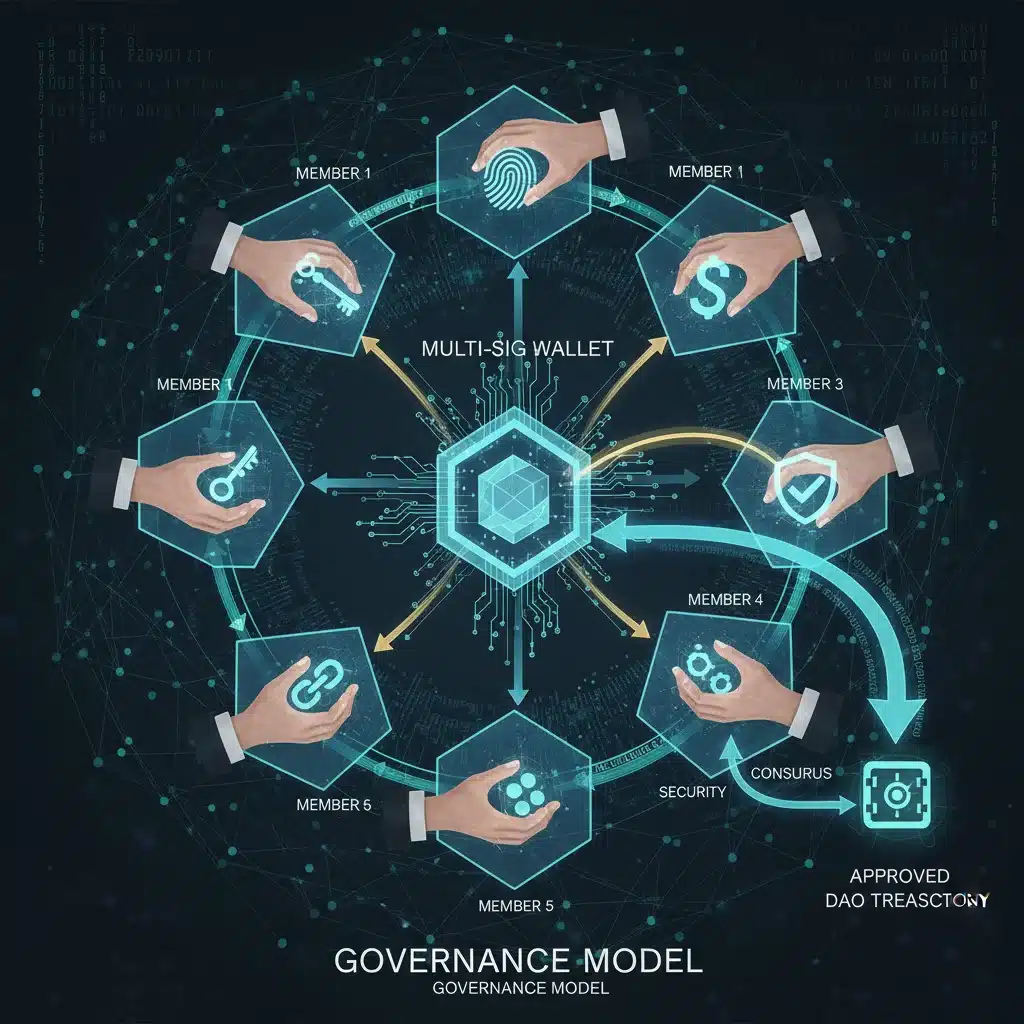
- Multi-Signature Wallets: For critical operations like treasury management or contract upgrades, requiring multiple authorized signers to approve transactions significantly reduces the risk of a single point of failure or malicious actor.
- Time Locks: Implementing time locks on critical actions (e.g., withdrawing large sums from the treasury, upgrading core contracts) provides a delay, allowing the community to react and potentially intervene if a malicious proposal is passed.
- Voting Mechanisms: Designing resilient voting systems that are resistant to sybil attacks and voter manipulation. This includes considering quadratic voting, conviction voting, or reputation-based voting models.
- Emergency Protocols: Establishing clear emergency procedures, including mechanisms for pausing contracts, revoking permissions, or upgrading contracts in case of a critical vulnerability. This requires careful consideration to balance decentralization with the ability to respond to crises.
- Transparent Communication Channels: Fostering open communication channels within the DAO to quickly disseminate information about potential threats and coordinate responses.
5. Incident Response and Disaster Recovery
Even with the most robust preventative measures, incidents can occur. A well-defined incident response plan is crucial for minimizing damage and ensuring recovery. This includes:
- Monitoring and Alerting: Implementing continuous monitoring of smart contract activity and setting up alerts for unusual or suspicious transactions.
- Pre-defined Procedures: Having clear, pre-defined procedures for responding to different types of security incidents, including who is responsible for what actions.
- Community Communication: Transparently communicating with the community during an incident, providing updates and instructions.
- Post-Mortem Analysis: Conducting a thorough post-mortem analysis after every incident to identify root causes and implement corrective measures to prevent future occurrences.
- Insurance Solutions: Exploring decentralized insurance protocols that can provide a safety net for DAO treasuries against smart contract exploits.
Advanced Strategies for Enhanced DAO Smart Contract Security
Beyond the foundational pillars, several advanced strategies can further bolster the security posture of DAOs.
Upgradeability and Proxy Patterns
Given the immutability of smart contracts, the ability to upgrade them is a critical consideration for long-term DAO smart contract security. Proxy patterns (e.g., UUPS, Transparent Proxy) allow for the logic of a smart contract to be upgraded while maintaining the contract’s address and state. However, upgradeability itself introduces new security risks, as a malicious upgrade could introduce vulnerabilities or seize control. Therefore, upgrade mechanisms must be secured with robust governance, time locks, and careful auditing.
Decentralized Oracles and Data Integrity
Many DAOs rely on external data feeds (oracles) for their operations, such as price data for DeFi protocols or real-world event data. The security of these oracles is paramount, as manipulated data can lead to significant exploits. Utilizing decentralized oracle networks (e.g., Chainlink) with multiple independent data providers and robust aggregation mechanisms can mitigate this risk. Furthermore, implementing sanity checks and circuit breakers within the smart contract logic to detect and halt operations based on anomalous oracle data is a crucial layer of defense.
Economic Security and Game Theory
A often-overlooked aspect of DAO smart contract security is economic security. This involves designing the DAO’s tokenomics and incentive structures to align participants’ interests and deter malicious behavior. Game theory principles can be applied to ensure that attacking the system is economically unviable or that honest participation is always the most profitable strategy. This includes mechanisms like slashing (penalizing malicious actors) and bonding (requiring collateral for certain actions).
Bug Bounty Programs
Engaging the broader security community through bug bounty programs is an effective way to proactively identify and fix vulnerabilities. By offering rewards to ethical hackers who discover and responsibly disclose bugs, DAOs can leverage collective intelligence to enhance their security posture. Platforms like Immunefi and HackerOne specialize in facilitating these programs for blockchain projects.
Security-Focused Tooling and Infrastructure
The Web3 security ecosystem is rapidly maturing, offering a growing array of tools and infrastructure solutions. Leveraging these resources is crucial:
- Hardhat/Foundry for Testing: Advanced testing frameworks that facilitate comprehensive unit and integration testing.
- Etherscan/Blockchain Explorers: For transparency and monitoring of contract interactions.
- On-chain Monitoring Tools: Services that provide real-time alerts for suspicious activities or large fund movements.
- Decentralized Identity Solutions: For enhancing the security of governance participants, especially in sensitive roles.
Challenges and the Future of DAO Smart Contract Security
Despite the advancements, securing DAOs remains a complex challenge. The rapid pace of innovation in Web3 means new attack vectors are constantly emerging. Furthermore, the inherent decentralization of DAOs, while a strength, can also complicate coordinated security responses.
The future of DAO smart contract security lies in a continuous commitment to:
- Education and Awareness: Ensuring all DAO members, from developers to token holders, are educated about security best practices.
- Community Collaboration: Fostering a culture of shared responsibility for security within the DAO and across the broader Web3 ecosystem.
- Research and Development: Investing in cutting-edge security research, including advancements in formal verification, AI-powered auditing, and new cryptographic primitives.
- Standardization: Developing and adopting industry-wide security standards and best practices for DAO smart contracts.
By embracing these principles and continuously adapting to the evolving threat landscape, DAOs can build a resilient and secure future for decentralized governance. The journey towards truly secure and robust DAOs is ongoing, requiring vigilance, collaboration, and a deep understanding of the intricate balance between innovation and security. Ultimately, the success of DAOs hinges on their ability to protect the assets and decisions of their communities through impregnable smart contract logic and responsive governance.
The decentralized nature of DAOs means that security is not just the responsibility of a single team or individual but a collective endeavor. Every participant, from the core developers who write the smart contracts to the community members who vote on proposals, plays a role in maintaining the integrity and security of the organization. This shared responsibility is both a challenge and a unique strength of the DAO model. By fostering a security-first mindset and continuously investing in education and tooling, DAOs can truly embody their promise of secure, transparent, and resilient governance.